
An ordinal is a transitive set well-ordered by membership and represents the order type of a well-order.
In the presence of choice, a cardinal number may be represented by the least ordinal in its bijection class.
The disjoint union tags the elements of its summands, for example .
The image of a function asks which outputs a chosen set of inputs reaches. A preimage asks which inputs reach a chosen set of outputs. Both constructions apply to every function, including one that loses information by sending several inputs to the same output. Their difference is useful whenever a transformation must be followed forward or a condition on its result must be traced back.
Consider the function withEvery input has exactly one output, but zero has two inputs and three has none. The full image of a function is , a proper subset of the codomain . Selecting inputs gives image . Selecting outputs instead gives preimage .
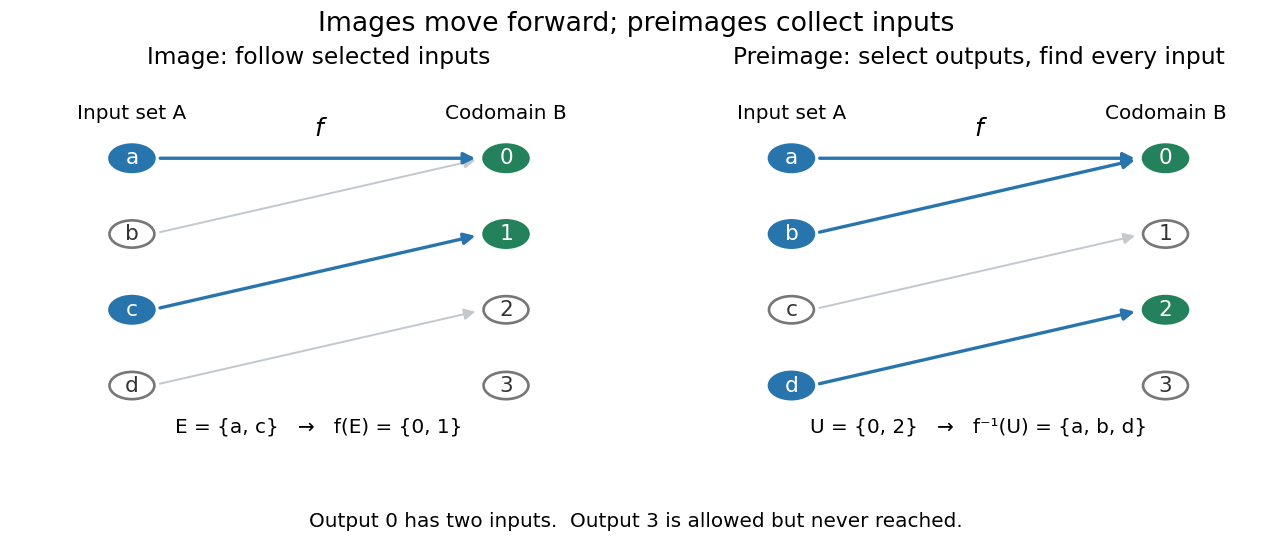

The function is not injective, because , and is not surjective onto , because three is absent from its image. Restricting only the codomain to makes the same rule surjective; it remains noninjective. This separates the output set actually reached from the target set specified in the definition. The definitions of images of a function and preimages, including the distinction from an inverse function, are given in Richard Hammack, Book of Proof, §12.6: Image and Preimage.
In ZF, if for every infinite , apply this to . The product-sum comparison lemma applied to and its Hartogs ordinal gives either an impossible injection or a surjection . In the latter case, ordering each by its least ordinal preimage well-orders . The converse is the well-orderable-cardinal identity .
Every family of nonempty sets has a choice function. In ZF this is equivalent to the well-ordering theorem.
A function assigns exactly one output in the specified codomain to each input in its domain of a function . Its rule may be a formula, a finite table, or another unambiguous assignment. The outputs actually reached form its image of a function . A codomain states where outputs are allowed; the image of a function records where they actually land. Oscar Levin's introduction makes this distinction explicit. [ref]
https://discrete.openmathbooks.org/preview/sec_intro-functions.html. Levin, Discrete Mathematics: An Open Introduction, Functions
.For example, , , has the entire real line as its domain of a function and codomain, but its image of a function is . Both and give the output : several inputs sharing an output is permitted. Assigning two distinct outputs to one input is not permitted. A partial function can be undefined at some elements of a larger specified source set; an ordinary function on must be defined at every element of .
Three properties describe how a function uses its target. An injective function never sends distinct inputs to the same output. A surjective function reaches every member of its specified codomain. A bijection does both, pairing each source element with exactly one target element. These are different requirements, as finite arrow diagrams show.
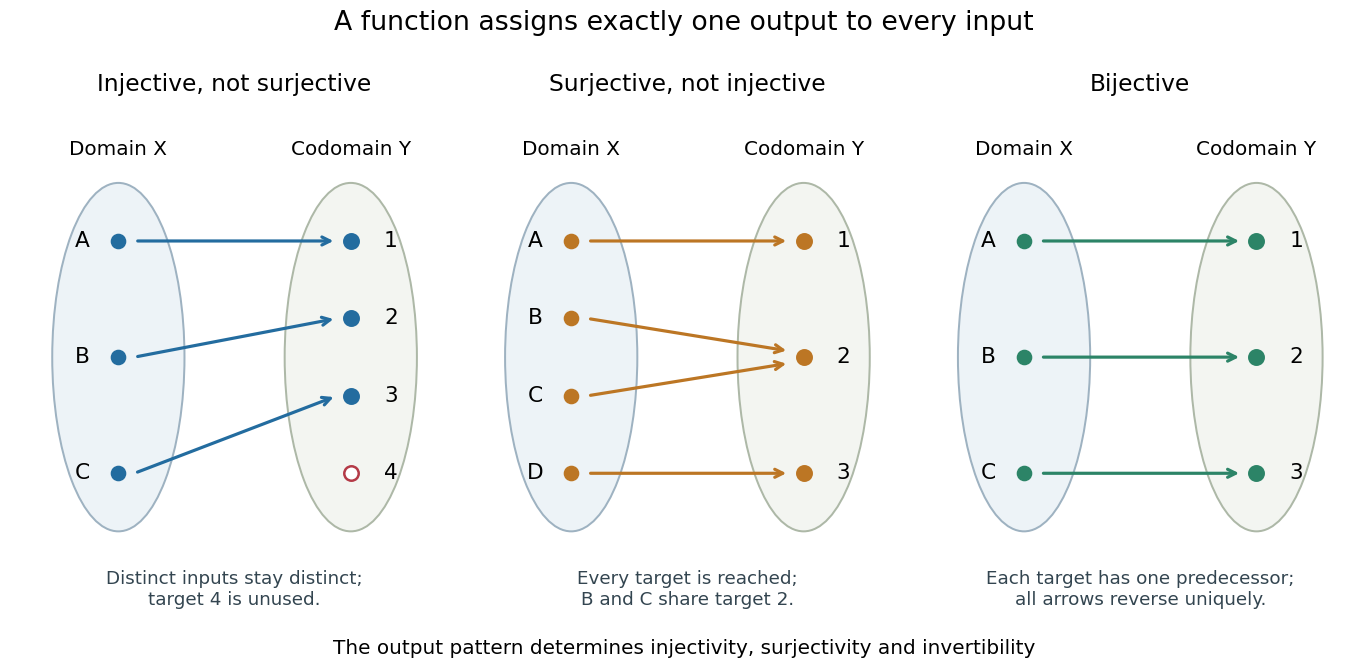

The chosen codomain matters even when the formula does not change. The function from to is not surjective, whereas the same rule from to is surjective. Both fail injectivity. Further restricting the domain of a function to makes it a bijection onto , with square root as its inverse function.
Functions make transformations composable: if and , their function composition is . Identifying each intermediate codomain prevents attempting to feed an output into a rule that is not defined there. When a transformation is a bijection, an inverse function recovers the original input without ambiguity. This is useful whenever information must be transported or a calculation reversed.
A set is a collection of distinct objects regarded as its set elements. Membership, written , is the basic question: is one of the objects in ? For example, : repeated entries and their written order do not change a set. A multiset retains multiplicities, while a tuple retains positions as well. Choosing the right object therefore determines which distinctions the mathematics remembers.
A set can collect possible outcomes of a probability space, vertices of a graph, or allowed inputs of a function. The empty set contains none; a subset selects members of a previously given set; the power set collects every such selection. These constructions are useful because they can be stated once and reused regardless of what the members represent. In an axiomatic account, rules such as the axiom schema of separation specify which collections exist as sets.
Forcing extends a model of set theory by adjoining a filter generic for a partially ordered set of finite or otherwise controlled approximations.
There are unlisted articles, also show them or only show them.