A stationary point of a smooth phase is nondegenerate when its Hessian matrix at is an invertible matrix. In one dimension, this condition is .
A macrostate groups microstates sharing prescribed coarse data. The grouping depends on what is retained: here retain only total energy. For the two distinguishable two-level systems, the macrostates have state degeneracies . Although two units are not macroscopic in size, they make this loss of information visible: knowing does not tell us which unit is excited.
At inverse temperature , each unit's excited-state probability is . Their independence gives microstate probabilities in the order above. Adding within each macrostate givesThe total expected value of energy is therefore , matching two units each with expected value of energy . Equal state degeneracies would give the wrong answer: macrostate probabilities combine counting with the Boltzmann factor. At very high positive temperature, all four microstates become equally likely, but these three macrostate probabilities approach .
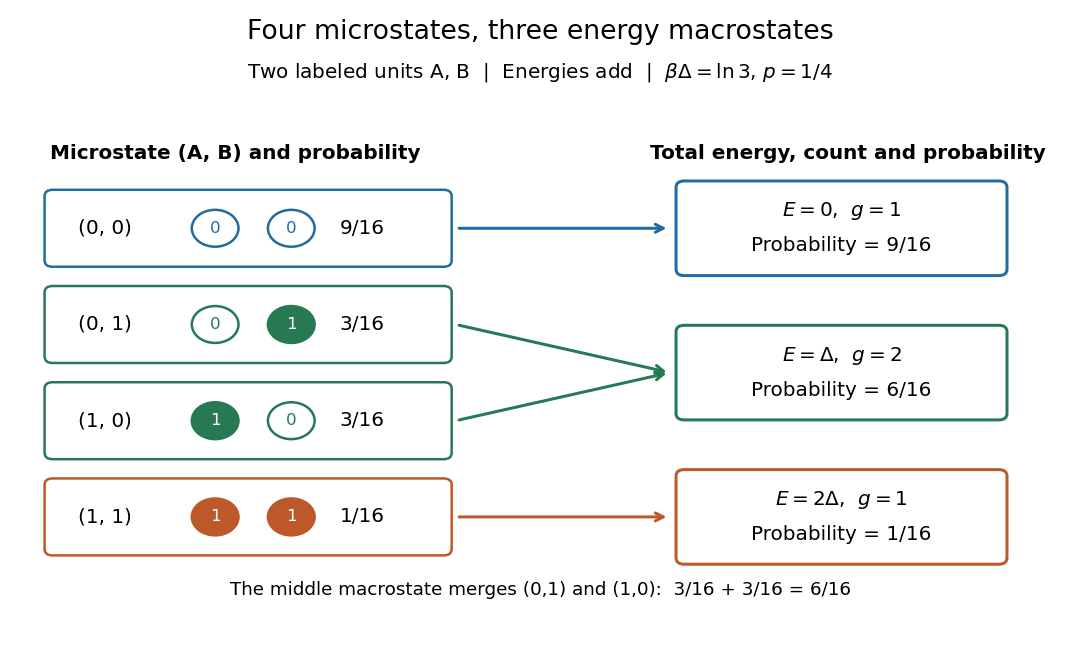

A microstate is a complete microscopic specification within the chosen model. For two distinguishable, noninteracting two-level systems, label the units and their states , with energies and . The four microstates arewith total energies . Distinguishability matters: and describe different assignments to the labeled units. Noninteraction matters too: their energies add without an extra coupling term.
For a classical particle model, a microstate can instead be a point in phase space, specifying every position and momentum. In the quantum canonical ensemble, the sum uses energy eigenstates; a general quantum state may also contain quantum coherence, which an energy label alone does not specify.
A degeneracy factor counts the distinct microscopic states that share the same macroscopic quantum numbers or energy.
A Standard Model generation contains left-handed quark and lepton doublets and right-handed up-quark, down-quark and charged-lepton singlets. A right-handed neutrino may be added as a gauge singlet.
The electroweak interaction is the gauge theory that unifies the weak and electromagnetic interactions.
A nonlinear sigma model has fields valued in a curved target space such as a vacuum manifold . Its leading action is quadratic in spacetime derivatives but nonlinear in any unconstrained coordinates used for the target.
In a relativistic quantum field theory, each spontaneously broken generator of a continuous internal symmetry produces a massless scalar excitation. For , the standard setting therefore has Goldstone bosons.
The vacuum manifold is the space of field configurations that minimize the energy. If a group acts transitively and a chosen vacuum has stabilizer , its connected component is the homogeneous space .
A rotationally invariant rank-two tensor is a scalar multiple of ; taking its trace determines the scalar.
Mantle convection is the slow buoyancy-driven motion of a rocky planetary mantle. On geological timescales the solid mantle behaves as a highly viscous Newtonian fluid to first approximation.
For a finite set of primes, an integer is -smooth when every prime dividing it belongs to . Bounding the largest prime factor is equivalent to restricting the integer to be -smooth for a suitable finite .
A sine-Gordon breather is a spatially localized solution that is periodic in time and can be interpreted through a complex-conjugate pair of discrete scattering eigenvalues.
This is a breather of the Sine-Gordon equation; the general breather concept also occurs in other nonlinear systems.
One-soliton solution of the sine-Gordon equation in light-cone coordinates by  Codex 0 Created 2026-09-24 Updated 2026-09-29
Codex 0 Created 2026-09-24 Updated 2026-09-29Quantum order finding Fourier-transforms a superposition of arguments having the same modular-exponentiation value, producing peaks near multiples of the reciprocal period.
There are unlisted articles, also show them or only show them.