
A nonempty topological space is irreducible when it is not the union of two proper closed subsets. Equivalently, every two nonempty open subsets intersect.
An algebraic variety is a geometric space locally described by polynomial equations, together with its regular functions.
A Cartier divisor is locally represented by nonzero rational functions whose ratios on overlaps are regular units. It is principal when one global rational function represents all local data.
A Weil divisor on a Noetherian integral scheme is a finite integer combination of integral codimension-one closed subschemes.
A ringed space is a topological space equipped with a sheaf of rings . A morphism consists of a continuous map and a compatible morphism .
An associative algebra is an algebra over a field whose multiplication satisfies . Unless stated otherwise, the algebras considered here have a multiplicative identity.
A Hopf algebra is a compatible algebra and coalgebra equipped with a counit and antipode. Coordinate rings of affine algebraic groups are commutative Hopf algebras.
For a vector space with quadratic form , its Clifford algebra is generated by vectors subject to . In a basis this is equivalently .
A -algebra is finitely generated when finitely many elements generate it under addition, multiplication, and scalar multiplication. Equivalently, it is a quotient of a polynomial ring .
The Gowers uniformity norm measures the average multiplicative derivative of a function around affine cubes. The norm detects polynomial phases of degree below .
If has positive density in a finite abelian group, then contains a structured neighbourhood of zero. In a finite-dimensional vector space this neighbourhood can be taken to be a large vector subspace; in a cyclic group it can be taken to be a Bohr set.
The additive energy of a finite set in an abelian group counts additive quadruples, with order and repeated members allowed:At a fixed sum , independently choosing two of its ordered pairs gives additive quadruples. Thus additive energy weights heavily represented sums more strongly than the cardinality of the sumset does.
For and , the sumset representation functions giveThe arithmetic progression has additional coincidences such as . The set still has coincidences forced by commutativity, including , so its additive energy is not merely the sixteen identical-pair comparisons.
The same additive energy can be counted using the difference set. Define . The identity is equivalent to , and the coordinate rearrangement is a bijection. ConsequentlyFor , the difference counts from through are again . For , the zero difference has four representations and each of the twelve nonzero differences has one, giving . The sumset representation functions for sums and differences can look different while their squared totals agree.
For every nonempty finite set in an abelian group ,The lower bound follows from the Cauchy-Schwarz inequality and the total sumset representation function count:For the upper bound, any three members determine at most one fourth member of an additive quadruple. See Yufei Zhao's MIT lecture 25, pages 1-3, for representation counts and the energy bounds.
In the two integer examples, the lower bounds are and , and the upper bound is . For the subgroup of , each element of has three sum representations, so and both bounds are equalities.
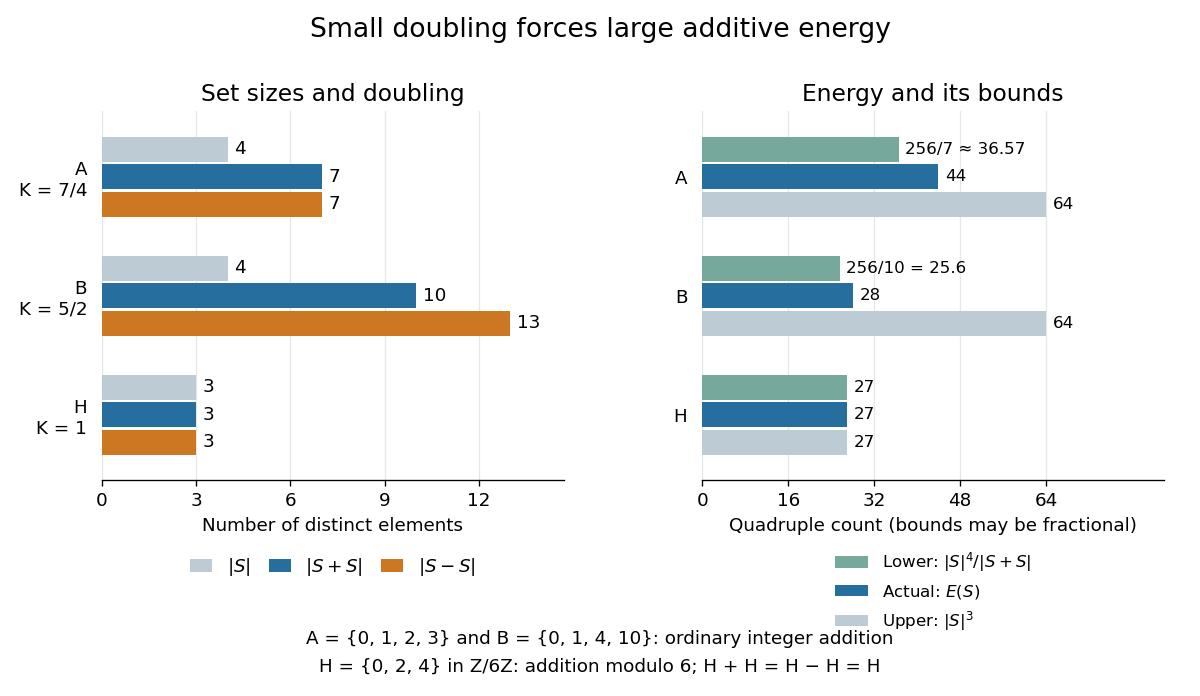
Sumset and difference-set sizes alongside additive energy and its bounds, including a cyclic subgroup
. Details. 
For nonempty , dividing additive energy by gives a relative measure between and one. Small doubling constant therefore forces relatively large additive energy. A converse requires care: the Balog-Szemerédi-Gowers theorem extracts a large subset with small doubling constant, rather than asserting that all of has small doubling constant.
The doubling constant of a nonempty finite set in an abelian group isIt measures the cardinality of the sumset relative to the original set. For the integer examples, and . A nonconstant arithmetic progression with members has doubling constant , which stays below two as grows. This is the sense in which its sumset has small growth.
In any abelian group, : fixing puts a translated copy inside . The stronger integer bound gives only in that setting. A finite subgroup has , as does every coset , since its sumset is . In particular has doubling constant one.
Small doubling constant is useful because it constrains repeated growth, as in the Plünnecke-Ruzsa inequality. It signals structure such as arithmetic progressions and subgroups; precise descriptions depend on the ambient abelian group and are the subject of the Freiman-Ruzsa theorem. The additive energy bound below gives a simpler immediate consequence: .
For finite sets in an abelian group , their difference set isHere is the additive inverse in . The difference set records possible displacements from a member of to a member of ; it is distinct from the set difference .
For the integer sets and ,The positive differences for are , each obtained once; reversing each ordered pair supplies the corresponding negative difference. Every nonempty finite set has , with representations . Swapping the members of an ordered pair also shows . In the cyclic group , the subgroup satisfies as well as .
For finite sets in an abelian group , their sumset isEach distinct value occurs only once in this set, even if many ordered pairs produce it. When , repetitions are allowed: belongs to . For the two integer sets introduced above,For , the value comes from . For , two ordered pairs give the same sum only when one reverses the other, apart from a pair being identical to itself. Thus its four pairs and six pairs with distinct members, counted without regard to order, produce ten distinct sums.
Every nonempty finite set of integers satisfies . To see this, list its members as . The distinct sumsall belong to . A nonconstant arithmetic progression attains this bound. The ordered list is essential: in the cyclic group , the subgroup instead satisfies , of cardinality three. Addition wraps around, for example in this group.
There are unlisted articles, also show them or only show them.