
The foundations of quantum mechanics study the physical and conceptual status of quantum states, measurement, nonlocal correlations, and possible extensions of quantum theory.
Quantum decoherence is the suppression of observable phase coherence when a system becomes entangled with unobserved environmental degrees of freedom. In a preferred basis, tracing out the environment damps off-diagonal entries of the system's reduced density matrix while leaving the corresponding populations unchanged.
Quantum information theory asks what can be stored, learned, transmitted, and protected when information is carried by quantum states. Its basic objects are density operators, measurement in quantum measurements, and quantum channels; its resources include qubits, entanglement, and classical communication. Specifying the task matters: preserving an unknown quantum state, recovering a classical bit, and estimating a probability amplitude are different demands on the same physical system.
A particularly beautiful feature is that knowing the whole need not mean knowing its parts. A Bell state is a completely specified pure state, yet either qubit alone has a maximally uncertain reduced density matrix. Conversely, two systems can share perfectly matching measurement records without entanglement. The worked Bell correlations versus a classical mixture comparison separates these possibilities using only two choices of Pauli measurement.
This viewpoint makes limitations useful design rules. Schumacher compression asks how much quantum memory a source needs; Holevo's theorem limits the classical information extractable from an encoding; quantum error correction protects states against noise. Quantum teleportation uses shared entanglement and classical communication to transfer an unknown state. Its resource accounting respects both quantum no-signalling and the no-cloning theorem.
A bipartite pure state is maximally entangled when either reduced density matrix is maximally mixed.
The inverse of a quantum circuit applies the adjoints of its gates in reverse temporal order. The Hadamard gate, Pauli Z gate, and controlled-NOT gate are each self-inverse.
The Pauli gate interchanges and .
The Hadamard gate is the unitary operatorwhere is the identity operator. It maps the computational basis to the Hadamard basis:
These outputs have equal computational-basis measurement probabilities, but their relative quantum phase differs. Applying another Hadamard gate sends them to different definite outputs. Calling this gate a classical coin toss would discard precisely the information that makes this possible. [ref]
https://quantum.cloud.ibm.com/learning/en/courses/basics-of-quantum-information/single-systems/quantum-information. Watrous, IBM Quantum Learning, unitary operations on qubits
.Starting from , compare two quantum circuits, reading matrix products from right to left:Here is the Pauli Z gate. After the first Hadamard gate, the probability amplitudes are . Inserting changes them to without changing their squared magnitudes. At the final gate, the contributions to output zero cancel and those to output one add. Without , cancellation occurs at output one instead. This is controlled interference, with the quantum phase determining which answer emerges.
The same calculation works for any phase gate :For example, gives , while gives . The output-one amplitude at is : its two complex contributions add before the Born rule is applied. A phase gate alone leaves the populations unchanged; recombination converts its relative quantum phase into observable probabilities.
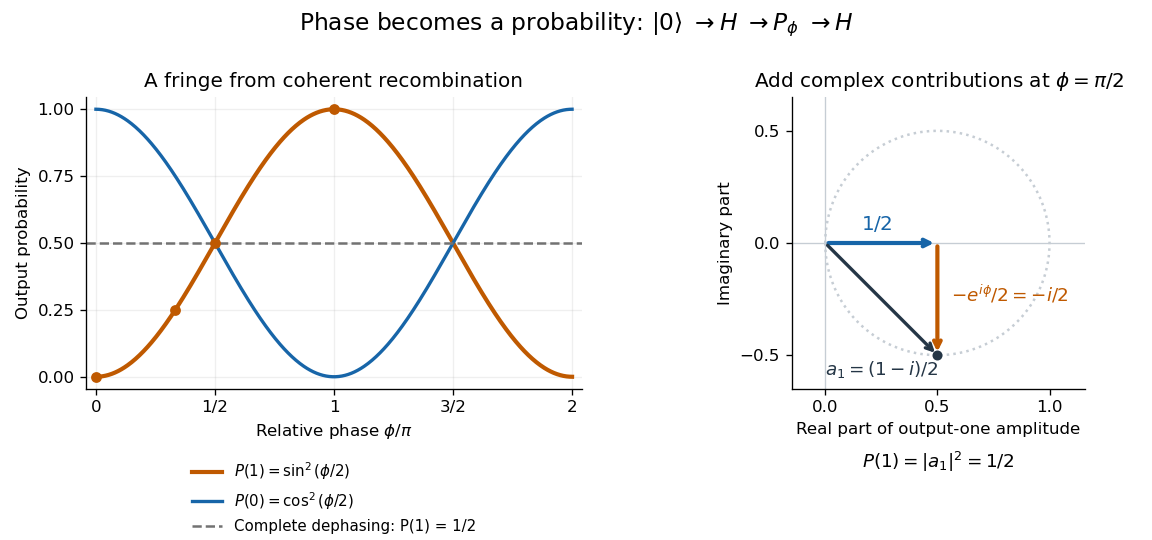
Hadamard interference: a relative phase changes output probabilities through complex amplitude addition; the dotted circle traces the output-one amplitude as the phase varies
. Details. 
If quantum decoherence completely removes the computational basis coherence between the gates, the intermediate density matrix becomes . Both the phase gate and final Hadamard gate leave unchanged, so for every . The disappearing fringe explains why preserving quantum coherence matters: it enables the gate sequence to carry phase information into the final measurement.
A charged particle in a uniform magnetic field has equally spaced orbital energy levels with guiding-centre degeneracy.
The variational method estimates the lowest energy of a Quantum Hamiltonian by choosing a trial wavefunction, evaluating its energy, and optimizing the trial parameters. It uses the quantum variational principle, the Rayleigh-Ritz variational principle expressed for quantum states. Let be a self-adjoint operator bounded below, and define , the bottom of its spectrum. Every normalized admissible trial quantum state satisfiesWhen is an energy eigenvalue, it is the ground-state energy; equality holds precisely for a quantum state in the ground-state subspace. Otherwise the bottom of the spectrum need not be attained by any normalizable wavefunction.
Admissible means finite form energy. Choose a real and use the shifted quadratic form of a positive quantum Hamiltonian:The form domain is independent of this choice of and can be larger than the operator domain . For , is the usual expectation value; for nonzero unnormalized trials, divide by to get the form version of the Rayleigh quotient. See the quantum variational principle for the general domain justification.
Thus each trial energy is an upper bound on , and minimizing within a trial family improves that upper bound. It is not a lower bound on . The Gaussian variational energy for the harmonic oscillator reaches because its family contains an exact ground state. The exact variational solution in a two-level system makes the equality condition visible as vanishing excited-state probability amplitude.
The method is useful when solving the Schrödinger equation exactly is difficult but integrals of a trial wavefunction are tractable. Enlarging a trial family cannot increase its optimal energy, although an optimum need not be attained. The beauty is that even an imperfect trial gives a rigorous bound, provided its form energy is computed exactly: numerical integration errors require separate control. The Gaussian variational estimate for a solvable sextic potential provides an existing example beyond a quantum harmonic oscillator.
A short proof explains the direction. With a complete orthonormal eigenbasis of energy eigenstates, write , where and . ThenThis is a weighted mean of nonnegative energy differences; equality requires every occupied energy eigenstate to have energy . [ref]
https://ocw.mit.edu/courses/8-05-quantum-physics-ii-fall-2013/61bc31b8d8bf0680c322733910a71aa0_MIT8_05F13_Chap_01.pdf. Barton Zwiebach, Wave Mechanics, MIT 8.05, 2013, §5, pp. 18–20
. For continuous spectrum, the spectral theorem replaces the sum by an integral against the scalar spectral measure of , with the same nonnegative integrand. This proves the bound without assuming an orthonormal eigenbasis exists.The historical setting predates quantum mechanics: Rayleigh's The Theory of Sound, volume I, appeared in 1877, and Ritz's paper on solving variational problems of mathematical physics appeared in volume 135 of Crelle's journal, catalogued by its publisher as 1909, pp. 1–61. These are original works associated with the Rayleigh-Ritz method; the dates here identify the publications rather than assert priority. [ref]
https://archive.org/details/theorysound06raylgoog. Lord Rayleigh, The Theory of Sound, volume I, 1877
; [ref]https://doi.org/10.1515/crll.1909.135.1. Walter Ritz, Über eine neue Methode zur Lösung gewisser Variationsprobleme der mathematischen Physik, original article and publisher metadata
.The Breidbart basis bisects the computational and diagonal qubit bases. For equiprobable and , whose overlap magnitude is , it realizes the Helstrom measurement and succeeds with probability
The Deutsch-Jozsa algorithm uses phase kickback and interference to distinguish constant from perfectly balanced Boolean functions with one oracle call.
A quantum circuit is a finite composition of quantum gates acting on quantum registers. Reading the diagram from input to output gives the order in which its unitary operations are applied.
There are unlisted articles, also show them or only show them.