The Born approximation replaces the unknown total field inside a scattering integral by the known incident field, thereby retaining only single scattering. In nonrelativistic quantum mechanics, first-order Lippmann-Schwinger iteration gives
For and , the ansatz solves the stationary Schrödinger equation whenIt has and , so it saturates the Heisenberg bound.
The Robertson uncertainty principle bounds the product of the standard deviations of two observables in the same quantum state. For a normalized pure state and self-adjoint operators , write their expectation values and variances asand similarly for , where is the identity operator. The quantum uncertainties then obeyHere is the commutator, and every expectation value is taken in the same . These standard deviations describe the outcome spreads when and are measured on separate ensembles prepared in that same quantum state. They are not instrument errors or the change caused by a preceding measurement in quantum mechanics. The definition and bound are developed in Barton Zwiebach, Uncertainty Principle and Compatible Observables, 2013, §§1–2.
For unbounded self-adjoint operators, the operator domains matter. Assume , so that both second moments are finite; here means the second moment of the measured probability distribution, equal to , even if is undefined. To use the displayed operator commutator, also assume . Without these product-domain assumptions, the always meaningful version on uses as its right-hand side. These qualifications prevent a formal commutator identity from being applied to an inadmissible quantum state.
The brief proof is Cauchy-Schwarz inequality applied to and :The final equality uses self-adjointness and the product-domain assumptions. Thus a geometric statement about inner products becomes a constraint on experimental spreads. For nonzero , equality requires to be proportional with a purely imaginary proportionality factor; the equality case of the Heisenberg uncertainty relation turns this condition into a Gaussian wave packet.
The bound is useful because computing a single commutator and its expectation value can constrain two entire outcome distributions. Its right-hand side depends on the quantum state: the spin uncertainty state dependence example gives both a positive saturated bound and a zero bound for the same noncommuting observables. Robertson's paper, titled "The Uncertainty Principle", appeared on 1 July 1929 in Physical Review, volume 34, starting at page 163. [ref].
To distinguish two gates in one use without an ancilla, choose an input and discriminate the output states and .
Environment-assisted two-state pure-state transformation by  Codex 0 Created 2026-09-24 Updated 2026-09-24
Codex 0 Created 2026-09-24 Updated 2026-09-24There are a unitary and normalized environment states satisfyingexactly whenNecessity follows from preservation of inner products. For sufficiency, choose to make the input and output inner products equal; equal two-vector Gram matrices define an isometry that extends to a unitary.
A cloning operation for a family of pure states would mapfor every state in that family. A single physical operation cannot clone every unknown quantum state.
The no-cloning theorem forbids a universal unknown-state cloning operation, while orthogonal families can be cloned.
An uncommunicated local trace-preserving operation cannot change the other subsystem's reduced state.
Amplitude amplification increases the probability of obtaining an answer accepted by a specified Boolean function. It requires a coherent preparation , its inverse, and a marked-state phase oracle that negates accepted components. Alternating that sign change with a reflection operator about the prepared state directs interference toward the accepted subspace. Brassard, Høyer, Mosca, and Tapp developed the general framework, extending Grover's algorithm beyond a uniform quantum superposition. [ref]
https://arxiv.org/abs/quant-ph/0005055. Brassard et al., Quantum Amplitude Amplification and Estimation, 2000, §2
.If a normalized quantum state has good amplitude , the product of the reflection in the bad axis and the reflection in the state line rotates its good-bad plane by . After iterations the good probability isso iterations raise a small good amplitude close to one. Success subsequently oscillates, making the stopping time part of the algorithm.
Compute the exact Grover search on four entries directly. Order the computational basis as and mark . The Hadamard transform prepares amplitudes . The marked-state phase oracle changes these to , whose arithmetic mean is . The Grover diffusion operator performs inversion about the mean:The three unmarked amplitudes become , while the marked amplitude becomes . All three stages have squared norm one. Here , so and one iteration gives , agreeing with the explicit calculation.
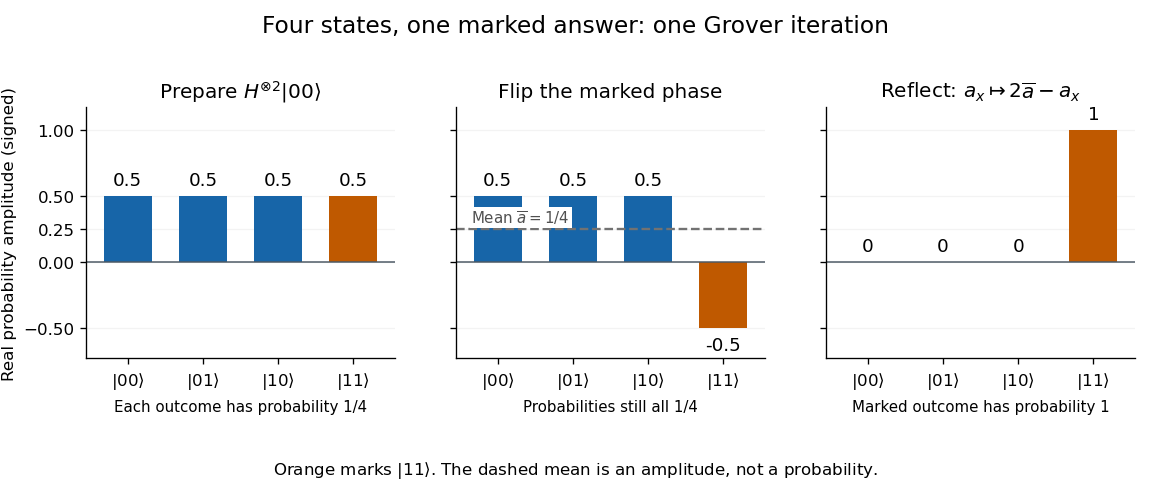
One Grover iteration on four states: a phase flip followed by reflection about the mean concentrates all amplitude on the marked state
. Details. Grover's original search paper was submitted on 29 May 1996; its algorithm combines selective sign changes with inversion about the mean. The example exposes the beauty of that construction: a change initially invisible to computational-basis measurement becomes complete cancellation of every wrong answer. [ref].
The marked-state phase oracle is an assumed operation, whose implementation cost must be counted. Computational-basis measurement yields a candidate label, here ; using it to retrieve a record requires the relevant data access. Preparing a quantum superposition does not make all its entries available as classical outputs. The improvement concerns the number of oracle queries needed to obtain an accepted label.
A measurement in quantum mechanics turns a quantum state preparation into a classical outcome, such as a detector label. Two questions must be distinguished: how likely is each outcome, and what quantum state remains conditional on that outcome? A positive operator-valued measure answers the first; a quantum instrument answers both. This distinction is useful whenever a measured system participates in a later experiment, including quantum state tomography and measurement-based quantum feedback.
For a density operator , the Born rule gives , where the are positive operators satisfying . Here is the identity operator, and denotes the trace. Positivity makes every nonnegative; completeness makes their sum one. For a pure state, and . A projective measurement is the special case in which the are orthogonal projections onto mutually orthogonal subspaces.
For a qubit, choose the computational basis and write a normalized pure state, up to global phase, asThe angle is a relative quantum phase; at the poles it does not distinguish states. Measuring the Pauli matrix reports for label zero and for label one, withThese probabilities describe repeated identical preparations. They do not assign a hidden, pre-existing value to every possible measurement basis.
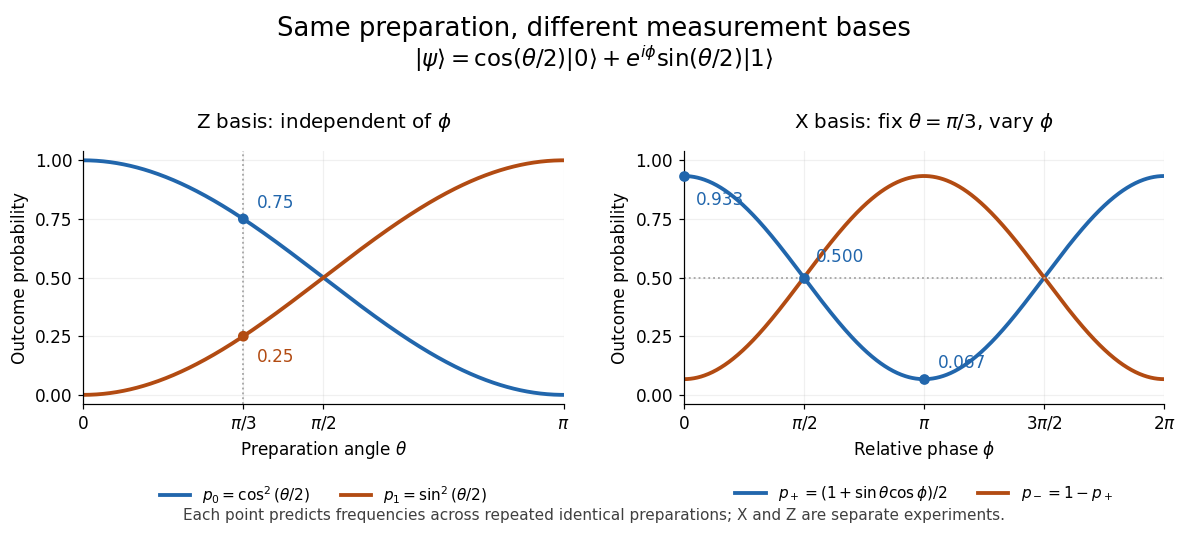


The Born rule grew out of Max Born's 1926 work on quantum scattering: squared probability amplitudes determine the relative frequencies of scattering outcomes. Born explained this statistical interpretation again in his 1954 Nobel lecture. This probability law does not by itself select a post-measurement state. [ref]
https://doi.org/10.1007/BF01397477. Born, 1926 collision paper
; [ref]https://www.nobelprize.org/uploads/2018/06/born-lecture.pdf. Born, Nobel lecture, 1954, pp. 261–262
.For a particle of charge , the changes and leave the minimally coupled Schrödinger equation invariant when .
These are the eigenvectors of one Pauli matrix, not an alternative name for the whole matrix family.
First-order degenerate perturbation theory diagonalizes the perturbing operator within each degenerate eigenspace of the unperturbed Hamiltonian.
Time-independent perturbation theory expands the eigenvalues and eigenstates of in powers of a small perturbation .
This is the stationary branch of perturbation theory.
Expanding a state in unperturbed energy eigenstates with their free phases converts the time-dependent Schrodinger equation into coupled equations for slowly varying amplitudes. To first order, the perturbation on the right-hand side acts on the initial unperturbed state.
This is the time-dependent branch of perturbation theory; its corrections describe transition amplitudes.
A Fermi oscillator has nilpotent lowering operator , anticommutator , and occupation Hamiltonian with levels zero and one.
There are unlisted articles, also show them or only show them.