An intermediate-mass black hole has a mass between stellar remnants and supermassive black holes, approximately --.
Black-hole accretion converts gravitational binding energy of inflowing matter into heat, radiation, outflows, and growth of the black hole.
The common difference of an arithmetic progression is the fixed difference between consecutive terms.
The Möbius function assigns a cancellation weight to each positive integer:Thus a squarefree integer contributes a sign determined by its number of distinct prime factors; a repeated prime factor makes the weight zero. This packages the alternating signs of inclusion-exclusion into an arithmetic function. [ref]
https://darijgrinberg.gitlab.io/floor.pdf. Darij Grinberg, MIT 18.781 lecture notes, Definition 2.1.2
For example, , , and , since . In contrast, : all three have the square of the prime number as a divisor. On prime powers, and for .
The Möbius function is a multiplicative function: for coprime integers, their prime factors are disjoint, so either a squared prime factor forces both sides of to vanish, or the counts of distinct prime factors add and their signs multiply. It is not a completely multiplicative function, since . Its Möbius divisor-sum identity makes it the inverse of the constant-one arithmetic function under Dirichlet convolution: , the Identity for Dirichlet convolution. This is why the small set of weights can undo an entire divisor sum.
The Von Mangoldt function assigns a natural logarithm weight to each positive power of a prime number. For a positive integer ,Here and throughout the Chebyshev functions, means the natural logarithm. In particular, : the exponent must be positive, even though the convention in prime power allows exponent zero. The support of a function of therefore consists precisely of the prime powers greater than one. [ref]
For example, and , whereas . A composite number can have a nonzero weight: has just one distinct prime factor. But has two distinct prime factors, so its weight is zero. At the weight is , not . This choice lets successive powers record successive copies of the same prime factor in the Von Mangoldt divisor identity.
The Von Mangoldt function is useful because it connects two views of the prime numbers: the prime factorization of an individual integer, through a divisor sum, and the accumulated weights below a cutoff, through the Second Chebyshev function. The latter turns questions about the distribution of prime numbers into questions about a partial sum of an arithmetic function.
The divisor function counts the positive integer divisors of a positive integer . In particular , because has just one positive integer divisor. More generally the notation gives and the sum-of-divisors function . Thus the divisor function counts the positive integer divisors, while adds their sizes. [ref]
https://darijgrinberg.gitlab.io/floor.pdf. Darij Grinberg, MIT 18.781 lecture notes, Definition 2.1.2 and Theorem 2.1.6
If the prime factorization is with distinct prime numbers and positive exponents , thenThe short proof is a count: each positive integer divisor has a unique form , where . There are choices at each prime number, and choosing them gives every positive integer divisor exactly once. For there are no prime factors and the product is .
For , choose and to obtain . The six values are ; sorted, the positive integer divisors are . Therefore . The diagram makes the independent exponent choices visible.
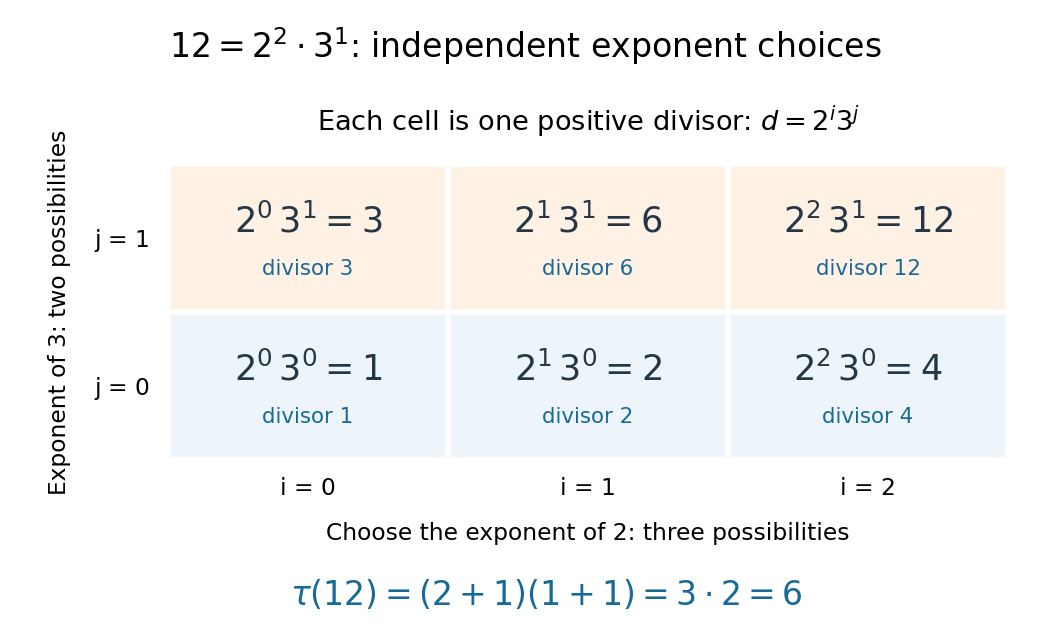
The prime factorization gives a three-by-two array of positive integer divisors , so the divisor function has
. Details. 
This count is useful because a known prime factorization gives without testing every smaller positive integer for divisibility. It also proves the divisor function is a multiplicative function: coprime integers have disjoint prime factors, so their exponent choices combine. For example , but , so it is not a completely multiplicative function. Equivalently, under Dirichlet convolution, counting ordered pairs of positive integers whose product is .
The Dirichlet convolution of arithmetic functions is the arithmetic functionIn the first sum, runs over the positive integer divisors of ; the second uses ordered pairs of positive integers whose product is . Both sums are finite. Each pair contributes one weight from and one from , so Dirichlet convolution combines information attached to complementary factors. It turns a divisor sum into an operation on arithmetic functions. [ref]
https://darijgrinberg.gitlab.io/floor.pdf. Darij Grinberg, MIT 18.781 lecture notes, Sections 2.3 and 2.4: Dirichlet convolution and examples
For the six ordered pairs are . The constant-one arithmetic function gives one per pair, while the identity arithmetic function weights the first factor by its size:Here is the divisor function and is the sum-of-divisors function. By comparison, the pointwise product of arithmetic functions gives and .
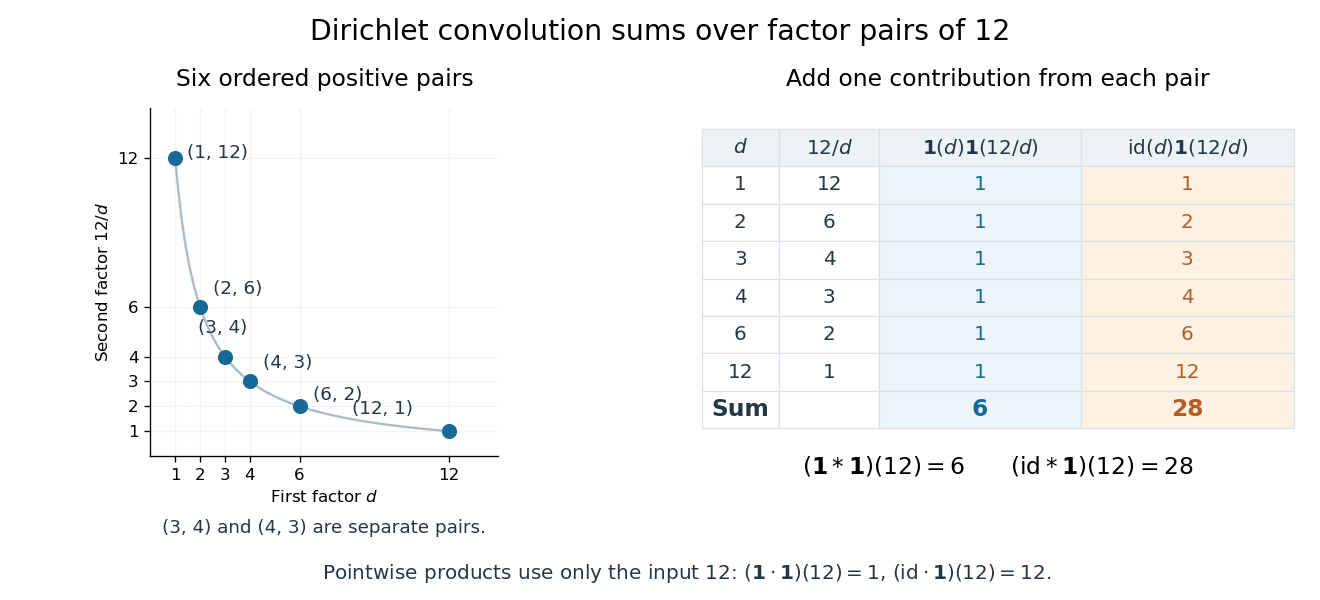
Six ordered pairs of positive integers with product 12 contribute to Dirichlet convolution: one per pair for the divisor function, or the first factor for the sum-of-divisors function
. Details. 
Commutativity follows by swapping the two entries of every ordered pair. Associativity follows by reindexing either grouping over the same ordered tuples of three positive integers:For example, counts ordered tuples of three positive integers with product . Distribute the two occurrences of the prime factor among three entries in ways, and the one occurrence of the prime factor in ways. These binomial coefficients are the stars and bars counts of exponent choices in the nonnegative integers; prime factorization therefore gives such tuples. Directly, the same Dirichlet convolution is .
The Identity for Dirichlet convolution is , and the Möbius function reverses a divisor sum because . This makes Dirichlet convolution useful both for counting factorizations and for recovering an arithmetic function from its divisor sum.
In four dimensions, global static coordinates have
A Dirichlet series is a series of the formMultiplication of absolutely convergent Dirichlet series corresponds to Dirichlet convolution of their coefficients.
Invariance principle for a low-degree multilinear polynomial by  Codex 0 Created 2026-09-24 Updated 2026-10-13
Codex 0 Created 2026-09-24 Updated 2026-10-13Let and be independent, centered, variance-one random variables with vanishing third moments and fourth moments at most . If is multilinear of degree at most and , then
The Boolean hypercube is the set , or equivalently . Its hypercube graph joins two vertices exactly when they differ in one coordinate.
A rank- vector bundle is locally isomorphic over the base to the projection , with linear transition maps on fibers.
Cohomology is the contravariant counterpart of homology, formed from cochains and coboundaries. A coefficient ring equips it with the cup product and hence with a graded ring structure.
Realization of the simplicial construction produces the corresponding topological cone.
There are unlisted articles, also show them or only show them.