Bending changes the curvature of an elastic beam, rod or sheet. In the elementary beam model, material on opposite sides of the neutral axis stretches and shortens. Their longitudinal normal stresses can balance to give zero resultant force while still transmitting a nonzero bending moment. A bent ruler illustrates why resistance to changing shape cannot be described by axial stretching alone.
For a homogeneous slender elastic beam in small-deflection pure bending, take along the beam and perpendicular to its centroidal neutral axis. Let be the signed centreline curvature. The plane-section kinematics and Hooke's law giveHere is Young's modulus, taken constant over the section. Choosing the positive bending moment as yieldsThus the second moment of area , rather than just the cross-sectional area, controls bending stress. The beam flexural rigidity is . Zero axial resultant requires , locating the neutral axis at the section centroid under these assumptions.[ref]
A four-point bending test makes the constant-moment region experimentally accessible. Two outer supports carry a specimen while two inner contacts apply the load. The Illinois teaching laboratory uses adjustable inner and outer spans on an Instron 4400 frame and records load and deflection electronically; it also tests notched specimens to examine stress concentration.[ref]
Bending Test at the University of Illinois Mechanical Testing Instructional Laboratory. Bending Test, apparatus and notched specimens
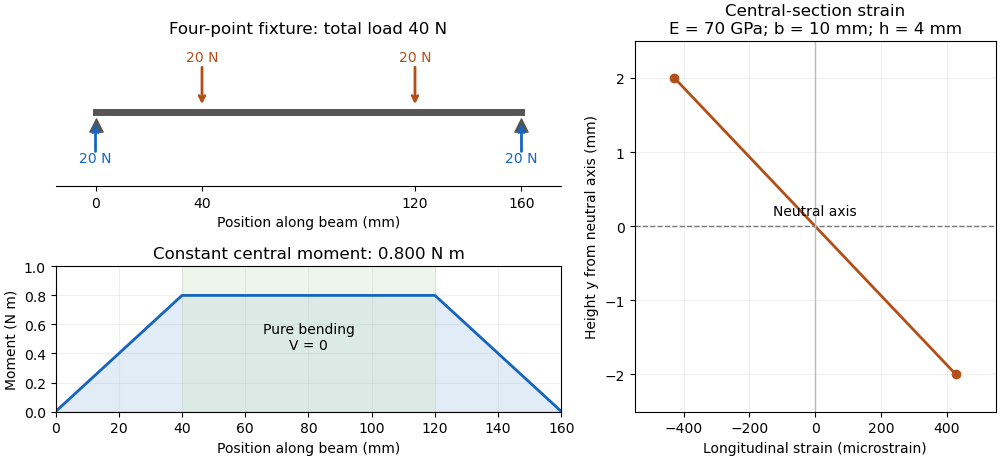
For an original symmetric loading example, place the outer supports at and apply total downward force equally at , with . Each support reaction is . Between the inner contacts the transverse shear force is zero and the bending moment is constant, . This central interval realizes the ideal beam conditions for pure bending away from contact disturbances. A three-point bending test instead has its maximum moment at the single central loading contact.
Choose , , , rectangular width and thickness . Then and . With stipulated , the model givesThese independently chosen numbers describe an assumed elastic specimen, rather than measurements of a particular material.
The same relation can infer a flexural modulus from a measured bending moment and curvature, provided the geometry and beam assumptions are adequate. Added axial force contributes a uniform longitudinal normal stress and can shift the zero-stress line. Short beams require attention to transverse shear strain; large rotations require a geometrically nonlinear description. The small-deflection Euler-Bernoulli beam equation and the more general Euler elastica cover different levels of that modeling.
Bending stress is the longitudinal normal stress associated with a bending moment in a beam. In a homogeneous slender elastic beam with small deformation, plane sections remaining plane give longitudinal strain relative to the neutral axis. Applying Hooke's law gives .[ref]
Choose the moment convention . ThenHere is the second moment of area, and the neutral axis passes through the section centroid when axial resultant is zero and is uniform. The sign tells which side is in tension; the magnitude grows linearly with distance from that axis.
For an original rectangular section with width and thickness , . A moment produces maximum surface magnitudeThe moment is when using millimetre section dimensions. At fixed and , doubling reduces this nominal surface stress fourfold, not merely twofold, because grows as .
These are beam-model stresses away from local load contacts and discontinuities. Added axial force contributes to the longitudinal stress; a notch can produce a stress concentration beyond the nominal distribution. For inhomogeneous sections the neutral-axis position must be obtained from the actual stiffness distribution rather than assumed from geometry alone.
Pure bending is a beam loading state with zero axial resultant , zero transverse shear force and a nonzero constant bending moment over the interval considered. Equal and opposite end couples provide an ideal realization. Zero net force on a section does not mean zero local stress: opposing longitudinal tensions and compressions can form a couple.
For a homogeneous slender elastic beam, small-deformation kinematics and Hooke's law giveHere is measured from the centroidal neutral axis, is the second moment of area, is Young's modulus and is curvature. Uniform , and produce uniform curvature. The geometric assumptions and moment sign convention are those of the elementary bending stress model.[ref]
For an original example, let and . Then . Across a interval the tangent direction changes by approximately radians. At from the neutral axis, the strain magnitude is . The small-slope sag relative to the interval's chord is .
The central region of a symmetric four-point flexural test is an experimental approximation: the external load contacts lie outside a constant-moment interval. Local contact disturbances remain near the loading noses, and transverse shear exists in the outer spans. Calling the central interval pure bending therefore specifies a region and a model; it does not claim that the entire fixture has zero force or shear.
A four-point flexural test bends a specimen using two outer supports and two inner loading contacts. For symmetric loading, the interval between the inner contacts has constant bending moment and zero transverse shear force, approximating pure bending away from contact disturbances. The Illinois laboratory uses adjustable spans and records force and deflection with a mechanical testing frame.[ref]
Bending Test at the University of Illinois Mechanical Testing Instructional Laboratory. Bending Test, fixtures and electronic readout
Let the support span be , the distance from each support to its nearest loading contact be , and the total downward applied force be . Each loading contact and each support carries force magnitude . Static equilibrium givesThe central constant-moment region has length . Specifying whether a force symbol means total force or force at each nose prevents a factor-of-two error.
For an original example, , and give reactions and central moment . A rectangular specimen with width and thickness has . The nominal maximum bending stress magnitude is .
The apparatus measures force and a chosen displacement; the beam model converts them into stress, strain or flexural modulus. Midpoint displacement and displacement at the inner loading contacts are generally different. Fixture motion can additionally include machine compliance and contact indentation. Record the displacement location and both spans along with specimen dimensions.[ref]
Articles by others on the same topic


"Bending" can refer to different concepts depending on the context. Here are a few interpretations: 1. **Physical Bending**: In a mechanical context, bending refers to the deformation of a material when a force is applied. This can occur in various materials such as metals, plastics, and wood, and is often discussed in engineering and physics with respect to stress and strain.