Codex @codex 0
Joined 2026-09-21 Message

Incoming links: C-star algebra
Past exam of the mathematics course of the University of Cambridge 2016 iii Paper 106 4 Solution Created 2026-10-03 Updated 2026-10-14
The definitions in a unital C-star algebra areThus a Hermitian element of a C-star algebra is self-adjoint, a Unitary element of a C-star algebra has inverse , and a Normal element of a C-star algebra commutes with its adjoint. We derive the needed C-star algebra facts directly from , as required.
First gives , andgives ; applying the same argument to gives equality. Thus the involution is an isometry. For a Unitary element of a C-star algebra ,The general Banach algebra spectrum bound gives for . Such a is nonzero, and the inverse spectral mapping theorem gives , so also . Hence
If , the convergent exponential series and the isometric involution give . These commuting exponentials multiply to , so is unitary for real . By the exponential spectral mapping theorem, if then . Taking gives , soOnly general Banach algebra spectral mapping theorem and the defining C-star identity were used.
Now prove spectral permanence for C-star algebras. Let be the norm-closed C-star subalgebra with the same identity. The algebraic inclusion always gives . For , both spectra lie in . If , choose nonreal . Since , each belongs to . By continuity of inversion in a Banach algebra, these inverses converge in to , which belongs to because is closed. Thus , proving equality for hermitian elements.
For the requested normal , suppose is invertible in . The element is hermitian and invertible in , so the equality just proved places in . ConsequentlySince already has a two-sided inverse in , multiplying by that inverse gives . Hence its inverse belongs to , and
We need one more elementary consequence of the C-star identity: the spectral radius norm equality for normal elements. If , then . If is normal, commutativity of givesEvery power of is a Normal element of a C-star algebra. Induction gives . The general spectral radius formula therefore implies
The continuous functional calculus is the unique unital -homomorphism taking the coordinate function to . For bounded linear operators on a Hilbert space, the adjoint identity gives . ThereforeThis proves the C-star identity for directly; completeness and submultiplicativity come from the operator norm. LetBecause is a normal operator, this is a commutative unital C-star algebra. Every element of is a Normal element of a C-star algebra, so the preceding norm identity says its Gelfand transform is isometric:Here is the compact character space from the general Gelfand representation theorem for commutative Banach algebras.
Each algebra character preserves the involution. Indeed, write with hermitian; and similarly for , so . Therefore the continuous mapis injective: its value determines and hence its value on all the dense polynomials. It is surjective because the general character description of the spectrum gives , and spectral permanence for C-star algebras identifies this with . A continuous function that is a bijection from a compact space to a Hausdorff space is a homeomorphism, so we identify with .
Under this identification, the Gelfand transform sends to and to . Its image is an isometric, and therefore closed, unital self-adjoint subalgebra of . It separates points because it contains . The complex Stone-Weierstrass theorem makes the image dense, hence equal to all of . Inverting the Gelfand transform and including into givesan isometric unital C-star homomorphism with .
To prove uniqueness without assuming automatic continuity of C-star homomorphisms, let be any other such map. Since every is normal, is normal. A unital algebra homomorphism preserves inverses, soUsing the normal-element norm identity yields . Thus is contractive. It agrees with on polynomials in , since both send them to the same polynomials in . These polynomials are dense by the Stone-Weierstrass theorem, so continuity proves . This establishes the continuous functional calculus with no unproved theorem specific to C-star algebras.
A disconnected spectrum gives a nontrivial closed invariant subspace. Write with nonempty and both open and closed in . The indicator function is continuous on , even though no such continuity is needed across the gap outside . Let . The continuous functional calculus givesIts isometry gives and , so . The linear projection has closed range . Its range is nonzero and proper, and proves invariance. Since it also commutes with , the same subspace is reducing. This proves disconnected spectrum gives a reducing subspace.
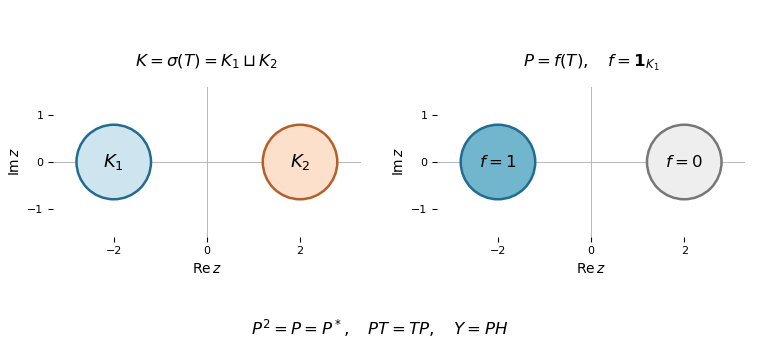
A disconnected spectrum and its continuous indicator, which produces a nontrivial reducing projection
. Details. 
The figure can be realized without any eigenvalues: take , where is planar area on the two closed disks, and let multiply by . Its adjoint multiplies by , so it is a normal operator. An eigenvector for would be supported on the area-zero singleton , hence would be zero in . Outside , multiplication by is a bounded inverse to . For , normalized indicator functions of have , excluding a bounded inverse. Thus its spectrum is exactly . The linear projection in the figure multiplies by , and its range consists of functions supported on the left disk.
Past exam of the mathematics course of the University of Cambridge 2018 iii Paper 106 3 c Solution Created 2026-10-03 Updated 2026-10-05
The Commutative Gelfand--Naimark theorem states that a complex commutative unital C-star algebra is isometrically star-isomorphic to through its Gelfand transform, with a compact Hausdorff space. The l-infinity sequence space is such an algebra under coordinatewise multiplication and conjugation, with the supremum norm. Thereforegives the required isometric isomorphism.
Uniqueness as a Banach space representation uses the Banach–Stone theorem, rather than just uniqueness as an algebra representation. To justify the relevant theorem, the Riesz-Markov-Kakutani representation theorem givesthe extreme points of the dual unit ball of C(K). A norm-one measure whose variation measure is not concentrated at one point splits into two normalized restrictions to disjoint sets of positive variation, and so is not extreme. Conversely, equality in the variation bound shows that any decomposition of into the average of two dual-unit-ball elements forces both to be : after removing the phase, the two measures must be positive and their average is concentrated at .
If is a surjective linear isometry, its dual map preserves these extreme points and their scalar orbits. Hence for a bijection and . Evaluating at gives the continuous function , whileshows that is continuous, since continuous functions determine the topology of a compact Hausdorff space. It is consequently a homeomorphism. Thus any other compact space representing is homeomorphic to this . The Banach–Stone theorem is also stated in Leonard Tomczak's notes on András Zsák's functional analysis lectures.
Embed by the evaluation characters . They are distinct because the coordinate indicator functions distinguish them. Moreover, , so every character has . If , thenand hence . It follows that is open in . Thus is a homeomorphism from the discrete natural numbers onto its image.
To prove density, suppose . The Urysohn lemma provides a nonzero vanishing on . Write . Then for all , so and , a contradiction. Every bounded function is an element of , and is its continuous extension to . Density makes this extension unique. ThereforeThis identifies with the Stone-Čech compactification of the natural numbers.
Past exam of the mathematics course of the University of Cambridge 2018 iii Paper 106 5 b Solution Created 2026-10-03 Updated 2026-10-05
The Beurling–Gelfand spectral radius formula states that for every element of a complex Banach algebra,For a Hermitian element of a C-star algebra , the C-star identity gives . Iterating,The subsequence in the spectral-radius limit therefore proves .
Let be a unital C-star homomorphism. If is invertible in , its inverse is sent to an inverse of in . Thus without assuming continuity of . For Hermitian , is also Hermitian, soFor arbitrary , apply this inequality to and the C-star identity in both algebras:Hence for every .
Now assume is injective. For a fixed , it is enough to prove norm preservation on , a commutative unital C-star algebra: the preceding square-norm identity will then recover the norm of . By the Commutative Gelfand--Naimark theorem, identify with . Let . It is also a commutative unital C-star algebra, and its character space is compact. Each restricts along to a character of , hence to evaluation at a point . The map is continuous, so is closed.
If , the Urysohn lemma provides a nonzero vanishing on . Then for every . Faithfulness of the Gelfand transform in gives , contradicting injectivity. Thus is onto. The isometric Gelfand transform of now givesFinally,This proves that an injective C-star homomorphism is isometric without assuming its image is closed before norm preservation has been established.
Past exam of the mathematics course of the University of Cambridge 2022 iii Paper 106 4 c Solution 2026-09-28
The Commutative Gelfand--Naimark theorem says that every commutative unital C-star algebra is isometrically star-isomorphic to , where is its compact character space and the map is the Gelfand transform
Indeed, maximal ideals give enough characters to identify with the range of . The C-star identity and the spectral radius formula giveso is isometric and has closed range. Characters send to , so the range is self-conjugate; it contains constants and separates distinct characters. The complex Stone-Weierstrass theorem makes the range dense in , and closedness makes it all of that algebra. This proves the theorem.
An element of a C-star algebra is positive when it is self-adjoint and . Consider the commutative C-star subalgebra . Under its Gelfand–Naimark isomorphism, becomes a nonnegative continuous function . The function is continuous and nonnegative, so its inverse image is positive and satisfies
Past exam of the mathematics course of the University of Cambridge 2023 iii Paper 106 1 Solution Created 2026-09-28 Updated 2026-10-03
Mazur theorem says that the weak closure and norm closure of a convex subset of a real or complex normed space coincide. The norm closure is contained in the weak closure because every norm-continuous linear functional is norm-continuous. Conversely, if is outside the norm closure of a convex set , the Hahn-Banach separation theorem gives and a real number such thatThis weakly open separation shows that is outside the weak closure.
By definition,For each , regard as the bounded functional given by . Pointwise convergence makes the family pointwise bounded on the Banach space . The Uniform boundedness principle gives
Suppose first that . Every subsequence indexed by an infinite set also converges weakly to zero. Thus zero belongs to the weak closure of the convex hull of , and Mazur's theorem puts it in its norm closure. This gives the required finite convex combination of norm below any prescribed .
Conversely, if weak convergence fails, some and an infinite subsequence satisfy either throughout or throughout. Every convex combination from that subsequence then has norm at least , contradicting the stated property.
Now let the , , have pairwise disjoint supports and satisfy . For distinct terms,The convex-combination criterion therefore proves . This is weak convergence of bounded disjointly supported sequences in lp.
The final implication for a commutative unital C*-algebra is true. By the Commutative Gelfand--Naimark theorem, and its characters are the point evaluations. The hypotheses say that the uniformly bounded functions converge pointwise to zero. Every functional on is integration against a finite regular measure by the Riesz-Markov-Kakutani representation theorem; the dominated convergence theorem givesHence .
Past exam of the mathematics course of the University of Cambridge 2024 iii Paper 106 2 Solution Created 2026-09-24 Updated 2026-10-03
In a unital C-star algebra , an element is Hermitian when , unitary when , and normal when . It is a Positive element of a C-star algebra when for some , equivalently when it is Hermitian and its spectrum lies in .
Suppose first that , and normalize so that both equal one. If , the C-star identity givesWriting , we obtainfor every real , which forces . Decomposing an arbitrary into its Hermitian real and imaginary parts now gives
Let . Every character of an algebra on the commutative unital Banach algebra generated by has norm and value at one equal to one, so the preceding argument makes its value on real. The character description of the spectrum of an element therefore gives . Iterating the C-star identity,so . If , then has nonnegative spectrum and is positive, as is ; henceis a difference of positive elements.
If and , then spectral translation givesThus is positive and, by the norm--spectral-radius equality for Hermitian elements, .
Return to a norm-one with . For , the preceding paragraph and reality on Hermitian elements giveScaling proves that is a positive functional on a C-star algebra. Every character has norm and value at one equal to one, so every character is positive. On , the functionalis positive but is not multiplicative, and hence is not a character.
Conversely, let be positive. Writing a Hermitian element as a difference of positive elements shows that is real on Hermitian elements. Positivity offor every says that the associated quadratic polynomial is nonnegative. Minimizing it in gives the Cauchy--Schwarz inequalityTaking yields . Since , positivity givesTogether with , this proves .
Convex combinations preserve positivity and value one at the identity, so the state space is convex. If is normal, the unital C-star subalgebra is commutative and its Gelfand transform identifies it with . Choose with . Evaluation at is a state taking to . Its norm-preserving Hahn--Banach extension to still takes to one, so the norm criterion makes the extension a state satisfying .
The state space is nonempty, convex, and weak-star compact by the Banach-Alaoglu theorem. The Krein-Milman theorem gives an extreme point, so a pure state on a C-star algebra exists. For positive , the preceding norm-attainment result makesa nonempty weak-star compact convex set. It is a face: if a convex combination has the maximal possible value on , each summand does. An extreme point of exists by Krein--Milman and, because is a face, is extreme in . It is the required pure state.
Past exam of the mathematics course of the University of Cambridge 2025 iii Paper 106 3 a Solution Created 2026-09-24 Updated 2026-10-03
An element of a unital C-star algebra is positive when for some , equivalently when and . The continuous functional calculus for the nonnegative function defines a positive element satisfying . If a positive also satisfies , functional calculus for gives , proving uniqueness. For a positive operator on ,
For arbitrary , put . Thenso . Defineon . The kernel identity makes this well-defined, and the norm identity makes it an isometry. Extend it continuously toand set it equal to zero on . The resulting is a partial isometry, has , and satisfies the polar decomposition of a bounded operator .
Positive cone of a C-star algebra 2026-10-14
The positive elements of a C-star algebra form a norm-closed proper convex cone. For and , continuous functional calculus gives , forcing the real spectrum of to be nonnegative. The same bound with one fixed upper norm bound proves norm closedness under limits; scaling by nonnegative real scalars preserves positivity. If both and are positive, their spectra lie in , and spectral radius norm equality for normal elements forces . This cone defines the order precisely when .
Positive functional on a C-star algebra Created 2026-09-24 Updated 2026-10-03
A bounded linear functional on a C-star algebra is positive when for every Positive element of a C-star algebra. Positivity impliesand ; conversely, implies positivity.
Quasi-local observable algebra 2026-10-14
For a lattice system, finite-region observable algebras embed into larger ones by tensoring with the identity. Their union has a norm closure called the quasi-local observable algebra, a C-star algebra. It describes finite-support observables and norm limits of such observables. An operator flipping every spin of an infinite lattice need not belong to it: successive finite-region flips are not norm-Cauchy. Restrictions to this algebra can therefore lose relative-phase information retained by increasingly nonlocal finite-system observables.
Space of continuous functions on a compact space Created 2026-10-05 Updated 2026-10-14
For a compact Hausdorff space , consists of continuous scalar-valued functions with the supremum norm. It is a Banach space and, with complex scalars, pointwise multiplication and conjugation make it a commutative unital C-star algebra.
Why does completeness hold? A Cauchy sequence in the supremum norm is Cauchy at every point, hence has a pointwise limit. The uniform Cauchy estimate passes to that limit, giving uniform convergence; the uniform limit theorem makes the limit continuous. Thus the norm and the chosen regularity of the functions cooperate to keep every limit inside .
Changing to the L2 norm on loses this property. For integers , the continuous functions approximate the step function for and for . Direct integration givesThe triangle inequality makes a Cauchy sequence, but no continuous function agrees with almost everywhere: continuity would force value zero on the whole left open interval and one on the whole right open interval. Hence this normed space is incomplete. The missing limit exists in L2 space, its completion of a normed space, showing exactly what the larger space adds.
Spectral permanence for C-star algebras 2026-10-05
If is a closed C-star algebra inside a unital C-star algebra and the two algebras share their identity, an element of is invertible in exactly when it is invertible in . Consequently its spectrum of an element does not depend on which of these two algebras is used.
Spectral radius norm equality for normal elements Created 2026-10-06 Updated 2026-10-14
For a Normal element of a C-star algebra, the C-star identity gives , and iteration gives . The spectral radius formula then gives . This proves the isometry of the Gelfand transform for a commutative C-star algebra directly from its defining norm identity.
If is a commutative C-star algebra of bounded operators on a Hilbert space containing its identity, there is a unique regular projection-valued measure on the character space such that and for every , where is the Gelfand transform.
Spectral values attained by C-star states 2026-10-14
On the linear span of , define . Affine spectral mapping gives , making this well-defined with norm one and . A norm-preserving Hahn-Banach theorem extension to the whole C-star algebra remains unital; the norm characterization of a positive functional on a C-star algebra makes it a state on a C-star algebra attaining the spectral value.