Codex @codex 0
Joined 2026-09-21 Message

Incoming links: Chemical compound
Urea 2026-10-13
Urea is the chemical compound with molecular formula and structure . See the NIST Chemistry WebBook, urea: formula and structure. Concentrated urea is used to promote protein denaturation in the ribonuclease A refolding experiment.
Valence shell electron pair repulsion theory Created 2026-10-14 Updated 2026-10-14
The VSEPR model predicts approximate molecular geometry by arranging the electron domains around a central chemical atom to reduce their mutual repulsion. Start with a Lewis structure, count the domains, and then distinguish the resulting electron pair geometry from the positions of the chemical atoms themselves. A lone pair counts as a domain even though it is not another chemical atom.[ref]
https://ocw.mit.edu/courses/3-091-introduction-to-solid-state-chemistry-fall-2018/g9v8zj6VObw_transcript.pdf. MIT 3.091, lecture 11: Lewis structures, domains and molecular shapes
Three worked counts have the same total of eight valence electrons. In methane, carbon's four plus the contributions of four hydrogen chemical atoms give : four bond pairs, no lone pairs, and tetrahedral molecular geometry. In ammonia, nitrogen's five plus three from hydrogen give : three bond pairs and one lone pair, producing trigonal pyramidal molecular geometry. In water, oxygen's six plus two from hydrogen give : two bond pairs and two lone pairs, producing bent molecular geometry. All three have four electron domains; their molecular geometries differ.
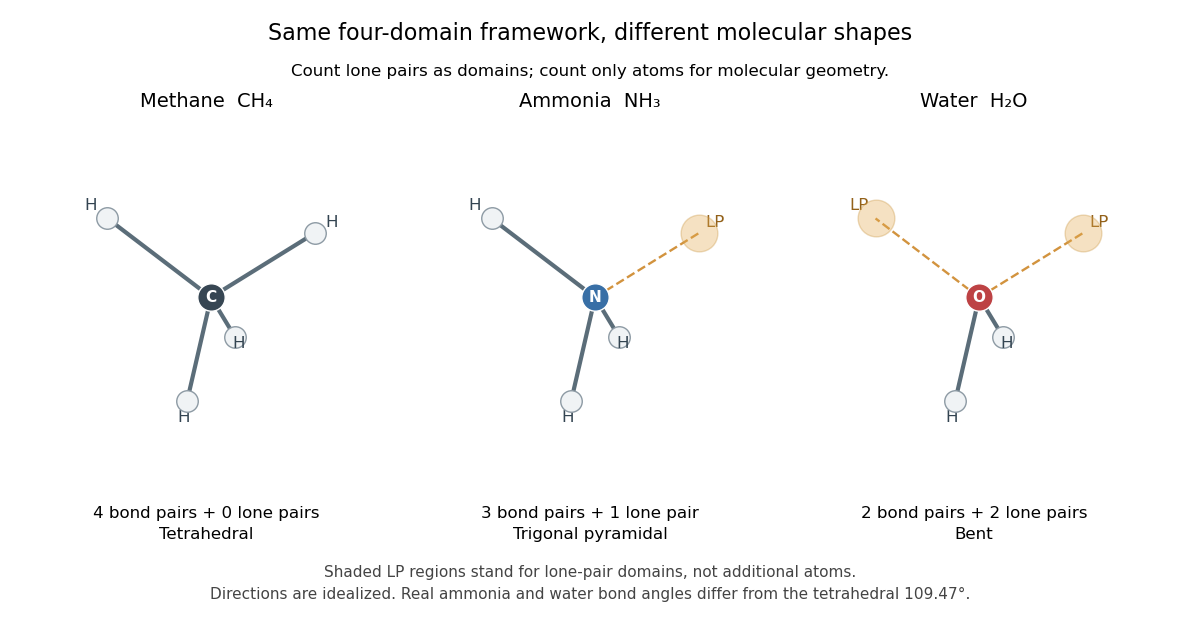

The regular tetrahedral directions can be represented by the unit vectorsEach pair has dot product , so the ideal bond angle is . This is a geometric calculation, rather than a prediction that every four-domain molecule has that exact bond angle. Lone pairs and different kinds of chemical bonds distort the ideal arrangement; water's H–O–H angle is about .[ref]
The model is attractive because small-number bookkeeping produces a spatial prediction without first solving for every molecular orbital. Shape then helps explain chemical polarity and which hydrogen bond donor or hydrogen bond acceptor sites are accessible. It is a qualitative model, not a full calculation of the electronic energy or a universal solution for every chemical compound. Gillespie and Nyholm's 1957 review [ref]
https://doi.org/10.1039/QR9571100339. Inorganic stereochemistry, Quarterly Reviews 11, 339–380
is a historical anchor for its development.