Rigid compartments impose a different constraint: fixed volume rather than fixed pressure. With Helmholtz free energy ,This follows immediately by differentiating in the chemical potential differential above. It expresses the same chemical potential through the thermodynamic potential appropriate to fixed temperature and volume.
Consider a closed system consisting of two rigid compartments of equal volume , maintained at a common fixed temperature . A valve permits exchange of the same ideal gas; the partition stays in place. Initially and , with conserved total amount of substance . These are macroscopic moles, modeled continuously, not twelve individual particles. By the ideal gas law, , so initiallyAt with the stipulated , this is approximately , favoring transfer from A to B.
At fixed and equal , integrating the ideal-gas chemical potential gives the total Helmholtz free energy, up to a term independent of the allocation,Here is a positive reference amount of substance; any omitted common term linear in is constant along this exchange. Let be the dimensionless fraction in A. The relative Helmholtz free energy then takes the particularly simple formIts derivative along the allowed transfer and its second derivative areThus the Helmholtz free energy is a strictly convex function of the allocation for positive amounts. Its unique minimum has , or , and equal chemical potentials. Initially its excess above this minimum is at . Relaxation decreases the total Helmholtz free energy by this amount in the model; the final pressures are also equal because both compartments have the same volume.
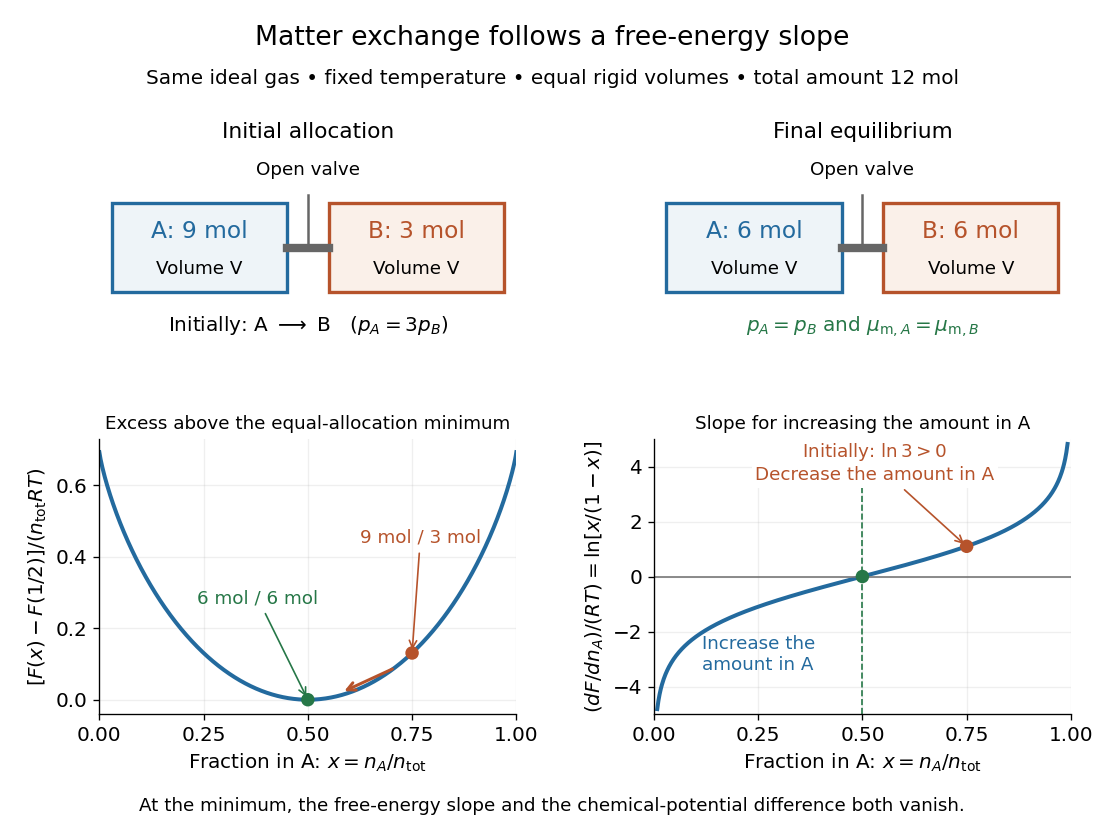

The beautiful connection is that the direction of matter exchange and the slope of a free energy curve are the same calculation. The entropy gained by redistributing the ideal gas makes equal allocation favorable here. As with chemical equilibrium, a free energy minimum identifies the favored state, while transport properties determine how quickly it is reached. The fixed-temperature, fixed-pressure Gibbs free energy criterion is summarized in 16.4 Free Energy; the rigid experiment instead uses Helmholtz free energy.
Articles by others on the same topic
There are currently no matching articles.