For a pure ideal gas at temperature and pressure ,where is the molar gas constant and specifies the reference pressure of the standard state. The ratio inside the natural logarithm is dimensionless. The chemical potential difference therefore depends on a ratio of pressures, not an absolute difference. See MIT 5.60, Lecture 14, page 4.
For a chemical species in an ideal gas mixture, replace by its partial pressure. More generally write using its thermodynamic activity and a consistent standard state. For an ideal dilute chemical solution, with reference concentration ; the thermodynamic activity section describes departures from this idealization.
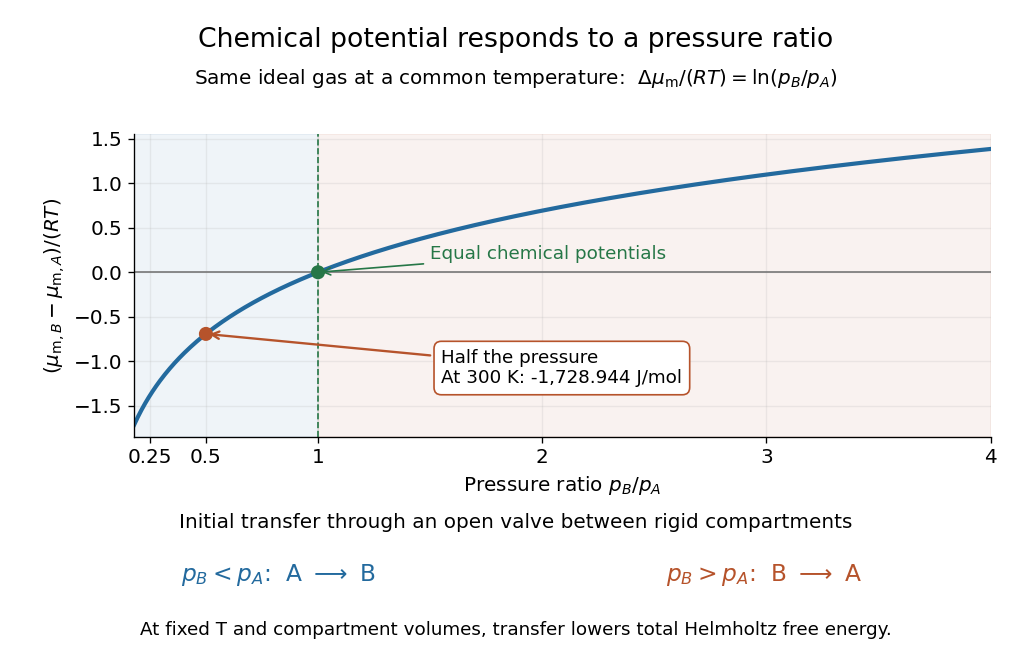
As a computed comparison, take identical chemical species at , with and . Stipulate . ThenHalving the pressure gives the same decrement whether starting from or , provided the ideal gas approximation remains valid. This comparison uses different pressures; it is not the common-pressure reservoir setup of chemical potential equality for particle exchange. The fixed-volume example in chemical potential and Helmholtz free energy supplies an exchange experiment with unequal initial pressures.

Articles by others on the same topic
There are currently no matching articles.