A chemical shift in photoelectron spectroscopy is a difference in binding energy for the same kind of core electron in different chemical surroundings, using comparable energy references. Identifying a chemical element assigns its family of lines; resolving chemical shifts within that family asks how its chemical atoms are bonded. For example, distinguishing a metal from its chemically modified surface requires more than detecting that element in both places.
The removal energy compares the initial electronic state with the state left after emission. Redistribution of the remaining Electrons changes that final state's energy; a measured shift therefore includes relaxation as well as initial bonding effects.[ref]
Electron Spectroscopy for Atoms, Molecules and Condensed Matter by Kai Manne Börje Siegbahn. p. 69: frozen-orbital approximation and relaxation
This makes chemical shift in photoelectron spectroscopy useful but conditional. Compare the same electron shell, the same photoelectron binding energy reference, and compatible sample conditions. Agreement with a chemically appropriate reference supports an assignment; a line position by itself need not uniquely determine an oxidation state. An unresolved sum of two chemical components can even have a centroid where neither component lies. The following Gaussian mixture distribution shows exactly how that happens without claiming a material identification.
Choose two hypothetical environments A and B of one chemical element, with line centers and . Model each line by a normalized Gaussian function with common standard deviation , and stipulate integrated count weights , . On the binding energy axis , the normalized count density isAll energies in this expression use electronvolts. Each component's integrated area equals its count weight, and . There is no background, statistical counting fluctuation, or additional emission feature in this stipulated model. These choices deliberately isolate photoelectron peak overlap and resolution.
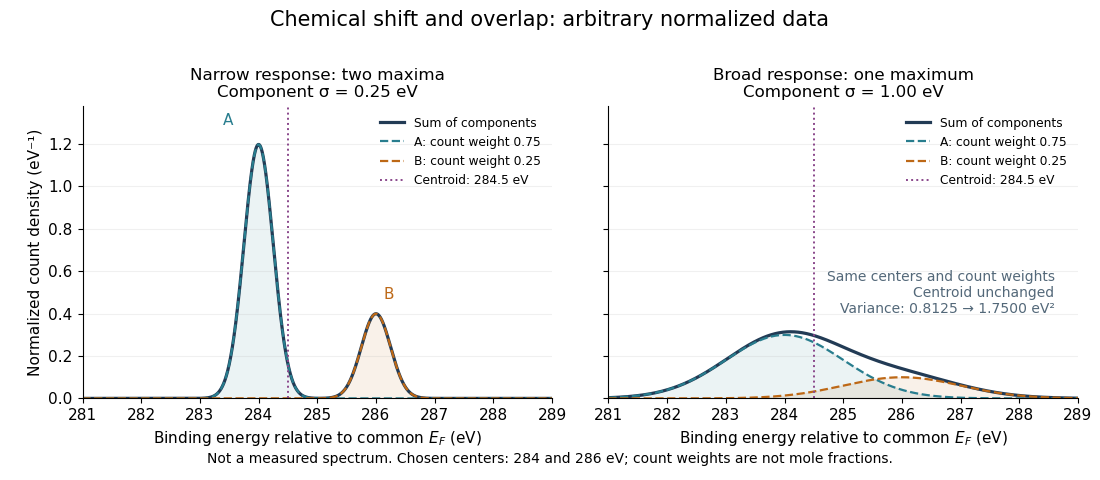
Two chemical components can blend into one maximum
. Original arbitrary normalized data, not a measured spectrum. The chosen Gaussian mixture distribution has centers and and integrated count weights and . Changing the common standard deviation from to changes the number of maxima from two to one, while leaving the centroid at . These count weights are not mole fractions; a chemical abundance inference requires cross section and analyzer-response calibration. Details.
Direct integration, or the law of total expectation applied to the component label, gives the centroidThe centroid lies between the chemical environments and is not either component's binding energy. Expanding within each component, the odd cross term integrates to zero. The resulting variance isFor the variance is and the two maxima are separated. For it is and there is one maximum. Each Gaussian's full width at half maximum is , approximately and respectively. The chemical separation remains in both cases. The number of visible maxima therefore does not equal the number of chemical components.
One interpretation of this change is additional independent Gaussian instrument blur. The convolution of probability densities adds the variances, so broadening to requires response standard deviation . A normalized response with zero mean preserves the centroid and integrated counts. Real line shapes and backgrounds can depart from this model, and separating hidden components is an inverse problem; a plausible fit does not alone establish uniqueness.
Finally, count weights describe detection. In a simple response model, let denote the number of emitting sites sampled in environment , its effective photoionization cross section, and the probability that its emitted Electron contributes to the selected measured line. ThenThe common factor includes exposure. Here includes escape from the sample, analyzer transmission and detection. Count weights equal site fractions only if the relevant response factors are equal or corrected. They are not automatically molecular mole fractions; different molecules can supply different numbers of the selected emitting sites. In an original example, equal site numbers with give the plotted count ratio despite a site ratio.
Articles by others on the same topic
There are currently no matching articles.