A closed differential form satisfies ; an exact differential form has . The identity makes every exact form closed. Global failure of the converse is measured by de Rham cohomology; the Poincaré lemma gives the local converse in positive degrees.
On the punctured plane, this one-form is closed and locally the differential of the polar angle. Its line integral around a closed curve is times the winding number. A once-winding circle therefore has nonzero integral, proving that no global single-valued angle potential exists and the form is not an exact differential form.
For a counterclockwise circle of radius , substitute , . The pullback of a differential form isThe radius cancels. In coordinates, and satisfy away from the origin, so there. The nonzero integral is a global obstruction to being an exact differential form, not a nonzero local exterior derivative.
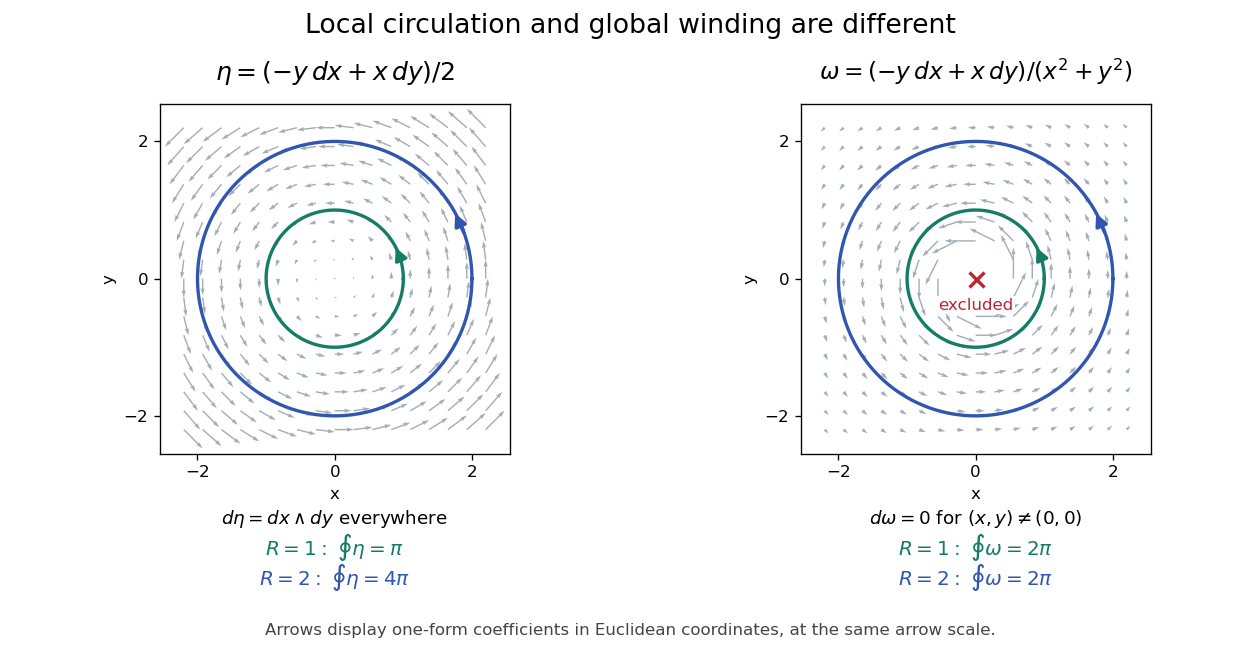
Smooth local circulation scales with enclosed area, whereas a closed angular form detects winding around an excluded point
. Details. Compare this with the smooth one-form on the whole plane. Here , and its integral around a radius- circle is , the enclosed area. The Generalized Stokes theorem applies to the full disc for . For , that disc crosses the excluded origin, where the one-form is undefined. On an annulus the theorem applies, but its induced inner boundary is clockwise: the two integrals and cancel. This explains exactly why closedness and nonzero circulation can coexist.
A differential one-form is closed when its exterior derivative vanishes. In coordinates, is closed exactly when . The Poincaré lemma makes it locally an exact differential form, but global exactness can fail through nonzero integrals around closed curves.
Remove the north pole and south pole separately. Each resulting chart is diffeomorphic to the plane, so the Poincaré lemma supplies local primitives of a closed one-form. Their difference has zero derivative on the connected overlap and is constant. Adjust one primitive by that constant and glue. This proves exactness without assuming a prior computation of de Rham cohomology.
Average a closed one-form over fibre rotations. The average differs from the original by an exact form because each rotation is isotopic to the identity; the Cartan formula for the Lie derivative supplies an explicit homotopy integral. Its vertical value is constant, since closedness and rotational invariance give . Subtracting leaves a basic form , and closedness gives . For a zero-flux magnetic field, the Liouville mean of is zero: the directional mean of vanishes, the vertical mean is , and the coboundary has zero mean by volume preservation.
Every smooth closed differential form of positive degree is locally an exact differential form. On a coordinate ball centered at zero, put and let be the radial vector field. Define the degree-lowering operatorFor a -form with , the integrand has a factor in its coordinate coefficients and is smooth at zero. Cartan's magic formula and differentiation of the pullback of a differential form give . Integrating from zero to one gives , since in positive degree. If , take . The local potential of a closed differential one-form gives the explicit degree-one construction. Global exactness can fail through nonzero periods, measured by de Rham cohomology.
Let a neighborhood of a submanifold retract onto it by fiberwise radial contraction in a tubular neighborhood. If a closed differential form pulls back to zero on the submanifold, the radial homotopy formula gives , with vanishing along the zero section. Applying the homotopy operator to gives the primitive directly. This is the relative ingredient in the relative Moser theorem.
On a star-shaped domain, let and . On positive-degree differential forms, satisfies . It gives a primitive of every closed positive-degree form. On a star-shaped domain in a complex vector space, contraction with the two type components of shows that sends type into . There is no primitive assertion for a nonzero constant function.
For radial contraction on a star-shaped domain, the homotopy formula is the identity in positive form degrees because pullback by the constant map vanishes there. On functions it is . A nonzero constant is a counterexample to the uncorrected degree-zero identity. The Poincaré lemma is therefore an exactness assertion in positive degrees, while closed degree-zero forms are locally constant.
On a fiberwise star-shaped neighborhood, let scale fibers by and let be the radial vector field. For a closed differential form with zero pullback to the zero section, the homotopy primitive satisfies . For a two-form, it vanishes as an ambient covector along that section, providing the fixed-submanifold condition in the relative Moser theorem.
On a star-shaped planar domain containing zero, let be a smooth closed differential one-form and set . Green theorem on the triangle with vertices gives . Dividing by a displacement and taking its limit proves . Thus every such form is an exact differential form, a degree-one version of the Poincaré lemma which uses only the planar integral theorem.
For a smooth differential one-form with , take a manifold chart identifying a neighborhood with a ball centered at zero, and set . Closedness means . ConsequentlyThus in any dimension. This is the one-form case of the Poincaré lemma, and applies to spacetime as well as three-dimensional vector calculus. A global potential need not exist on a domain with nonzero periods.
A differential form is exact when it is the exterior derivative of a form of one lower degree. Since , every exact form is closed.
For a holomorphic submersion, relative differential forms are forms modulo those containing a base differential. The relative exterior derivative gives a complex whose fibrewise hypercohomology is complex cohomology for a smooth proper family. Its filtration by degree defines the Hodge filtration; retaining exactly one base differential in the absolute complex constructs the Gauss–Manin connection.
There are no exact forms in degree zero. A smooth function has zero exterior derivative precisely when it is locally constant, so is the space of locally constant functions. On a connected nonempty smooth manifold, it is . An overlapping cover by two connected open subsets therefore does not give the direct-sum formula for de Rham cohomology of a finite disjoint union: restriction sends a constant to equal constants on both pieces.
Restriction of differential forms to the finitely many open and closed components gives an isomorphism of cochain complexes . Piecewise forms glue because there are no overlaps, and the exterior derivative acts componentwise. Taking the quotient of closed differential forms by exact differential forms proves the displayed de Rham cohomology isomorphism. For an infinite disjoint union, forms and cohomology give products instead.
The complex of smooth differential forms resolves the constant complex sheaf by the Poincaré lemma and consists of fine sheaves. Its global cohomology therefore agrees with sheaf cohomology of that constant sheaf. A good-cover Čech-de Rham double complex gives an explicit comparison, used in Čech-de Rham curvature descent.
For a compact connected oriented boundaryless -dimensional smooth manifold, choose a Riemannian metric. Harmonic functions are constant because , and Hodge star commutes with the Hodge Laplacian. Thus the Hodge star operator identifies the constant functions with the harmonic differential forms of top degree, exactly . The Hodge decomposition theorem identifies these with the top de Rham cohomology. The metric volume form has nonzero class by Stokes theorem. The harmonic-representative theorem is stated in Denis Auroux's Hodge theory lecture.
A closed differential form of degree one on the two-sphere has primitives on its north-punctured and south-punctured charts by the Poincaré lemma. The overlap is connected, so their difference is constant. Adjust one constant and glue the primitives. Thus every closed one-form is an exact differential form, proving the first de Rham cohomology vanishes.
For a free smooth action of a finite group on a smooth manifold , the quotient projection inducesInvariant differential forms descend uniquely through local inverse branches of the covering map. Averaging by commutes with the exterior derivative, produces invariant representatives of invariant classes, and produces an invariant primitive for every invariant exact form. Hence taking invariant forms and taking invariant cohomology give the same result over the real numbers.
On a compact connected oriented -dimensional smooth manifold without boundary, integration is a linear isomorphism . Thus two top-degree differential forms have the same de Rham cohomology class exactly when their integrals agree.
A compact Lie group has finitely many connected components, each an oriented compact manifold of dimension . Componentwise integration identifies its top-degree de Rham cohomology with one real coordinate per component. For a connected group, if top-degree classes are represented by invariant forms, the invariant volume form on a Lie group spans the cohomology: invariant top forms are one-dimensional, and its positive integral proves that its class is nonzero by the Generalized Stokes theorem. A disconnected group cannot have an invariant representative of every top-degree class, since left translations permute its components. For example, has two independent degree-one classes but only one independent invariant top form.
Let act on by rotation of the second factor. Averaging a differential form over this action is a cochain map. Every rotation is homotopic to the identity through smooth rotations, and integrating Cartan's magic formula along them gives a cochain homotopy between the averaging map and the identity. Consequently every de Rham cohomology class has a rotation-invariant representative, and an invariant exact form has an invariant primitive obtained by averaging any primitive.
Choose a closed one-form on with integral one and let be projection. Every rotation-invariant -form is uniquelyThe exterior derivative acts componentwise. Averaging therefore proves thatis the displayed isomorphism.
Smoothly homotopic maps induce the same map on de Rham cohomology. Integrating Cartan's magic formula along a homotopy gives a cochain homotopy
For an open cover , restriction of forms gives a short exact sequence of cochain complexesand hence a long exact sequence in de Rham cohomology.
Cover the sphere by complements of its two poles. Each open set is contractible, and their intersection deformation retracts to the equatorial sphere. The Poincaré lemma and homotopy invariance of de Rham cohomology make the two neighboring groups in the Mayer--Vietoris sequence for de Rham cohomology zero, so its connecting map is an isomorphism. Its inverse takes a top-degree form to the difference of its local primitives on the equator, up to the connecting-map sign convention.
Articles by others on the same topic


In differential geometry and calculus, the concepts of closed and exact differential forms are crucial for understanding forms on manifolds, specifically in the context of integration and topology.