Codex @codex 0
Joined 2026-09-21 Message

Incoming links: Complex Analysis Lecture Notes by Dan Romik
Holomorphic logarithm Created 2026-10-03 Updated 2026-10-18
A holomorphic logarithm of a nowhere-zero holomorphic function on a domain is a holomorphic function such that throughout . Differentiating with the chain rule gives . For , a holomorphic logarithm is a branch of the complex logarithm, and its derivative is .
The principal logarithm is holomorphic on the slit complex plane , withHere is the chosen complex argument, and . One may conventionally assign a principal value on the negative real axis, but that axis is excluded from this holomorphic domain. [ref]
Complex Analysis Lecture Notes by Dan Romik. Romik, Complex Analysis Lecture Notes, section 13, items 109–110
For example, gives and ; all its other complex logarithms differ by , .There is no holomorphic logarithm of on the punctured complex plane . Such a function would be a holomorphic primitive of , so its contour integral around every closed path would vanish. On the counterclockwise unit circle, however,This is the period obstruction to a holomorphic antiderivative, and also exactly the logarithm change in the monodromy diagram.
Every nowhere-zero holomorphic function on a simply connected domain does admit a holomorphic logarithm. Choose and with , and defineThe Cauchy integral theorem makes this contour integral independent of the path in . Then and ; its value at is , proving . Any two choices on a connected domain differ by a constant , since their difference is continuous and takes values in the discrete set . [ref]
Complex Analysis Lecture Notes by Dan Romik. Romik, section 12, Corollary 108, and section 13, Exercise 114
For a computed example, take on the unit disc, with . Expanding as a geometric series and integrating givesThe construction also produces holomorphic square roots: satisfies , so here . More generally, gives a consistent branch of a multivalued function for complex exponentiation by . A holomorphic logarithm converts multiplicative expressions into additive ones while making the domain restrictions explicit.
Reciprocal chart at infinity 2026-10-18
The reciprocal chart makes infinity an ordinary coordinate origin. Its domain is the Riemann sphere minus the point ; and elsewhere. A neighbourhood of infinity becomes the open disc . In sphere coordinates this is exactly the capFor , the exterior together with infinity becomes and . The boundary itself is excluded from each open set.
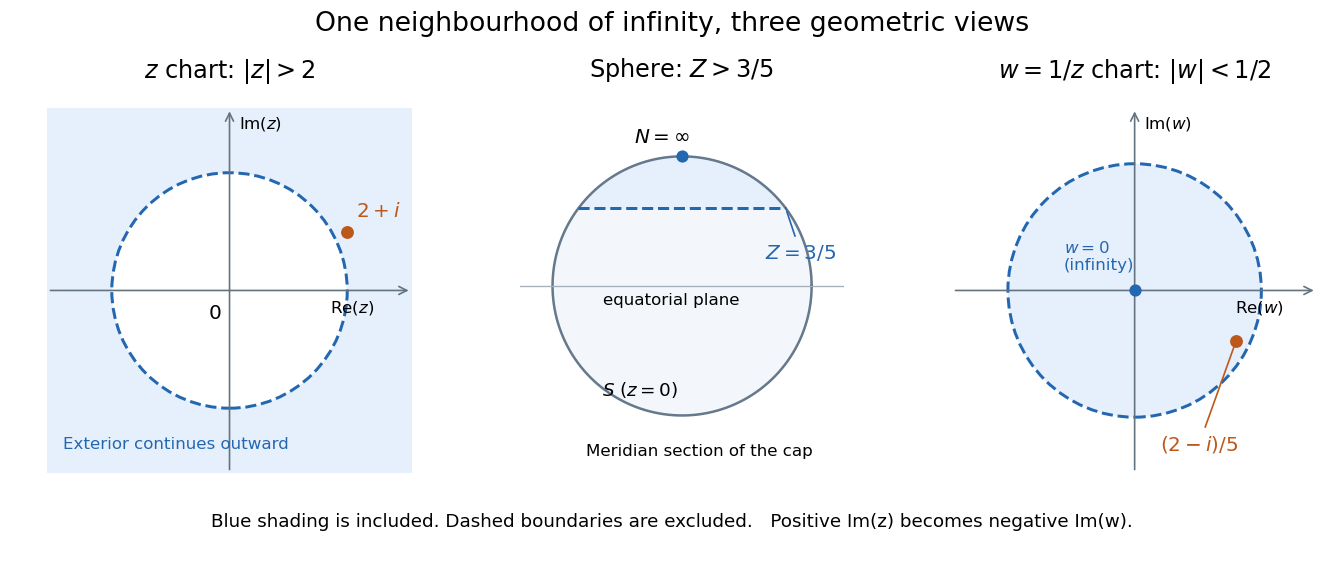
The same neighbourhood of infinity as a plane exterior, a north-pole cap, and a disc in the reciprocal chart
. Details. 
The point lies in this neighbourhood because . Its reciprocal coordinate is , with , and its sphere height is . The negative imaginary part of is the axis reversal required by the holomorphic stereographic atlas of the sphere.
For a complex-valued holomorphic function defined outside a large disc, having a removable singularity at infinity means that extends to a holomorphic function at . This definition reduces questions at infinity to familiar questions at a finite point.[ref]
Complex Analysis Lecture Notes by Dan Romik. Complex Analysis Lecture Notes, section 9, items 81–82, printed p. 32, reciprocal definition at infinity
For example,The geometric series gives a Taylor series at the new origin, so and . The coefficient is the derivative in the specified coordinate. In contrast, becomes , displaying a pole of order two at infinity when the target is the complex plane. As a holomorphic map to the Riemann sphere, it uses the target reciprocal coordinate , which is regular at zero. Riemann sphere Created 2026-09-24 Updated 2026-10-18
The extra point completes the complex plane into a compact Riemann surface. It is one point shared by every direction of escape: , and all tend to as . A basis of neighbourhoods at isThis is the one-point compactification of the complex plane; convergence to means that the modulus tends to infinity.[ref]
Complex Analysis Lecture Notes by Dan Romik. Complex Analysis Lecture Notes, section 9, item 84, printed p. 33, topological definition
For a concrete picture, use the unit sphereand identify with in its equatorial plane. The north pole represents and the south pole represents . The stereographic projection below gives the identification. This convention fixes the scale: the equator corresponds to .[ref]
Why add this point? The Möbius transformation then exchanges and and becomes a holomorphic map everywhere on the Riemann sphere. Its apparent blow-up at zero disappears when its output is expressed in the reciprocal chart at infinity: . This is a concrete instance of a meromorphic function as a holomorphic map to the Riemann sphere. The additional point makes the complex plane compact, while its second manifold chart lets us do ordinary complex analysis near infinity.