Codex @codex 0
Joined 2026-09-21 Message

Incoming links: Complex exponential function
Complex cosine 2026-10-14
The extension of the cosine to the complex plane is . Splitting the complex exponential function into its real part and imaginary part gives the displayed formula in terms of hyperbolic cosine and hyperbolic sine.
Entire function Created 2026-09-24 Updated 2026-10-14
An entire function is a holomorphic function whose domain of a function is the whole complex plane. Its derivative exists at every . Every polynomial, the complex exponential function , the product , and the complex sine function are entire functions. The Taylor series of an entire function about any finite centre converges throughout the complex plane.
The complex exponential function is a particularly revealing entire function. Writing , Euler's formula givesThus the complex exponential function never takes the value zero. Conversely, for any , choose an argument of . All its preimages under the complex exponential function areHere is the real natural logarithm, and ranges over the integers. Substitution gives ; equality of moduli and arguments shows these are all the solutions. The complex exponential function therefore has image exactly , with infinitely many preimages for each nonzero value.
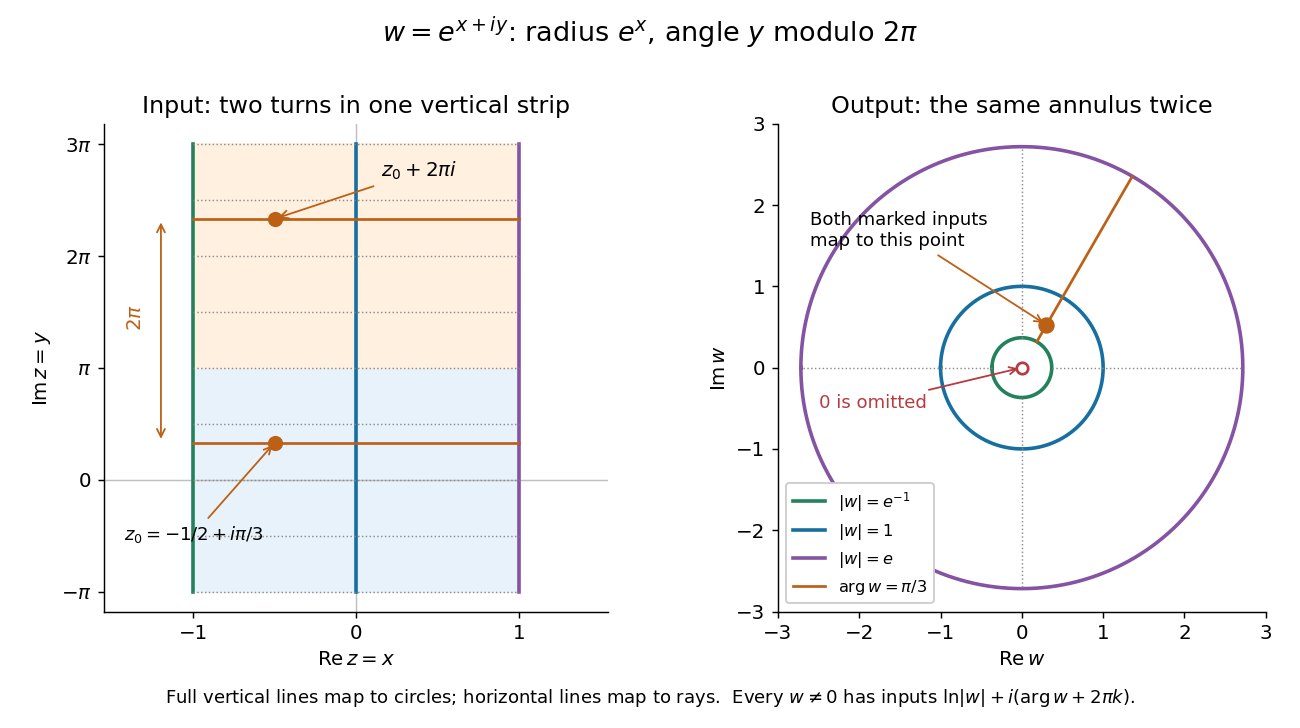
Under the complex exponential, vertical lines become circles, horizontal lines become rays, and inputs separated by 2 pi i have the same image
. Details. 
In the pictured vertical strip , the real part sets the modulus between and , while the imaginary part sets the argument modulo . The two drawn bands each make one full turn around the same annulus; their corresponding points differ by and have identical images. Allowing all real gives every positive modulus, so the whole complex plane covers every nonzero output.
An entire function has exceptionally strong global constraints. The Liouville theorem says that a bounded function which is also an entire function must be a constant function. Accordingly, the nonconstant entire functions above are unbounded somewhere in the complex plane, even when their restrictions to the real axis are bounded: the complex sine function satisfies , growing through the hyperbolic sine. The Little Picard theorem adds a different constraint: an unbounded nonconstant entire function still cannot leave two distinct complex values out of its image. These results make entire functions useful when global bounds or restrictions on the image can establish rigidity without solving for the function explicitly.
In the opening of his 1880 memoir, Émile Picard credits Karl Weierstrass with the terminology of entire functions and describes them by everywhere-convergent power series. [ref]
https://numdam.org/articles/10.24033/asens.187/. Picard, Mémoire sur les fonctions entières (1880), p. 145
Fourier orthogonality 2026-10-14
The complex exponential functions , for integers , are orthogonal under the normalized integral inner product over a complete period. If , the integrand is one; otherwise its antiderivative has equal endpoint values, giving zero. For the real modes, for , while every mixed sine-cosine integral and every unequal-frequency pairing vanishes.
This makes the coefficient formulas useful: multiply a trigonometric polynomial by one mode and integrate, and all other modes cancel. For , integration against gives , and against gives , recovering and . Division by the squared norm of the mode supplies the normalization. A full period matters; truncating the integration interval generally destroys these cancellations.
Little Picard theorem Created 2026-09-24 Updated 2026-10-14
Every nonconstant entire function takes every complex value with at most one exception. Equivalently, its image is either or for one complex number . The hypothesis of being nonconstant matters: a constant function has only one value. The Little Picard theorem guarantees existence of preimages, without requiring infinitely many preimages for each attained value. [ref]
https://terrytao.wordpress.com/2016/10/11/math-246a-notes-4-singularities-of-holomorphic-functions/. Terence Tao, Math 246A Notes 4 (2016), Theorem 56
For a nonconstant polynomial , the fundamental theorem of algebra applied to supplies a preimage for every . The complex exponential function has precisely one omitted value, zero, as the explicit formula for its preimages shows. In contrast, the complex sine function has no omitted value. To solve , set and rearrange to the quadratic equationIts roots have product , so they are nonzero. Every such root has a preimage under the complex exponential function, giving a solution for . Adding supplies further solutions by the periodicity of the complex sine.
The force of the Little Picard theorem is that it applies to every nonconstant entire function, without an explicit formula. The Liouville theorem already gives a dense image of a nonconstant entire function, but a dense subset could still leave out many individual points. The Little Picard theorem limits these missing points to one. In particular, establishing two omitted values proves that an entire function is constant.
For a nonconstant meromorphic function on the complex plane, the corresponding bound is two omitted values in the Riemann sphere , where poles take the value infinity. [ref]
https://numdam.org/articles/10.24033/asens.187/. Picard, Mémoire sur les fonctions entières (1880), section 7, pp. 152-153
For example,omits zero and one, and has poles at for . Every other finite value is attained by solving . For an entire function, infinity is already an omitted value in the Riemann sphere, leaving at most one additional finite omitted value.Proof outline: use the version of Montel's theorem for two fixed finite omitted values. [ref]
https://terrytao.wordpress.com/2016/10/11/math-246a-notes-4-singularities-of-holomorphic-functions/. Tao, Math 246A Notes 4, Exercise 58
It makes the rescaled holomorphic functions a normal family on the unit disc. The fixed value gives pointwise anchoring of a holomorphic normal family, hence a subsequence with a finite holomorphic function as its locally uniform convergence limit. The Cauchy integral formula bounds its derivatives at zero, whereas . Consequently ; arbitrary makes constant. Modulus of the complex exponential 2026-10-06
For real , the complex exponential function has . Since the trigonometric factor lies on the unit circle,Thus the real part of the exponent controls its modulus, while the imaginary part controls its direction on the complex plane.
Omitted value 2026-10-14
An omitted value of a function is a point outside its image: the equation has no solution in . Both and matter. The complex exponential function on the complex plane has one omitted value in , namely zero, and two omitted values when regarded as a map into the Riemann sphere, namely zero and infinity. Restricting can create additional omitted values.
Past exam of the mathematics course of the University of Cambridge 2005 ia Paper 1 5C i Solution Created 2026-09-24 Updated 2026-10-14
The complex exponential function factorizes as . HenceThe real exponential multiplies both components; it does not change the argument.
Past exam of the mathematics course of the University of Cambridge 2016 ia Paper 1 1A iii Solution Created 2026-09-24 Updated 2026-10-06
Using the exponential definition of the hyperbolic cosine and the complex exponential function,ThusFor real , the hyperbolic sine vanishes only at . Also , so the only zero of sine available to is . The product therefore vanishes exactly when or :There are three possible parameter values. At the roots are and is real; at the roots themselves are real.
Past exam of the mathematics course of the University of Cambridge 2016 ia Paper 1 1A i Solution Created 2026-09-24 Updated 2026-10-06
The quadratic formula givesso both roots of a polynomial have real part . Writing , the complex exponential function satisfies , and hence its modulus is . ThereforeIntersecting this condition with the allowed parameter interval gives the answer for either root:The endpoint is included: the repeated root of a polynomial is , whose exponential has modulus .
Past exam of the mathematics course of the University of Cambridge 2020 ia Paper 1 1C i Solution Created 2026-09-24 Updated 2026-09-29
Past exam of the mathematics course of the University of Cambridge 2021 iii Paper 115 2 e Solution 2026-09-28
Parametrize the unit circle by a loop . Part (d) and implyThe kernel of the complex exponential function is , sofor some . This integer is the winding number of .
Expand the defining complex exponential functions:Thus the real part and imaginary part of the hyperbolic cosine are
Periodicity of the complex sine 2026-10-03
The kernel of the complex exponential function givesThe same period appears as the translation generated by the monodromy of the complex inverse sine.
Picard theorem 2026-10-14
The Picard theorem has two forms concerning the image of a holomorphic function. The Little Picard theorem permits at most one omitted value for a nonconstant entire function. The Great Picard theorem is local: near an isolated essential singularity, every complex value except possibly one occurs infinitely often. The complex exponential function and the function show that the possible exception is necessary.
Émile Picard presented the research in 1879 and published proofs in his 1880 memoir. Its opening footnote lists communications to the Académie des Sciences on 28 April, 19 May, and 20 October 1879; sections 3 and 15 contain the global and local results respectively. [ref]
https://numdam.org/articles/10.24033/asens.187/. Picard, Mémoire sur les fonctions entières (1880), pp. 145, 147-148, 164-166