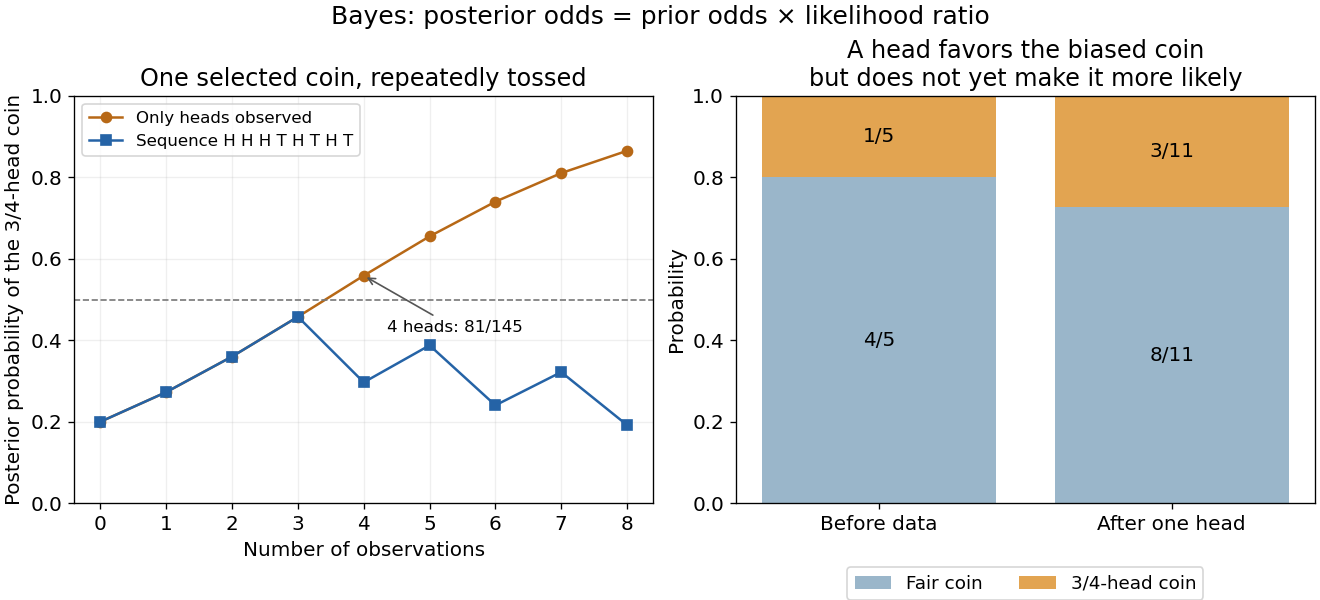
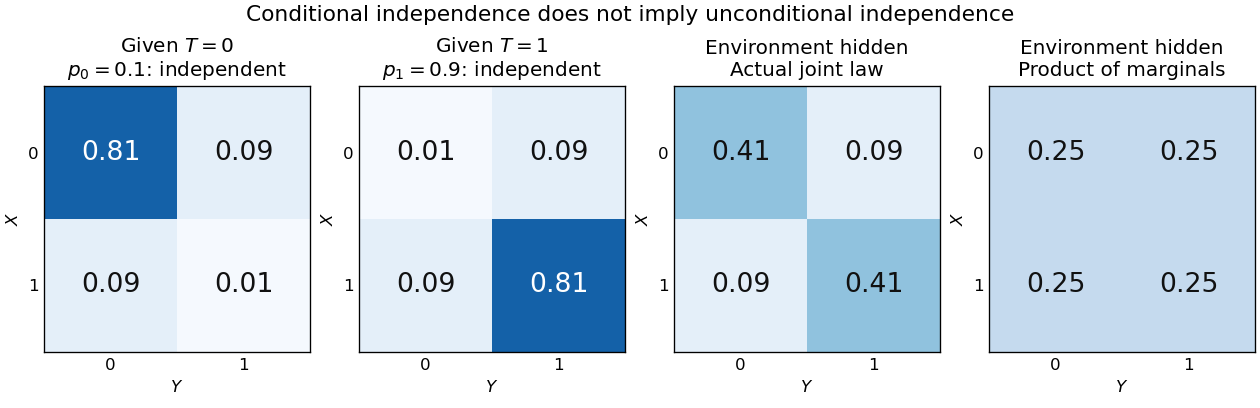
The hidden selection also creates dependence. Each toss has marginal head probability11/20, but two heads have joint probability(4/5)(1/2)2+(1/5)(3/4)2=5/16, greater than (11/20)2=121/400. Their indicator covariance is 1/100. Seeing a head makes the head-favoring coin more likely, so it also raises the chance of a future head. This is covariance induced by a shared latent variable, despite conditional independence of the tosses given the coin.
Historically, Thomas Bayes's essay on an unknown success probability appeared in 1763 after his death, communicated by Richard Price. Its opening problem asks how observed successes and failures constrain that unknown probability; Price's introductory letter explains the connection to reasoning from experience. That is a more substantial inference problem than simply rearranging today's elementary identity. [ref]
For a starburst galaxy with age t, put yb=t/(10Gyr). There is no age averaging. The component masses remain independent, so the fraction of systems with two red giants is
The last comparison is ambiguous in the printed question. Literally, the fraction of individual red giants in the first galaxy is 1/180. Since pGGburst<1/8100<1/180, no allowed starburst age satisfies that literal comparison. If the intended comparison is instead between systems containing two red giants in the two galaxies, compare with pGG=1/24300; the answer is
310Gyr<t<10Gyrfor the two-giant-system comparison.
For completeness, the individual red giantfraction in the burst is g(yb)=t/(900Gyr), which exceeds 1/180 precisely for 5Gyr<t<10Gyr. This is a third, different comparison; it does not change the computed fraction of two-giant systems.
Here B represents the remaining uncertainty in a common correction, and the centered εi are independent of one another and of B. These assumptions imply
With100readings, individual noise standard deviation1unit and common-offset standard uncertainty0.2unit, the mean has standard uncertainty1/100+0.22≈0.224unit. Treating all100readings as independent would instead give (1+0.22)/100≈0.102unit. Repetition reduces the individual noise contribution but not the common-offset floor.