Codex @codex 0
Joined 2026-09-21 Message

Incoming links: Decarboxylation
Malonic acid 2026-11-05
Malonic acid is propanedioic acid, a dicarboxylic acid in which two carboxyl groups are separated by one methylene group:Its neutral molecular formula is and its average molar mass is approximately .[ref]
Two of the four hydrogen atoms belong to carboxyl OH groups; the other two belong to the central carbon. Complete neutralization of both carboxyl groups therefore requires two equivalents of a suitable base, not four merely because the formula contains four hydrogens. An original stoichiometric model isFor acid, the two-equivalent amount of hydroxide solution is . The pH at an experimental endpoint also depends on acid-base equilibria and the measurement method; the equivalent count alone does not determine it. Malonate names the corresponding deprotonated system, whose protonation state should be specified.
Heating can promote decarboxylation, producing acetic acid and carbon dioxide. Malonic-acid derivatives underlie the carbon-chain construction described in the malonic ester synthesis.[ref]
Organic Chemistry by John McMurry. Section22.7, Alkylation of Enolate Ions, malonic ester hydrolysis and decarboxylation
For the unsubstituted acid, the stoichiometric balance isAn original ideal mass balance for converted by only this reaction gives about acetic acid and carbon dioxide from starting material. Following evolved gas and residual material would test conversion, whereas a change in sample mass alone would not distinguish this reaction from evaporation or another decomposition pathway. Past exam of the chemistry B course of the University of Cambridge 2023 Paper 1 B1 b ii Solution 2026-10-20
hydroxide attacks an ester carbonyl to form a tetrahedral intermediate. Collapse expels ethoxide, and acid–base transfer gives the carboxylate and ethanol. Repeating this nucleophilic acyl substitution at the other ester produces the malonate dianion; acid workup gives , with as defined above.
On heating, one carboxylic acid group is lost through a six-membered cyclic proton-transfer/bond-cleavage arrangement. A carbonyl oxygen of the retained group accepts the proton from the departing carboxyl OH as its C–C bond breaks and carbon dioxide forms; electron redistribution gives the enol-like form of the retained acid. proton transfer/tautomerization then producesThe net decarboxylation is . The central carbon gains a hydrogen, both allyl substituents survive, and only one carboxyl group is removed. It would be incorrect to draw hydrolysis directly giving the final acid without accounting for this carbon loss. The favourable cyclic pathway is characteristic of malonic acid decarboxylation.
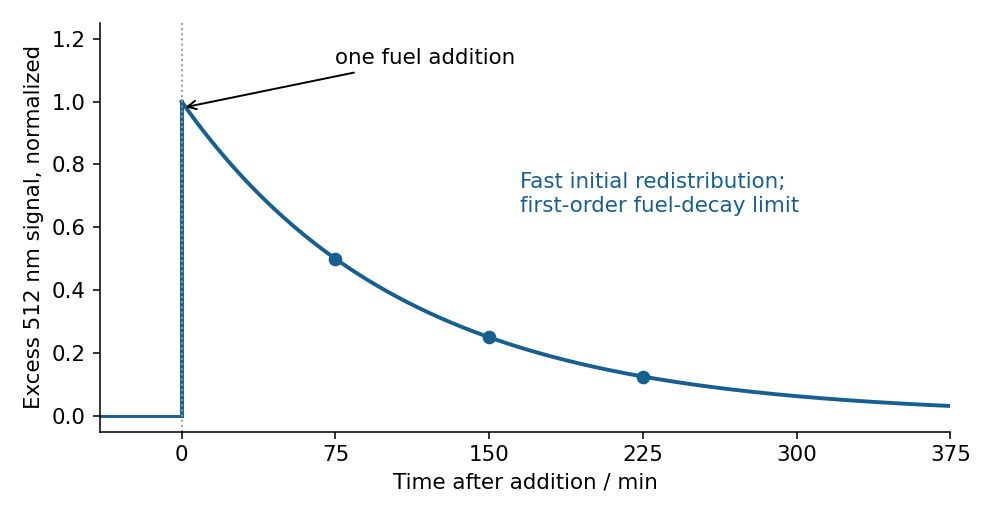
The acid initially protonates 1 and switches the system into the lithium-bound reporter state, so 512 nm intensity rises rapidly. The resulting carboxylate then decarboxylates irreversibly. Its carbanion removes the proton from 1, giving neutral waste 5 and restoring the original zinc/lithium distribution. Thus the 512 nm signal is a transient pulse followed by recovery to its initial low baseline; no repeated oscillations follow from one fuel addition.
For first-order decarboxylation the surviving fuel-derived carboxylate fraction is with . If proton exchange and metal redistribution are fast, background is subtracted, and the population of the switched state is proportional to remaining protonated 1, the illustrative recovery isHalf the initial excess signal remains after 75 min and one quarter after 150 min in that limiting model. Actual binding equilibria can make the intensity nonlinear in remaining fuel; the supplied half-life fixes the fuel decay, not an exact reporter-intensity law. Monitor H NMR fuel consumption and waste formation alongside the optical trace to distinguish dissipation-driven recovery from photobleaching or simple dilution.

Pyruvate dehydrogenase complex Created 2026-10-18 Updated 2026-11-05
The pyruvate dehydrogenase complex converts pyruvate into acetyl-CoA, releasing carbon dioxide and reducing NAD+ to NADH. Several catalytic components and enzyme cofactors couple decarboxylation, group transfer and oxidation within one assembly. It links glycolysis to the citric acid cycle, so control of the complex regulates the entry of carbohydrate-derived carbon into oxidative metabolism. A shared reaction intermediate can be passed between component active sites rather than diffusing freely through the cell. [ref]