A map on a metric space is chaotic in Devaney's sense when it is topologically transitive, its periodic points are dense, and it has sensitive dependence on initial conditions.
A continuous map is chaotic in Devaney's sense when it has topological transitivity, a dense set of periodic points, and sensitive dependence on initial conditions.
A map is topologically transitive when, for every pair of nonempty open sets , some iterate satisfies .
A continuous map is topologically mixing if for every pair of nonempty open sets there is an integer such that for every . This is stronger than topological transitivity, which asks only for some hitting time. For the full tent map, each sufficiently small dyadic branch interval is mapped onto the whole space by an iterate, proving mixing.
Periodic points are dense when every nonempty open set contains a point fixed by some positive iterate.
The butterfly effect is the intuitive idea that an arbitrarily small change in an initial condition can eventually change the observed future substantially. In dynamical systems, sensitive dependence makes this precise for a map on a metric space : there is one separation scale such thatThe same works at every point, whereas and the separation time may depend on the point and the requested closeness. For a flow map, replace the iteration of a map by with some . The state space matters: restricting to a single fixed point removes the alternative nearby states needed for sensitivity.
Sensitivity is compatible with deterministic evolution. Given an exact initial condition, there is still one orbit; uncertainty concerns which exact state a measurement represents. It also allows accurate short-term prediction. For a continuous function , each fixed finite iterated function is continuous, so sufficiently close initial states remain close at any specified finite step. What fails is a single initial accuracy that controls every future step.
The logistic map illustrates both sides. At , nearby orbits in the basin of attraction of its attracting fixed point approach one another. At , arbitrarily close states can eventually separate by a macroscopic fraction of . The definition asserts the existence of separating neighbours, not that every nearby pair must separate: and have exactly the same next state under the logistic map and hence the same subsequent orbit. Nor must separation increase at every step.
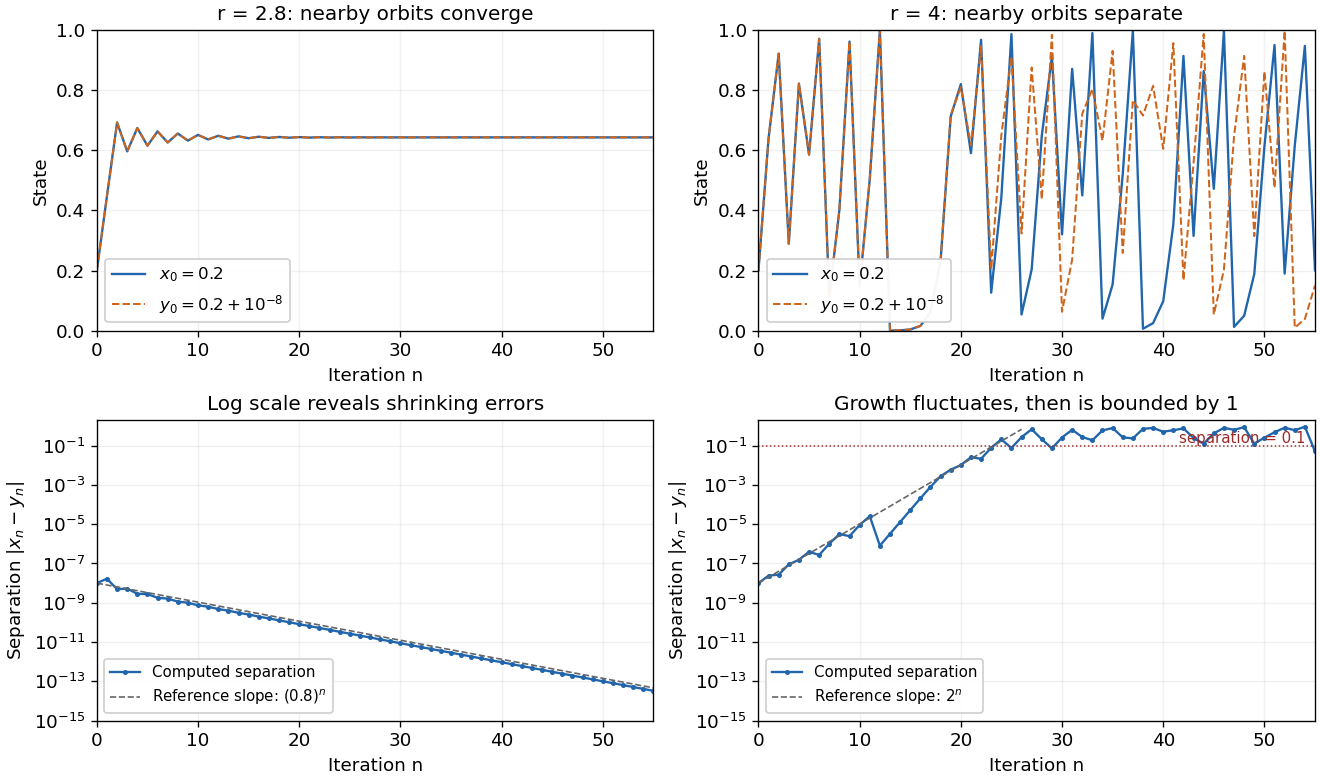
The same deterministic logistic rule can shrink or amplify initial uncertainty
. Each pair starts at and and uses the same logistic map parameter. At , the orbits approach the same attracting fixed point. At , this pair eventually gives visibly different states. The logarithmic panels expose changes hidden in the upper panels; dashed slopes illustrate the eventual contraction factor and a representative exponential growth factor . They are reference slopes, not exact formulas for these finite separations. Distances fluctuate and remain bounded by one. These computations illustrate the phenomenon; two numerical orbits alone do not establish the quantified definition. Details.
A positive Lyapunov exponent describes average exponential growth of an infinitesimal displacement along an orbit, when the relevant limit exists. It is related to sensitivity but is not a substitute for its uniform definition. For a differentiable interval map, the chain rule givesAt , the logistic map has for Lebesgue measure-almost every initial condition, while exceptional orbits can have different exponents. Finite-separation growth is only approximately exponential while the linear approximation remains useful. In a bounded state space, a separation cannot grow exponentially forever.
Sensitivity alone is also weaker than Devaney chaos, which additionally requires topological transitivity and dense periodic points. For example, on the real line has sensitive dependence and a positive Lyapunov exponent, but its only periodic point is zero, so it is not Devaney-chaotic. This distinguishes growth of uncertainty from the richer organization of recurrent orbits.
Edward N. Lorenz's "Deterministic Nonperiodic Flow" (1963) studied a thermal convection model with three ordinary differential equations. Its numerical orbits exhibited persistent nonperiodic motion and instability to small changes of the initial condition. Lorenz discussed the consequences for very-long-range weather forecasting: a deterministic law need not make a detailed distant future reliably recoverable from approximate observations. The historically relevant lesson of the Lorenz system is this growth of uncertainty under deterministic evolution.[ref]
https://samizdat.co/works/do-while/lorenz-1963.pdf. Lorenz's 1963 convection and predictability paper
A forecast horizon is the duration over which a prediction meets a specified error tolerance. If an initial uncertainty grows approximately as with positive Lyapunov exponent , then solving for when it reaches a tolerance gives the displayed estimate. Here is the natural logarithm and is measured per step of the discrete dynamical system; for a flow map, use the exponent per unit time instead. The estimate assumes the growth approximation remains valid up to the chosen tolerance and excludes additional model errors.
Reducing by a factor ten buys approximately more steps, rather than multiplying the forecast duration by ten. For typical logistic map orbits at , , so one extra decimal digit buys roughly steps in this approximation. Better measurements help, but their benefit is logarithmic. A forecast of a probability distribution or a stable long-term average asks a different question from predicting each individual state.
The doubling map preserves normalized Lebesgue measure on the unit circle. Each point has exactly two preimages, and modulo one, and each inverse branch scales lengths by .
If in base two, thenBinary cylinders make transitivity and density of periodic points transparent: concatenate prescribed finite blocks for transitivity and repeat a finite block for a periodic point.
Articles by others on the same topic
There are currently no matching articles.