Diffusion MRI gradient sampling is the choice of magnetic field gradient directions, strengths and repetitions used to acquire diffusion magnetic resonance imaging measurements. Under a Gaussian diffusion tensor model, different directions probe different values of a quadratic form. Acquiring many measurements in an uninformative set of directions cannot determine every tensor coefficient.
For a unit gradient direction , a separately measured matched baseline and fixed positive diffusion weighting b-value , the ideal signal model isThe symmetric matrix has six independent coefficients. Opposite directions and give the same model prediction. Thus counting orientations without considering their independent information can overstate diffusion tensor identifiability.
A 2003 Monte Carlo simulation study controlled the observation budget: one baseline plus60 diffusion-weighted observations. Six distinct orientations repeated ten times and30 distinct orientations repeated twice each use60 diffusion-weighted observations. The comparison asks how angular coverage and repetition affect estimated orientation, rather than simply comparing a longer acquisition with a shorter one.[ref]
The Effect of Gradient Sampling Scheme on Estimates of Fiber Orientation: Implications for Fiber Tractography by D. K. Jones. Methods and Table1: observation budget, directions and repetitions
The subsequent 2004 study compared direction schemes through estimated orientation, trace and fractional anisotropy at . These are distinct outputs of the same tensor fit. An acquisition suited to one readout need not minimize uncertainty in another.[ref]
The effect of gradient sampling schemes on measures derived from diffusion tensor MRI: A Monte Carlo study by Derek K. Jones. Primary Abstract: Monte Carlo design and tensor-derived measurements
An original design comparison separates two questions. Repeating the three coordinate axes may reduce random variation in their measured attenuations, but it adds no equations for the three off-diagonal tensor entries. Adding suitable mixed directions can supply those equations. Full matrix rank establishes uniqueness in the ideal model; practical measurement uncertainty, motion and model mismatch still require assessment.
Diffusion tensor identifiability asks whether the measurements determine a unique diffusion tensor within a stated model. For a constant symmetric matrix , known matched baseline and known , defineFor unit directions , these equations give a linear system with rowAll six coefficients are uniquely determined in this unrestricted noise-free linear model exactly when . The condition concerns independent equations, not merely the number of acquired images. Direction design and uncertainty in tensor-derived measurements were examined experimentally through controlled simulations by Derek Jones.[ref]
The effect of gradient sampling schemes on measures derived from diffusion tensor MRI: A Monte Carlo study by Derek K. Jones. Primary Abstract: sampling comparisons; displayed rank criterion is an explicit linear-algebra derivation
For a counterexample, use the six directions . Each antipodal pair repeats a row, so the matrix rank is three. Only are determined. Even restricting to physically positive tensors does not generally repair this: the identity matrix and a matrix with unit diagonal and both fit those data for any , while having different off-diagonal entries.
Replace the negative axes by , and . The axes first give the diagonal entries, thenand similarly for and . This directly proves uniqueness for the new design. If , and , all in units of , then in those units.
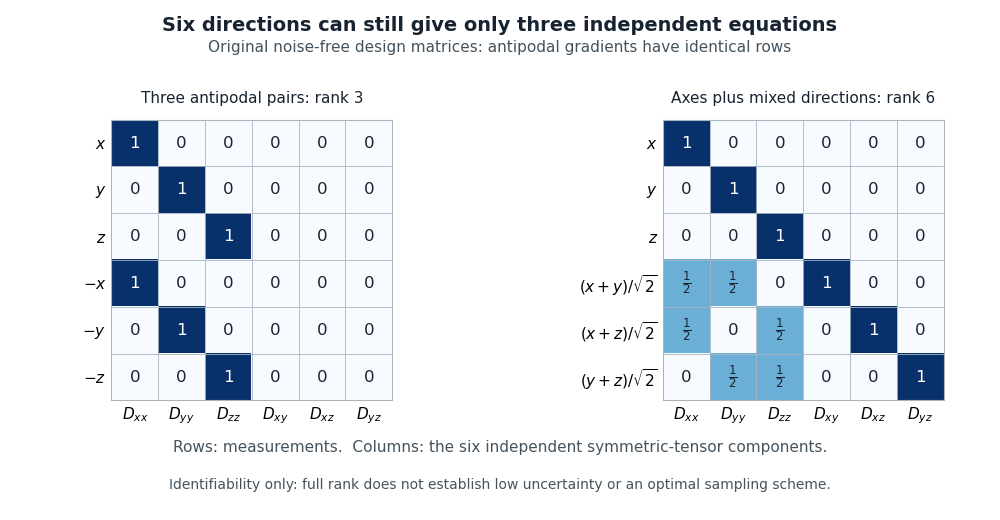
Original design-matrix example: antipodal axes give rank three, while axes and mixed directions give rank six
. Reused algebra illustration, not a reconstruction of a published acquisition or simulation. Rows represent measurements; columns represent the six independent tensor coefficients. Details.
Full matrix rank is not a guarantee of a stable estimate in noisy data. If must also be fitted, its logarithm is another unknown; the augmented signal model needs a corresponding independent baseline constraint. The six-coefficient argument above explicitly assumes is separately known. Likewise, tractography requires additional interpretation beyond uniqueness of a local tensor.
Articles by others on the same topic
There are currently no matching articles.