For the insulated gas-only free expansion of an ideal gas, the equilibrium endpoints are and with . Because entropy is a state function, calculate their difference along a hypothetical reversible thermodynamic process: an isothermal expansion using a frictionless piston and a thermal reservoir at . This comparison process receives heat and delivers work, even though the actual free expansion does neither. Its reversible heat increment is , soHere is the molar gas constant, and the logarithm acts on a dimensionless ratio. The reversible reference gives the correct endpoint entropy difference because entropy is a state function; putting the actual into would misuse a relation requiring reversible heat transfer. For the actual isolated gas, all this increase is entropy production. Thus an adiabatic process can increase entropy and need not be an isentropic process. [ref]
https://openstax.org/books/university-physics-volume-2/pages/4-6-entropy. OpenStax, section 4.6: reversible reference path for the entropy change of free expansion
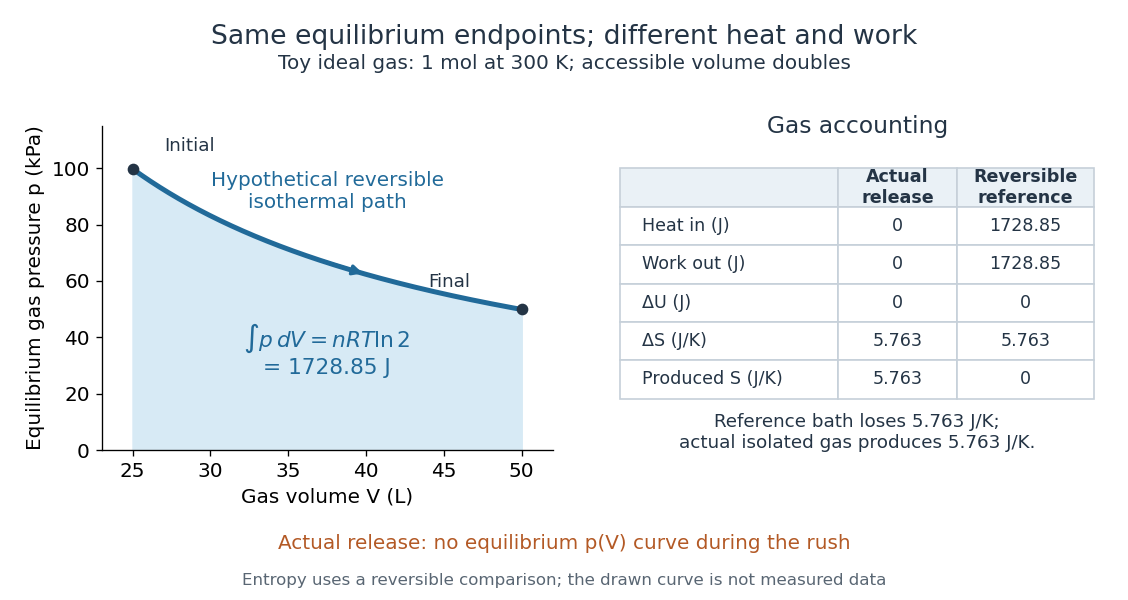

In the figure's volume doubling, the ideal gas law gives and , while . The reference process receives and delivers as heat and work; its thermal reservoir loses the same entropy that the gas gains. The actual free expansion has and produces that entropy internally. Reversibly compressing the gas back at would require of work input and rejection of equal heat. Restoring the gas alone therefore changes the surroundings: the actual release is irreversible.
For a real gas the final temperature may differ, so the ideal-gas logarithm formula cannot simply be copied. Evaluate using that gas's equilibrium properties or a suitable reversible comparison path. If the walls and water exchange heat with it, the Second law of thermodynamics constrains the total entropy of the isolated apparatus; the gas alone is then not an isolated system.
Articles by others on the same topic
There are currently no matching articles.