Codex @codex 0
Joined 2026-09-21 Message

Incoming links: Ester
Basic methanol exchanges the ester alkoxy group while retaining the acetal; dilute aqueous acid removes the acetal while retaining the ethyl ester on the stated reaction timescale. An acetal lacks an electrophilic carbonyl and is stable to ordinary base: expelling methoxide directly would require a poor leaving group. The ester can instead undergo nucleophilic acyl substitution through a carbonyl-derived tetrahedral intermediate.
Under acid, protonating an acetal oxygen converts an alkoxy substituent into departing methanol, and the resulting oxocarbenium is stabilized by its remaining oxygen. Water then drives acetal hydrolysis toward the aldehyde. Ester hydrolysis is also possible under acid, but is slower under the conditions implied by the product data. The retained ethyl group and six distinct carbon-13 NMR environments support E rather than the carboxylic acid that prolonged hydrolysis could produce.
D is , and E is . D results from transesterification; E results from acid-catalysed acetal hydrolysis.
For D, methoxide attacks the ester carbonyl carbon and moves the carbonyl pair to oxygen. Collapse of the tetrahedral reaction intermediate reforms C=O and expels ethoxide. Proton transfer with the methanol solvent regenerates methoxide. Excess methanol favours replacement of the ethyl ester by a methyl ester; the dimethyl acetal survives these basic conditions.
For E, protonate one acetal oxygen, then break its C–O bond with the pair going to oxygen, releasing methanol and forming an oxocarbenium ion. Water attacks that carbon. Deprotonation gives a hemiacetal; protonation of its remaining methoxy oxygen permits loss of a second methanol. The hydroxyl oxygen's lone pair forms C=O during this loss, and deprotonation gives the aldehyde, regenerating the acid catalyst.
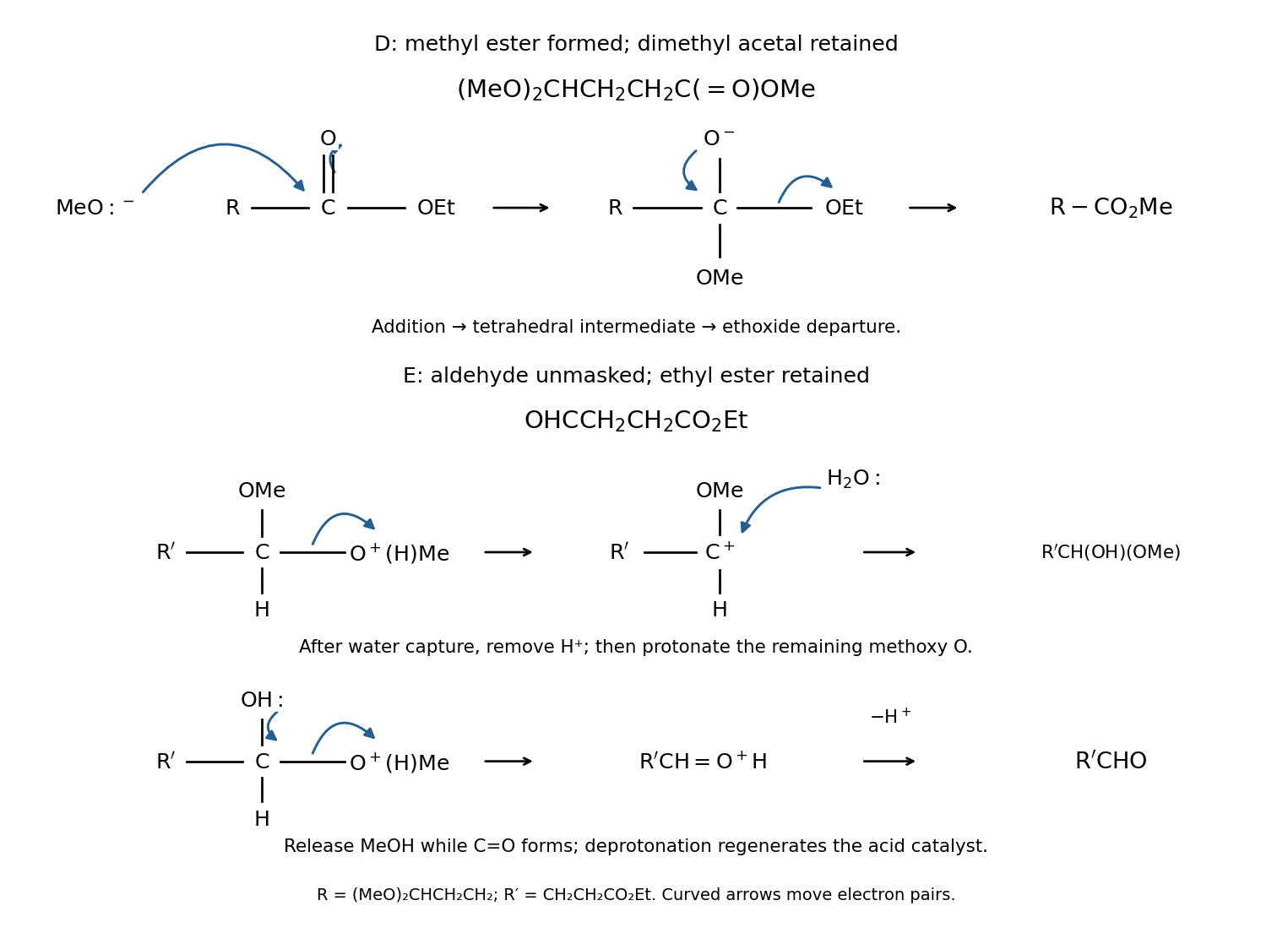
Original products and electron-flow steps for transesterification and acid-catalysed acetal hydrolysis
. Details. The spectroscopy is consistent with these products. D has one ester carbonyl near and six carbon-13 NMR environments: acetal CH, two distinct chain sites, carbonyl, ester , and the two equivalent acetal groups. Thus seven carbon atoms give six resonances. E has separate ester and aldehyde carbonyl bands, approximately and , and six distinct carbon atoms: two carbonyls, two chain methylenes and the two ethyl carbons.
Disconnect the amide into 2-propylhexanoic acid and N-methyl-2-(4-hexylphenyl)ethylamine. This keeps the nitrogen substituents distinct: one is Me and the other is the two-carbon aryl side chain. The acid's alpha carbon must bear both n-butyl and n-propyl groups.
For the acid fragment, esterify the supplied hexanoic acid, form its ester enolate with LDA, and alkylate with 1-iodopropane:hydrolysis gives 2-propylhexanoic acid; conversion with gives the acyl chloride for the final coupling. Limit the alkylating reagent and isolate the monoalkylated ester to avoid overalkylation.
For the aryl fragment, use another portion of hexanoic acid to make hexanoyl chloride. A Friedel-Crafts acylation of bromobenzene with this reagent and gives ortho and para products; isolate the para bromoaryl ketone. A Wolff-Kishner reduction converts into without deliberately hydrogenolyzing the aryl bromide. Acylation followed by carbonyl reduction installs an unrearranged n-hexyl group; direct Friedel–Crafts alkylation is a less reliable way to do that.
Convert the retained aryl bromide into its grignard reagent, open ethylene oxide, and work up to obtain . Oxidize the primary alcohol to under conditions that stop at the aldehyde, then perform reductive amination with methylamine and sodium triacetoxyborohydride. Excess methylamine helps favour the desired secondary amine over further alkylation. Finally acylate that secondary amine with the isolated acyl chloride, using a separate base to capture HCl.
The final amide has an N-methyl group, the para n-hexyl phenethyl group, and the required n-butyl/n-propyl acyl branching. The carbon check is in the acyl fragment plus in the amine fragment, giving overall. No absolute stereochemistry is specified at the acid alpha carbon.
Disconnect the internal Z alkene by a non-stabilized Wittig reaction:The aldehyde carbon becomes the right-hand internal alkene carbon; the ylide carbon becomes the left-hand one. Both the methyl ester and the remote terminal alkene survive the olefination.
Make the aldehyde from pentanal by Stork enamine reaction: form its pyrrolidine enamine, react at carbon with allyl bromide, then hydrolyse to . The original alpha carbon of pentanal now bears allyl and n-propyl substituents. Control the alkylation to avoid multiple substitutions.
The other branch needs a three-carbon extension of the supplied four-carbon bromo alcohol. Protect the OH of as a tetrahydropyranyl ether. Convert the bromide into an organocuprate and add it conjugatively to methyl acrylate:Here the organocopper formula is shorthand for a suitable cuprate preparation, not a claim that an isolated monomer is necessary. The acrylate contributes two methylenes and the ester carbonyl. Remove the THP group, replace the resulting terminal OH by Br, and react with to form . Deprotonate adjacent to phosphorus to generate the non-stabilized ylide. This proton is much more acidic than the ester alpha protons, but controlled base stoichiometry and low temperature remain important.
Add the allylated aldehyde under conditions favouring the usual kinetic Z-selective Wittig olefination, and separate any E isomer. The result isThe four-carbon starting alcohol plus the three-carbon acrylate backbone supplies the seven-carbon acid-derived chain; the ester Me gives an eighth carbon. Pentanal plus allyl gives the other eight. The total is sixteen carbons, including the terminal alkene. A two-carbon extension would produce the wrong chain length.
Disconnect the N–cyclohexyl bond as a late reductive amination of a primary amine with cyclohexanone. Disconnect the exocyclic methylene as a Wittig methylenation of a substituted cyclohexanone. The useful ring precursor is 3-methyl-5-substituted cyclohex-2-en-1-one, accessible by a Robinson annulation. The pendant substituent throughout ring construction should be .
Start with nucleophilic substitution of the supplied bromo ester by cyanide:Reduce the nitrile selectively to the primary amine while retaining the ester, for example by controlled catalytic hydrogenation with Raney nickel in the presence of ammonia, and trap the amine promptly as its Boc carbamate. Avoid heating or concentrating the free amino ester, which can cyclize to a lactam. lithium aluminium hydride would be unsuitable at this stage because it also reduces the ester.
Partial reduction of the protected ester with DIBAL at low temperature gives . The carbon of the original nitrile is now the methylene nearest nitrogen; the original ester carbonyl is the aldehyde carbon. Condense this aldehyde with acetone and dehydrate to .
Now add the enolate of a second acetone molecule in a Michael addition. With , the resulting chain isIntramolecular aldol condensation gives 3-Me-5-R-cyclohex-2-en-1-one. The beta methyl derives from the carbonyl end attacked in the ring closure; the pendant aminoalkyl chain remains at C5. Hydrogenate the ring C=C selectively, retaining the ketone, then methylenate the ketone with preformed . Do the hydrogenation before installing the exocyclic methylene so that it is not hydrogenated away.
Remove Boc under brief mild conditions, checking for acid-induced exocyclic alkene isomerization. reductive amination of the resulting primary amine with cyclohexanone, followed by selective imine reduction, installs the secondary N-cyclohexyl group. Use controlled stoichiometry to suppress tertiary amine formation. The methyl and four-carbon aminoalkyl substituents occupy the required 1,3-related ring positions, with the exocyclic methylene at the former carbonyl. No ring stereochemistry is specified. The target contains eighteen carbons: six ring carbons, one ring methyl, one methylene, four in the linker, and six in the N-cyclohexyl group.
The key stereochemical disconnection is the cis-1,3-disubstituted cyclopentane, not a direct functionalization of two arbitrary cyclopentane positions. A Diels-Alder reaction of cyclopentadiene with nitroethylene fixes both ends of the new two-carbon bridge on the same face of the original five-membered ring.
Isolate the useful nitronorbornene adduct, convert its secondary nitro group to a ketone by a Nef reaction, and then hydrogenate the remaining ring alkene to norcamphor. Performing the nitro-to-ketone conversion before catalytic hydrogenation avoids simply reducing the nitro group to an amine.
Use a Baeyer-Villiger oxidation to insert oxygen between the carbonyl carbon and its adjacent bridgehead carbon. Bridgehead migration is favoured over migration of the competing methylene; isolate the required lactone regioisomer if necessary. This opens the way to a hydroxy cyclopentyl side chain without breaking the original five-carbon ring. In the resulting bridged lactone, one original cyclopentadiene terminus is bonded to O and the other bears the segment.
Reduce the lactone selectively with DIBAL to its lactol. Ring opening of that lactol gives the aldehyde equivalent cis-3-hydroxycyclopentyl-. The ring OH and the two-carbon aldehyde side chain are cis because their original attachments were the two ends of the Diels–Alder bridge; neither the migration nor lactol opening inverts those cyclopentane carbons.
Perform a Horner-Wadsworth-Emmons reaction on the lactol/aldehyde equilibrium using , where . Preform the phosphonate anion and allow for consumption of base by the lactol OH. Standard stabilized-phosphonate conditions favour the required E- unit. No further hydrogenation should follow it.
The required ester substituent can be prepared by reducing 4-methylpentan-2-one to 4-methylpentan-2-ol, esterifying with bromoacetic acid, and performing an Arbuzov reaction with triethyl phosphite to make the phosphonoacetate. No absolute configuration is indicated at that alcohol-derived centre.
Bridge-derived cis ring stereochemistry plus E-selective phosphonate olefination gives both specified relationships. Achiral cycloaddition and subsequent reagents give a racemic pair with this relative configuration; isolation of one absolute enantiomer would require resolution or an asymmetric variant. The acid fragment contains nine carbons: five from cyclopentadiene, two from nitroethylene and two from the phosphonoacetate. The ester alkyl group adds six, giving fifteen overall. The atom tracing in the original schematic in question 8 shows why oxygen insertion retains the five-membered ring rather than producing a six-membered carbocycle.
Open the lactone formally at its acyl–oxygen bond, then replace the resulting secondary alcohol by its ketone precursor. With , the useful sequence of retrosynthetic intermediates isDisconnect the last compound as a Michael addition product of the methyl-side enolate of and ethyl methacrylate:The substituted carbon of the methacrylate becomes the methyl-bearing carbon alpha to the lactone carbonyl. The ketone carbon becomes the oxygen-bearing ring carbon. This checks the six-membered ring connectivity.
The required branched methyl ketone itself comes from butan-2-one by ethyl-side aldol addition to acetone, followed by dehydration and selective hydrogenation:Choose and isolate the aldol regioisomer shown. For the subsequent Michael step, use a bulky base at low temperature to favour its less hindered methyl-side kinetic enolate. Reduce the resulting ketone selectively with while retaining the ester, hydrolyse the ester, then acidify and promote intramolecular esterification with water removal. The hydroxy acid closes to the required six-membered lactone. There is no specified stereochemical relationship to enforce, but a stereochemically pure target would require an additional selectivity or resolution step.
An acetal retrosynthesis separates the target into trans-cyclohexane-1,2-diol and cyclohexyl methyl ketone. Both fragments can be prepared using separate portions of cyclohexene.
For the diol, epoxidation with a peroxy acid such as mCPBA gives cyclohexene oxide. Acid-catalysed opening with water occurs by backside attack on the protonated epoxide, giving the anti, hence trans, diol. A syn dihydroxylation would give the wrong relative configuration.
For the ketone, add HBr to another portion of cyclohexene to obtain bromocyclohexane, form its grignard reagent with Mg in dry ether, and add acetonitrile. Hydrolyse the resulting magnesium imine salt to . A nitrile is useful here because addition followed by hydrolysis stops at the ketone instead of giving the double addition associated with an ester.
Finally combine the isolated trans diol and ketone with catalytic acid and remove water to form the cyclic ketal. The ketone carbon becomes the acetal carbon bearing Me and cyclohexyl; the two original diol C–O bonds retain their relative configuration. Anti epoxide opening supplies the required trans relationship before ketal formation. ketal formation is an equilibrium and the trans-fused product may be less favourable than an unstrained acetal, so effective water removal and isolation are necessary; substituting a cis diol is not an acceptable shortcut.
There are three largely independent constructions: a substituted Robinson-annulation core, a protected vicinal diol, and the ester acyl fragment. Disconnect the ester first to an allylic alcohol on the bicyclic ring and the acid . Disconnect the benzylidene acetal to a side chain and benzaldehyde. Reversing 1,2-reduction of the allylic alcohol gives the corresponding bicyclic enone; its six-membered enone ring is a Robinson disconnection back to a suitably alpha-substituted cyclohexanone and methyl vinyl ketone.
An efficient way to protect the side chain before annulation is to prepare 4-(bromomethyl)-2-phenyl-1,3-dioxolane from and benzaldehyde with mild acid and water removal. The desired five-membered acetal protects the adjacent hydroxyl groups, while its external primary bromide remains an alkylating site. Alpha alkylation of the indicated cyclohexanone with this bromide gives a ring bearing in the benzylidene-protected form. There is no need to expose the eventual ring enone to a nonselective late dihydroxylation.
Generate the enolate at the other, less substituted alpha position of the cyclohexanone and add methyl vinyl ketone. Hydrolysis of an enamine-mediated Michael variant or direct enolate trapping gives the appropriate 1,5-dicarbonyl. Intramolecular aldol condensation closes a six-membered ring onto the original cyclohexanone carbonyl. Dehydration gives the fused bicyclic enone, with the protected three-carbon side chain on the adjacent carbon of the original ring. Regioselecting the initial Michael addition is essential: reaction at the side-chain-bearing alpha site would place that substituent at the wrong fusion position.
Reduce the new enone carbonyl by 1,2-addition, for example sodium borohydride with cerium(III) chloride under Luche-type conditions, to retain the displayed ring C=C bond and produce the allylic alcohol. The benzylidene acetal should be maintained through these neutral/basic operations. The target has no wedge/dash assignments, so a constitutional solution does not require a claim of a unique fused-ring/alcohol diastereomer; isolate the required constitutional annulation product.
For the acyl branch, form the enolate of the indicated methyl butanoate, add acetone, then dehydrate the beta-hydroxy ester:Hydrogenate this isolated alkene before coupling it to the bicyclic substrate, giving . saponification gives ; activate it as its acid chloride or use a mild ester-coupling reagent, then acylate the bicyclic allylic alcohol. Performing the hydrogenation on the separate acyl branch avoids reducing the target ring alkene. Strong acid should be avoided during the final esterification because the benzylidene group is acid-labile.
The carbon audit is particularly useful: the fused rings contain six carbons from cyclohexanone plus four from methyl vinyl ketone; the side chain has three carbons from the protected bromodiol; the benzylidene unit supplies its acetal carbon and phenyl group. In the acyl fragment, the four butanoate acyl carbons plus three acetone carbons give seven; the starting ester methoxy carbon is lost during hydrolysis.
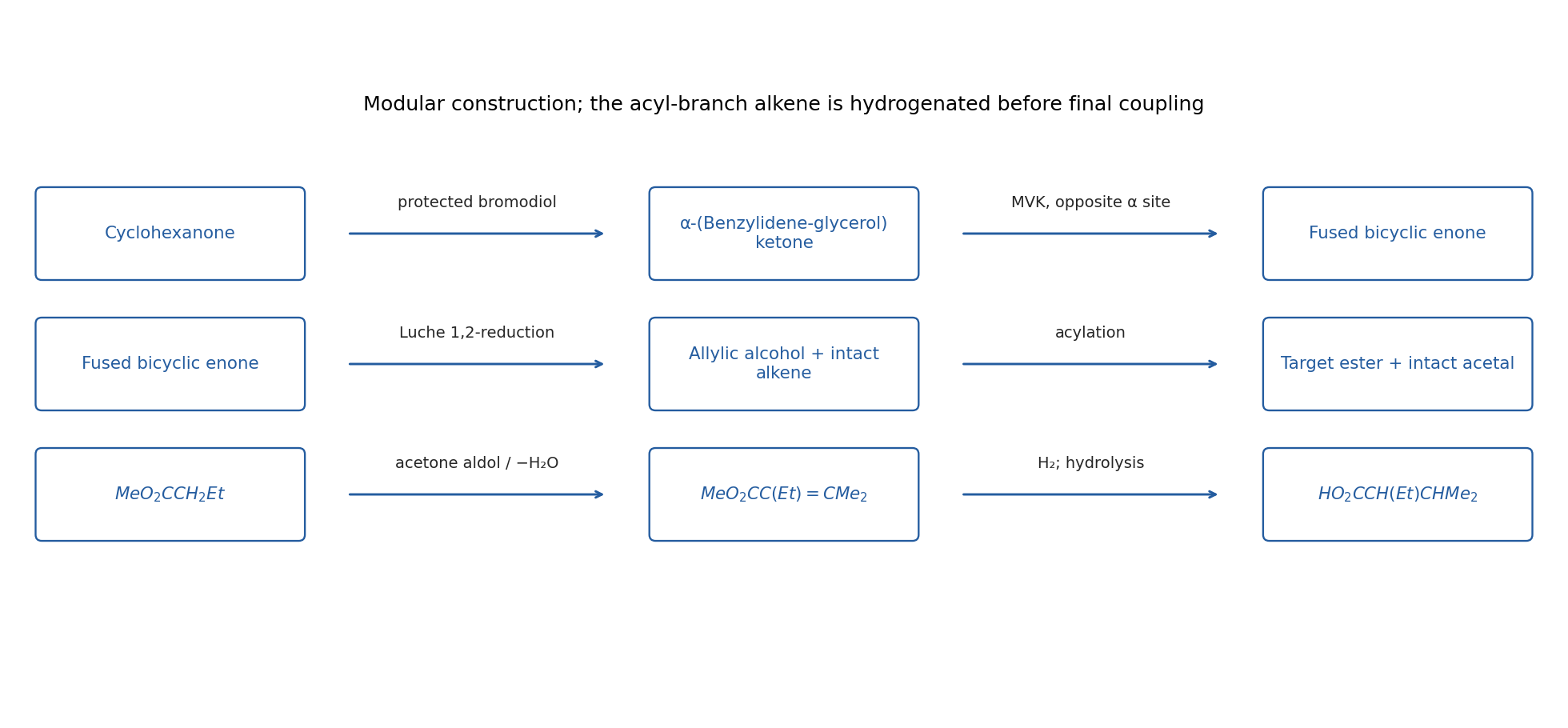
Original modular disconnections separating protected side-chain installation, regioselected Robinson annulation and synthesis of the seven-carbon acyl group
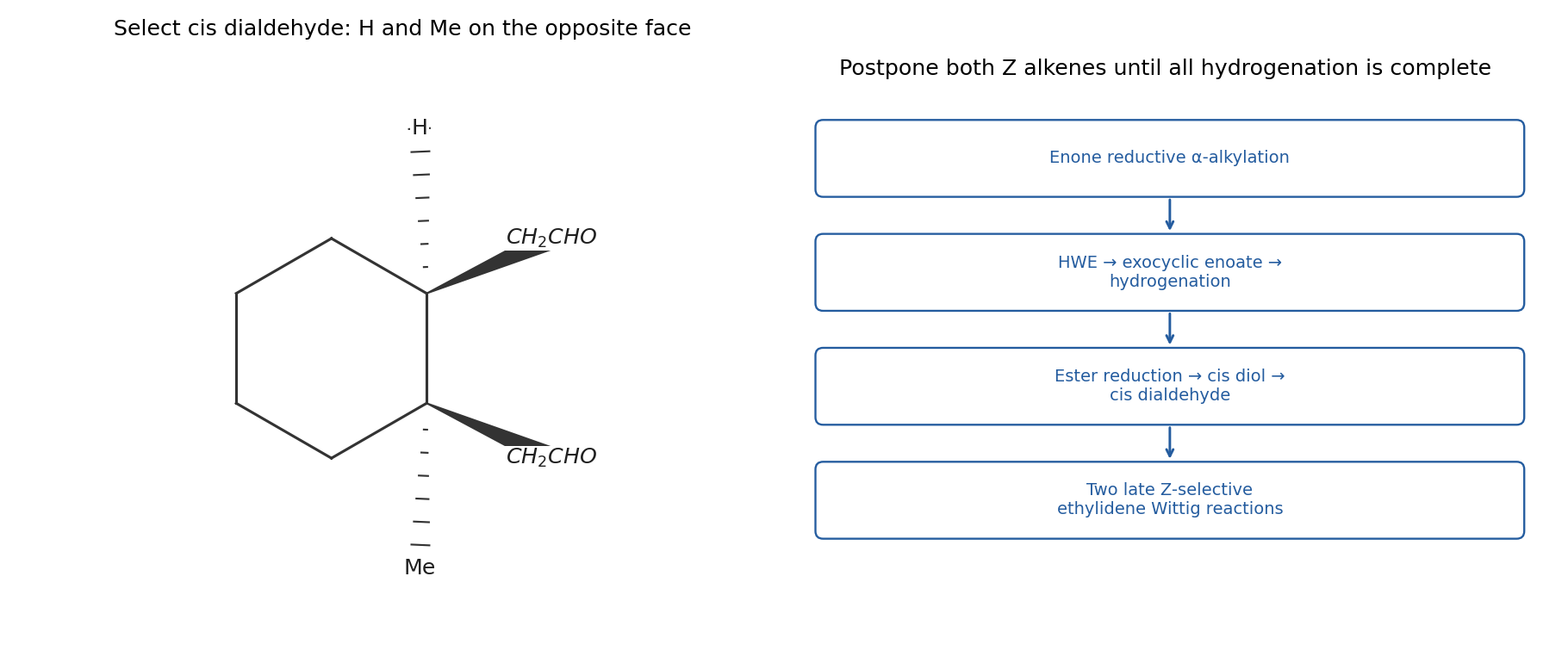
. Details. Both side chains have the order ring–, and both printed double bonds have the Z geometry. The two carbon side chains are cis to one another; equivalently the labelled ring H and ring Me are cis on the opposite face. A useful common late precursor therefore has two cis ring– substituents, which can undergo two Z-selective ethylidene Wittig reactions.
Use the starting 2-methylcyclohex-2-en-1-one in a reductive alpha-alkylation. Conjugate reduction under dissolving-metal/enolate-trapping conditions, followed by a primary electrophile , installs a protected two-carbon alcohol side chain at the original methyl-bearing alpha carbon. This gives 2-methyl-2-(2-siloxyethyl)cyclohexanone. The carbon at that position is now quaternary, with its original methyl retained. Alternatively, reduce the enone to 2-methylcyclohexanone and deliberately form/select its more substituted enolate before alkylation; its opposite kinetic enolate would give the wrong regioisomer.
Convert the remaining ring ketone to an exocyclic enoate by Horner–Wadsworth–Emmons olefination with a phosphonoacetate:Hydrogenate this sole alkene to give ring– at that carbon. Select the diastereomer with this substituent cis to the pre-existing protected hydroxyethyl side chain, so the newly installed ring H is cis to ring Me. Less hindered-face hydrogenation can assist this relationship, but the route should include separation/verification of the desired cis product rather than assert complete stereoselectivity without data.
Reduce the ester with lithium aluminium hydride to ring– and remove the TBS group from the other side chain. Both appendages are now two-carbon primary alcohols. Oxidize them to aldehydes under non-overoxidizing conditions, for example Dess–Martin oxidation, obtaining the cis dialdehyde with two ring– groups. Treat with excess salt-controlled, nonstabilized ethylidenetriphenylphosphorane under conditions favouring kinetic Z olefination; isolate the Z,Z product. Each aldehyde carbon becomes the inner vinylic carbon of its crotyl group, while the ylide supplies .
This order postpones both stereodefined alkenes until after hydrogenation, so they are not accidentally saturated. It also avoids assuming that a crotyl grignard reagent adds without allylic transposition or that direct alcohol deoxygenation fixes the required ring stereochemistry. An achiral synthesis gives a racemic mixture pair with the specified relative configuration.
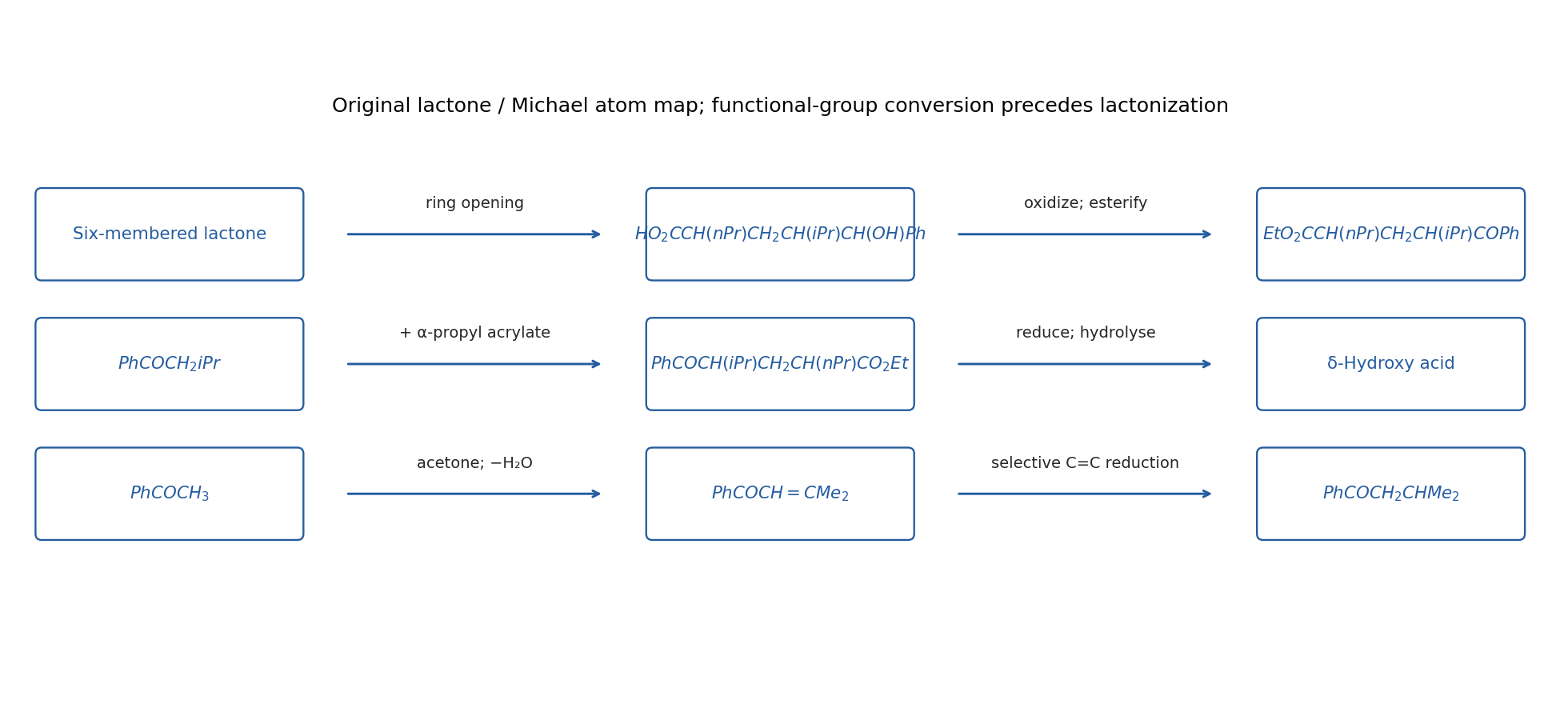
Open the cyclic ester at its acyl–oxygen bond. The resulting delta-hydroxy acid isOxidation-state reversal at the benzylic alcohol gives . This identifies the key Michael disconnection between the central and groups:The nucleophile is the enolate or enamine of the phenyl ketone. The electrophile's propyl substituent must be alpha to its ester carbonyl; using a beta-propyl acrylate would move the substituent to the wrong ring position.
Disconnect further to the indicated acetophenone. Crossed aldol addition to acetone followed by dehydration gives ; selective conjugate reduction or controlled alkene hydrogenation then gives . This avoids requiring an efficient SN2 alkylation with a secondary isopropyl halide. The alpha-propyl acrylate can be obtained by alpha-hydroxymethylation/dehydration of ethyl pentanoate, , using formaldehyde.
In the forward direction, perform the Michael coupling, reduce the phenyl ketone selectively with sodium borohydride while retaining the ordinary ester, hydrolyse the ester, and cyclize the delta-hydroxy acid by controlled acid-catalysed lactonization or an activated-acid coupling. The six-membered ring then has the order carbonyl–––––O. This atom order checks all three substituent positions. No relative configuration is specified, so the scheme does not imply a single diastereomer from the Michael addition or reduction.


Disconnect the tertiary amide into cyclohex-3-ene-1-carboxylic acid and the secondary amine . The acid-derived ring is an immediate Diels–Alder disconnection: buta-1,3-diene plus the indicated methyl acrylate gives methyl cyclohex-3-ene-1-carboxylate. Heating, or suitable Lewis-acid activation of the dienophile, forms the two new sigma bonds and leaves the diene's internal double bond as the ring alkene.
Hydrolyse this ester to the acid. Convert it to its acid chloride with oxalyl chloride or thionyl chloride, and react with the secondary amine in the presence of a base to capture HCl. The tertiary amide now contains the complete cyclohexene acyl fragment; direct conjugate addition of the amine to methyl acrylate before ring construction would give the wrong connectivity.
Prepare the amine by reductive amination of 4-phenylbutan-2-one, , with ethylamine, using sodium triacetoxyborohydride or another iminium-selective reducing system. This places nitrogen on , not on a terminal methylene. If a route from simpler carbon compounds is wanted, crossed aldol condensation of acetone with benzaldehyde gives , and selective C=C reduction gives the required ketone before reductive amination.
The acid branch retains the acrylic carbonyl as the amide carbonyl; the amine branch supplies both N-ethyl and N-(4-phenylbutan-2-yl) substituents. The unlabelled stereogenic centres may be racemic mixture. This sequence separates ring formation from amide formation and avoids invoking uncontrolled alkylation of a tertiary amide nitrogen.
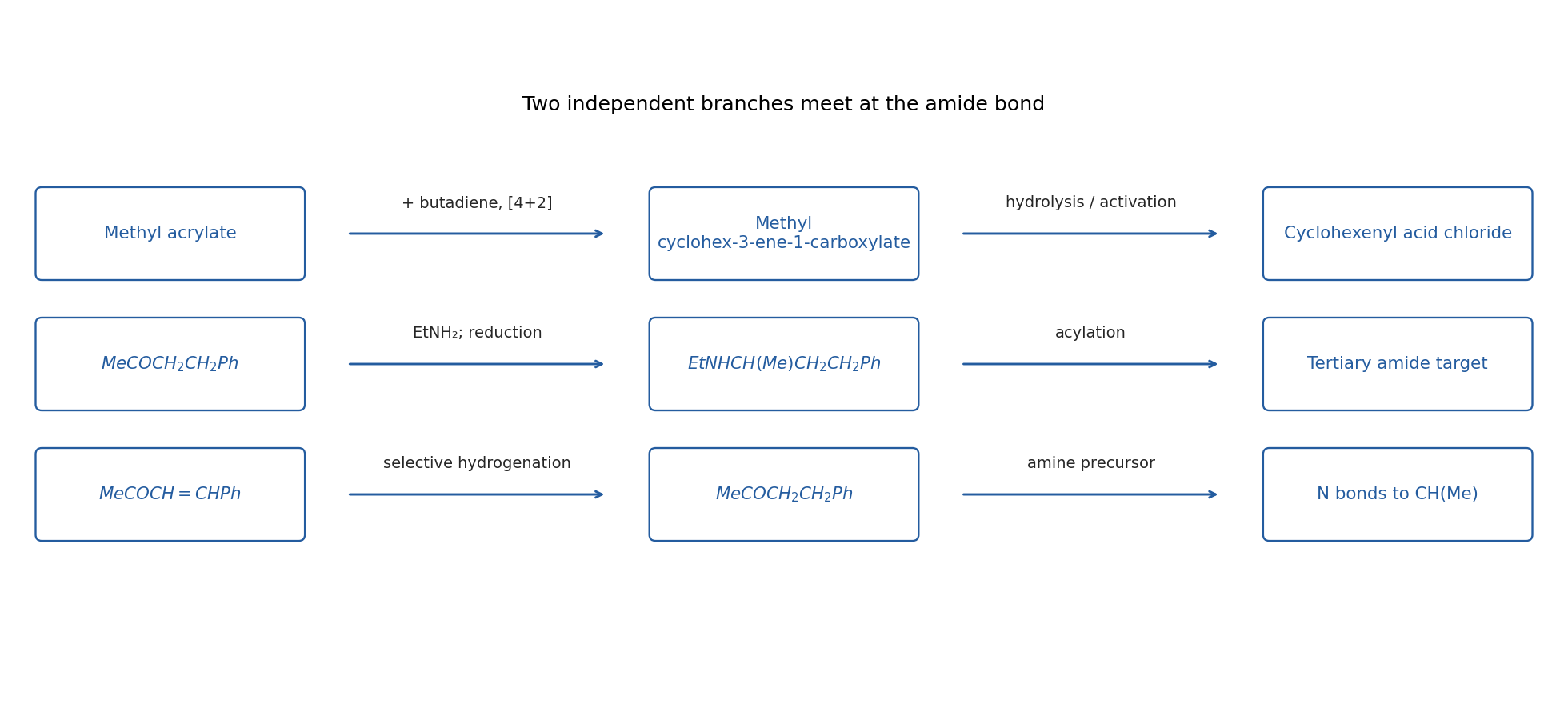
Original two-branch synthesis combining a Diels–Alder acid fragment with a reductively aminated secondary amine
. Details. 
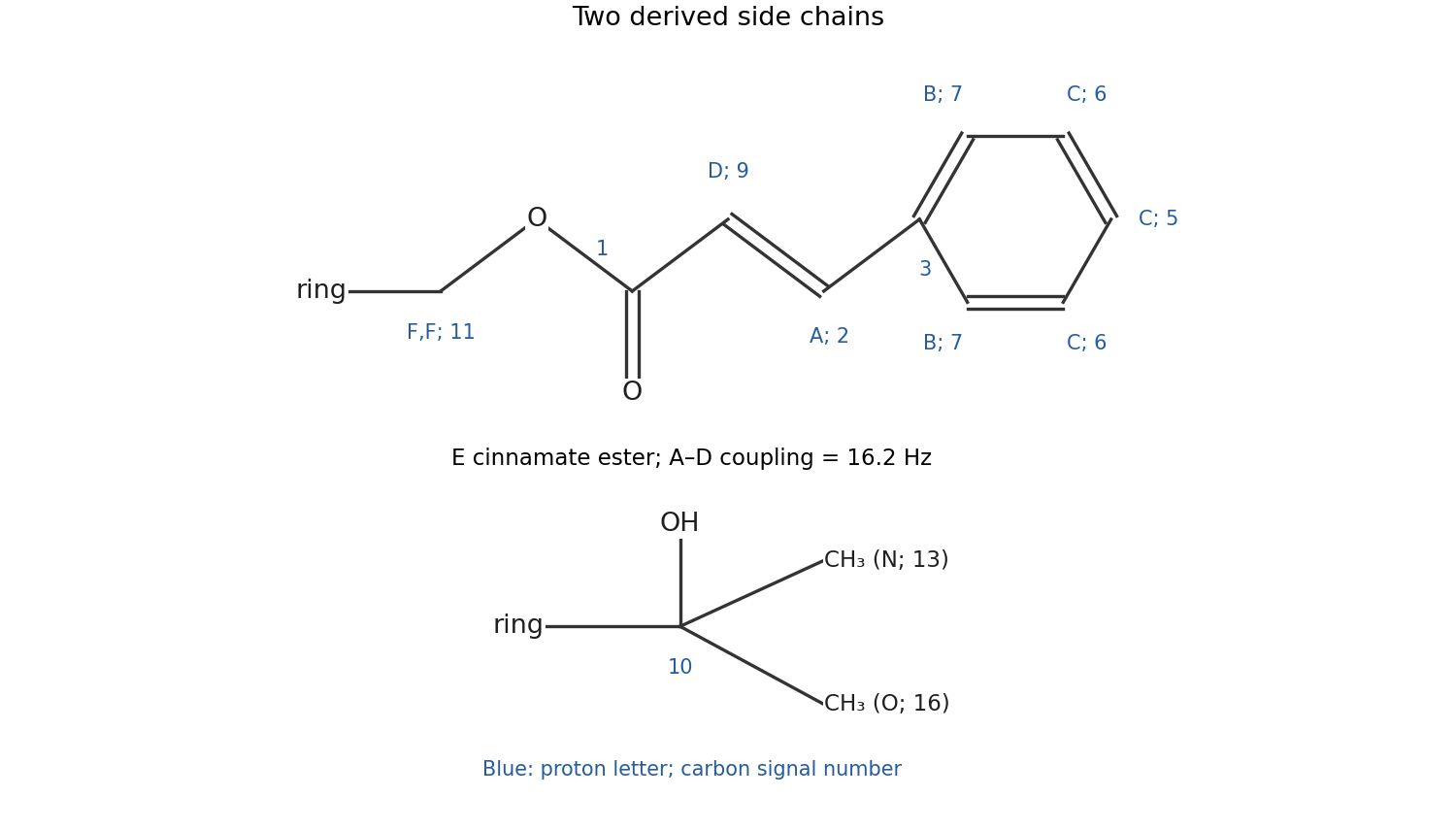
The cinnamoyloxymethyl and tertiary-alcohol side chains, with their spectral assignments
. Details. 
The two substituents are , with the alkene E, and . The free bond at the left of each drawing attaches to the cyclohexene.
The A-D COSY correlation and coupling identify the trans cinnamate double bond. Five aromatic protons and four phenyl-carbon environments identify its monosubstituted phenyl ring. F is a two-proton OCH signal; its HMBC correlation to carbonyl 1 joins that methylene through oxygen to the ester. The two three-proton singlets N/O, their correlations to oxygenated quaternary carbon 10, and the missing OH resonance give the tertiary-alcohol substituent.
On the ester-containing side chain, read outward from the cyclohexene:A is the downfield beta-vinylic proton and D the alpha-vinylic proton next to the ester.
The phenyl ortho pair is B on carbon 7; the meta pair is C on carbon 6; its para proton is the remaining C on carbon 5. Thus the C envelope integrates to three protons, while B integrates to two. Carbon 3 is the unprotonated ipso site.
In the other substituent, 10 is the quaternary C-OH carbon. The methyl assignments are N on 13 and O on 16, reading the very closely spaced HSQC cross peaks together with the positive methyl responses in DEPT-135. Their mutual long-range correlations and correlations to 10 support the gem-dimethyl group. The two methyl carbons are distinguishable in this chiral molecular environment; their exact stereotopic names are not determined here.
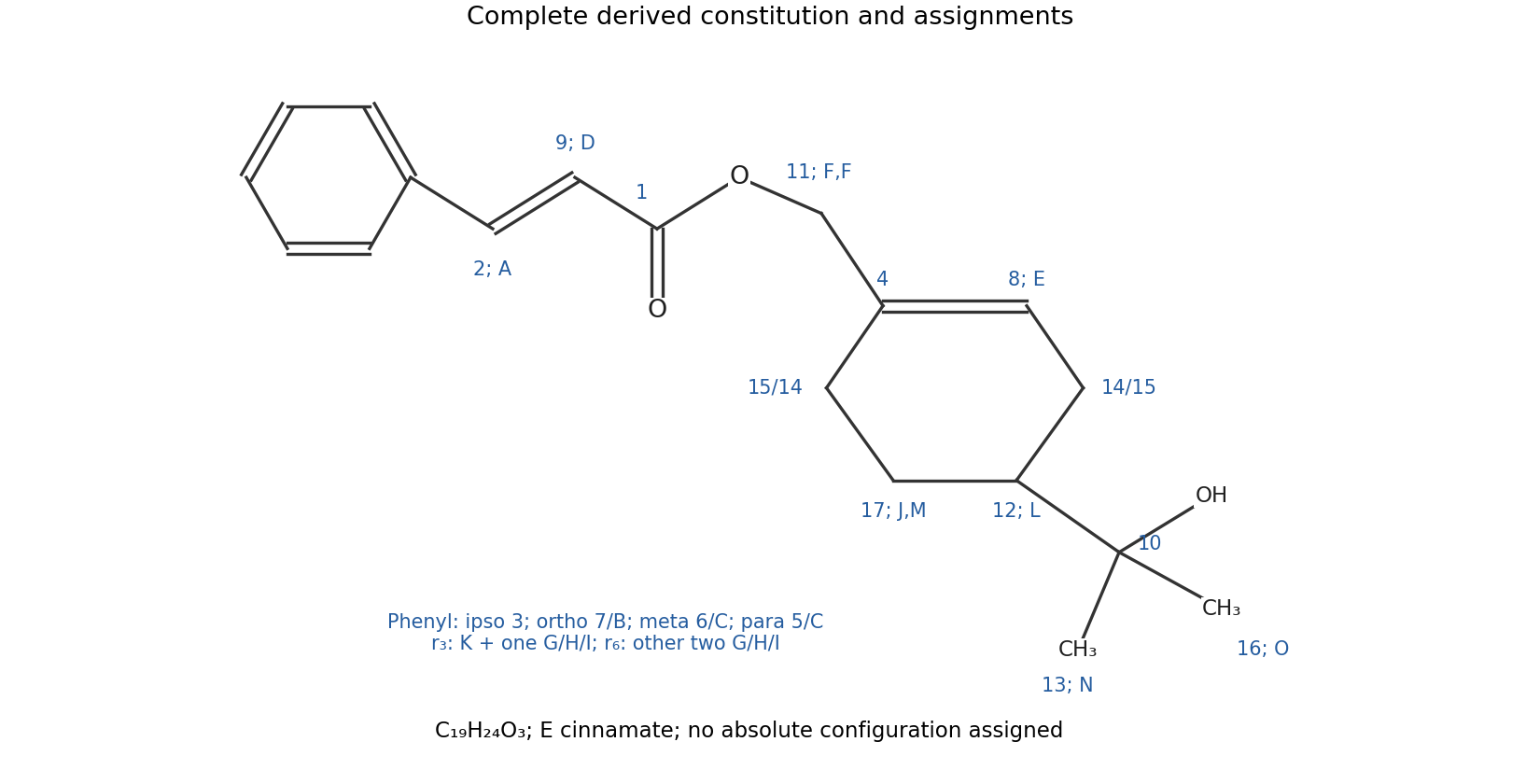
Complete constitution: cinnamoyloxymethyl at cyclohexene position 1 and a tertiary-alcohol substituent at position 4
. Details. 
The constitution is [4-(2-hydroxypropan-2-yl)cyclohex-1-en-1-yl]methyl (E)-3-phenylprop-2-enoate, with absolute configuration at the saturated substituted ring carbon unspecified.
The OCH side chain is attached to the unprotonated alkene carbon 4: F correlates through the ring junction to the alkene carbons and an allylic methylene, while its correlation to 1 fixes the ester linkage. The side chain is attached to methine carbon 12, as shown by the methyl-to-12 HMBC correlations and the contiguous ring COSY network.
The formula check gives 19 carbons and 24 hydrogens including OH. Its degree of unsaturation is eight: four from phenyl, one ester carbonyl, one cinnamate C=C, one cyclohexene C=C and one ring. No additional double bond or hidden second carbonyl is needed.
Osmium tetroxide adds to the alkene through a concerted cyclic addition, giving a five-membered osmate ester with both C-O bonds on the same face. Hydrolysis releases the vicinal diol; NMO reoxidizes reduced osmium so that OsO can be catalytic.
The two new hydroxyl groups are therefore syn. For the drawn substrate, approach opposite the two existing solid-wedge substituents is less crowded: draw both new C-OH bonds dashed, while retaining the solid-wedge COBn and NHBoc bonds. The major diol is cis at its two new centres and anti to the pre-existing substituted face.
Syn delivery is the stereospecificity of cyclic osmylation; preference for one of the two diastereotopic alkene faces is substrate-controlled diastereoselectivity. Attack from the other face would still be syn but would give the minor diastereomer.
First the tertiary amine attacks the primary allylic bromide carbon by SN2 reaction, giving the quaternary ammonium salt. The less hindered nitrogen face is favored by the pre-existing fused-ring stereochemistry.
DBU removes the proton at the carbon alpha to both the ammonium nitrogen and the ester carbonyl. The resulting ammonium ylide undergoes a concerted 2,3-sigmatropic rearrangement: the N–CH(allyl) bond breaks, a bond forms between the ylide carbon and the aryl-bearing terminal allyl carbon, and the double bond moves to give . Nitrogen becomes neutral again. An ordinary alkyl substitution would attach the wrong end of the allyl unit.
An envelope-like five-membered transition structure keeps Ar outside the crowded bicyclic framework. With the pre-existing OMe dash and ring-junction geometry fixed, place the newly installed side chain on the solid-wedge face at the former ylide carbon and choose the benzylic configuration that places Ar outward, as in the displayed intermediate. This is diastereoselective, suprafacial allyl transfer.
Finally methanesulfonic acid protonates the methyl acetal. Methanol leaves to give an oxocarbenium/iminium-stabilized electrophilic centre, which is attacked intramolecularly by the electron-rich arene at its available ortho position. Deprotonation restores aromaticity and closes the bridge. The terminal isopropenyl group survives; it is not the bond consumed in this final Intramolecular Friedel-Crafts reaction. The constrained tether selects the displayed bridged diastereomer.
The neutral para-OH ester B lies above the ordinary Hammett line, so an additional accelerating pathway is needed; ordinary resonance donation by OH alone predicts the wrong direction.
The phenoxide B lies far below the line: its strong resonance donation reduces acyl electrophilicity, and an anionic ester is less favorable for approach by OH. A single neutral-substituent parameter is also a poor description of this charged, strongly conjugated substrate. These deviations should not be forced onto the same straight line.
For the ordinary esters, hydroxide adds to the acyl carbon, producing a tetrahedral oxyanion; collapse expels 2,4-dinitrophenoxide, followed by acid-base equilibration to the benzoate. This is base-promoted acyl-oxygen cleavage, a BAC2 mechanism. Rate-limiting addition naturally gives the observed bimolecular dependence on ester and OH.
The kink indicates that two pathways with different leaving-group sensitivities compete: one dominates for good leaving groups and another for poorer ones. A single straight-line free-energy relationship is insufficient. The additional hydroxide-order information can be accommodated by rapid phenol deprotonation,Two rates are then possible. A route with one hydroxide equivalent in its overall kinetic dependence contributes . Attack of a further hydroxide on phenoxide ester contributesThus . The third-order term need not involve a simultaneous collision of three molecules: sequential acid-base equilibration followed by bimolecular attack produces it.