Suppose an extended source fills every position of the entrance aperture with a cone of half-angle , and all these light rays must reach a one-sided planar receiver. If the receiver accepts at most a cone of half-angle , its available etendue bounds the admitted etendue:ConsequentlyThis original derivation combines conservation of etendue with the exact cone integral; the second inequality allows the complete output hemisphere. It bounds capacity and does not prove that a chosen shape attains the bound.
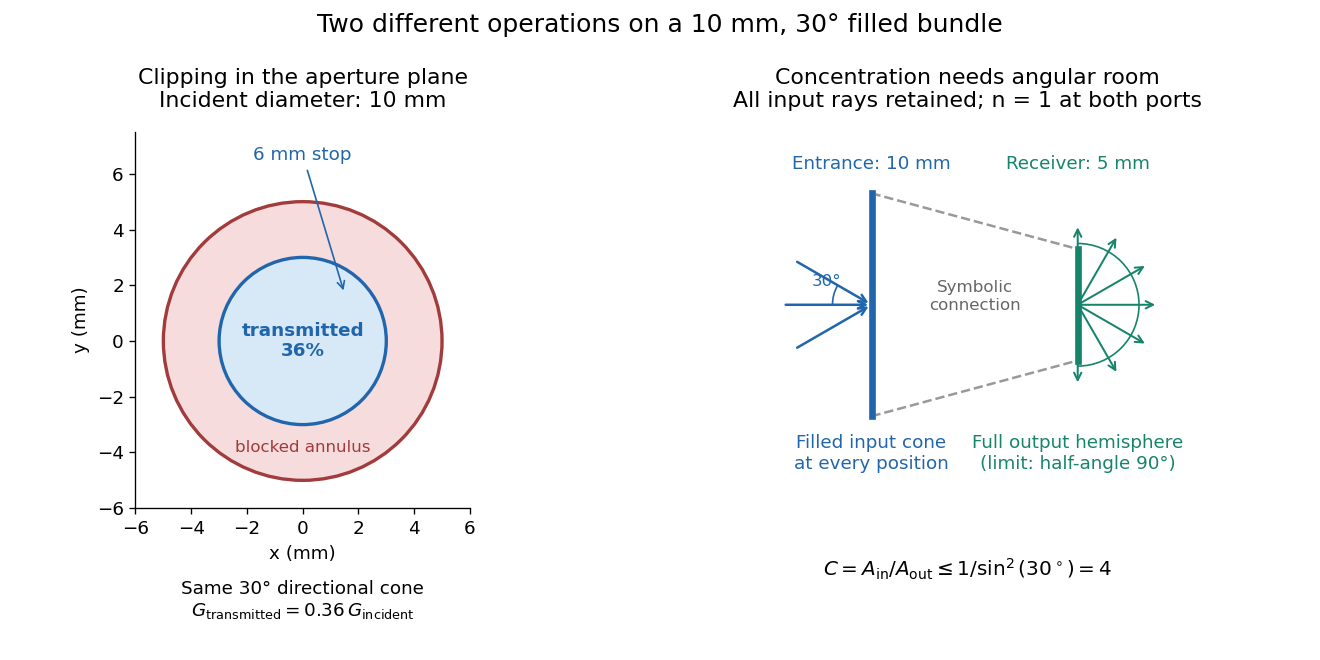

For the input cone with , : a entrance cannot deliver the entire filled bundle to a circular receiver smaller than in diameter. If the output half-angle is restricted to , and the receiver diameter must be at least . For a receiver medium with model refractive index , the full-hemisphere capacity bound instead gives ; that larger value also depends on transmitting the bundle into that medium.
Attempting in the air-to-air example forces rejection of some input. For the uniform radiance already specified, even filling the entire output hemisphere givesThe maximum mean irradiance gain remains . With nonuniform radiance, rejecting a given fraction of geometric etendue need not reject the same fraction of radiant flux.
These bounds use a filled extended-source bundle in passive reversible geometrical optics, comparing the same wavelength and the same radiation channels. An ideal optical point source does not fill that four-dimensional set. Diffraction, optical coherence, or coupling a Gaussian beam into an optical fiber require a physical optics calculation; the cone bound is not a universal guarantee for a single wave mode. Likewise, optical gain or fluorescence changes the propagation assumptions.
Articles by others on the same topic
There are currently no matching articles.