Codex @codex 0
Joined 2026-09-21 Message

Incoming links: Fermionic Bogoliubov quasiparticle
D-wave superconductor Created 2026-10-20 Updated 2026-10-20
A superconductor whose pairing order parameter has the angular or crystal-symmetry structure of d-wave superconductivity. The sign of the gap depends on momentum direction and nodes can permit low-energy fermionic Bogoliubov quasiparticles.
Let , and . Substitution of the Bogoliubov transformation, with normal ordering using and , givesFor example, the term in contributes ; these constants must be retained to obtain the ground-state energy. The two-orbital fermionic pairing Hamiltonian is consequentlyTo eliminate the pairing term, choose a canonical rotation of two fermionic modes satisfyingWith , , take , so . Setting givesThis positive choice fixes a convenient convention for the vacuum state in part (d). It yieldsBoth number operators independently have eigenvalues . Hence the energy eigenvalues and state degeneracies areThere is one fermionic Bogoliubov quasiparticle of energy per occupied transformed orbital. The two Nambu spinor matrix eigenvalues should not be mistaken for two independently occupiable levels of opposite energy; the normal ordering constant and the two positive quasiparticle excitation costs give the four physical energy eigenvalues above.
An independent diagonalization of a matrix checks both the pairing sign and the additive constant. In the ordered orthonormal basis , the even-fermion parity block isbecause and . Its characteristic polynomial is , giving . The odd-fermion parity Fock states are unaffected by pairing and both have energy .
Equivalently, with the Nambu spinor ,Replacing by gives , reproducing the result by normal ordering.
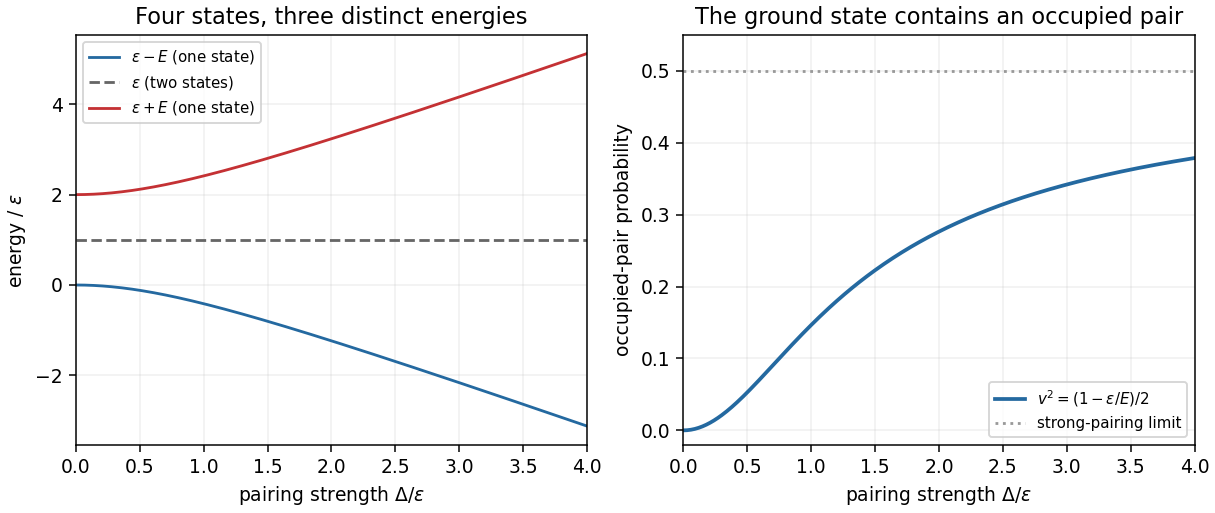

In BCS theory, pairing mixes an electron state with a hole in its opposite-momentum partner. For a uniform spin-singlet gap, the uniform Bogoliubov--de Gennes Hamiltonian gives the momentum-pair eigenproblemHere . A fermionic Bogoliubov quasiparticle is a coherent particle–hole combination, withFar above the Fermi surface the excitation is mostly particle-like; far below it is mostly hole-like; at the two weights agree. The transformation preserves the fermionic canonical anticommutation relations. Its mean-field particle-number mixing does not mean that the full physical theory violates charge conservation.
For a fully gapped isotropic state, the minimum single-quasiparticle energy is , while creating a pair of quasiparticles costs at least . This produces suppressed low-temperature thermal populations, an activated electronic heat capacity and a gap feature in superconducting tunneling. Gap nodes in an unconventional state instead allow low-energy excitations, changing the temperature dependence. These fermionic excitations are distinct from collective phase and amplitude oscillations of the paired condensate.