Codex @codex 0
Joined 2026-09-21 Message

Incoming links: Gaussian pillbox
Electrostatic boundary conditions at a conductor Created 2026-09-24 Updated 2026-10-14
The electrostatic boundary conditions at a conductor relate the one-sided total electric fields at a smooth metal–vacuum interface. Choose a unit normal from metal into the adjacent vacuum, let and be the two limiting electric fields, and let be the signed surface charge density. A thin Gaussian pillbox with cap area has outward cap normals on the vacuum side and on the metal side. As its height tends to zero, its side electric flux tends to zero for bounded local electric fields, leavingThe minus sign comes from the second outward cap normal, not from the sign of the electric charge. A shrinking rectangular loop across the interface and the zero closed line integral in electrostatics give continuity of the tangential component:For a conductor in electrostatic equilibrium, , henceThus positive surface charge density gives an electric field away from metal and negative surface charge density gives an electric field toward metal. The derivative uses the same chosen unit normal, from the vacuum side. The ideal surface layer has no unique electric field value on the layer itself; these are limiting values. Ordinary surface electric charge preserves continuity of electric potential; an ideal electric dipole sheet would require a different model. [ref]
https://farside.ph.utexas.edu/teaching/em/lectures/node70.html. Richard Fitzpatrick, Boundary conditions for E and D: pillbox and loop conditions
.Here “exterior” means just outside the metal, including the vacuum within a cavity in a conductor. On a spherical inner wall of radius , its unit normal from metal into the cavity in a conductor is . A central positive point charge gives there, soThe outward normal of the cavity in a conductor as a volume is instead ; confusing these two unit normals reverses the inferred sign. For a stipulated spherical enclosure with inner radius , outer radius , no external sources and total isolated metal electric charge , spherical symmetry and Gauss's law give the analytical modelIts outer surface charge density is . Grounding to with zero electric potential at infinity instead gives and zero exterior electric field, while preserving the same nonzero electric field inside the charged cavity in a conductor.
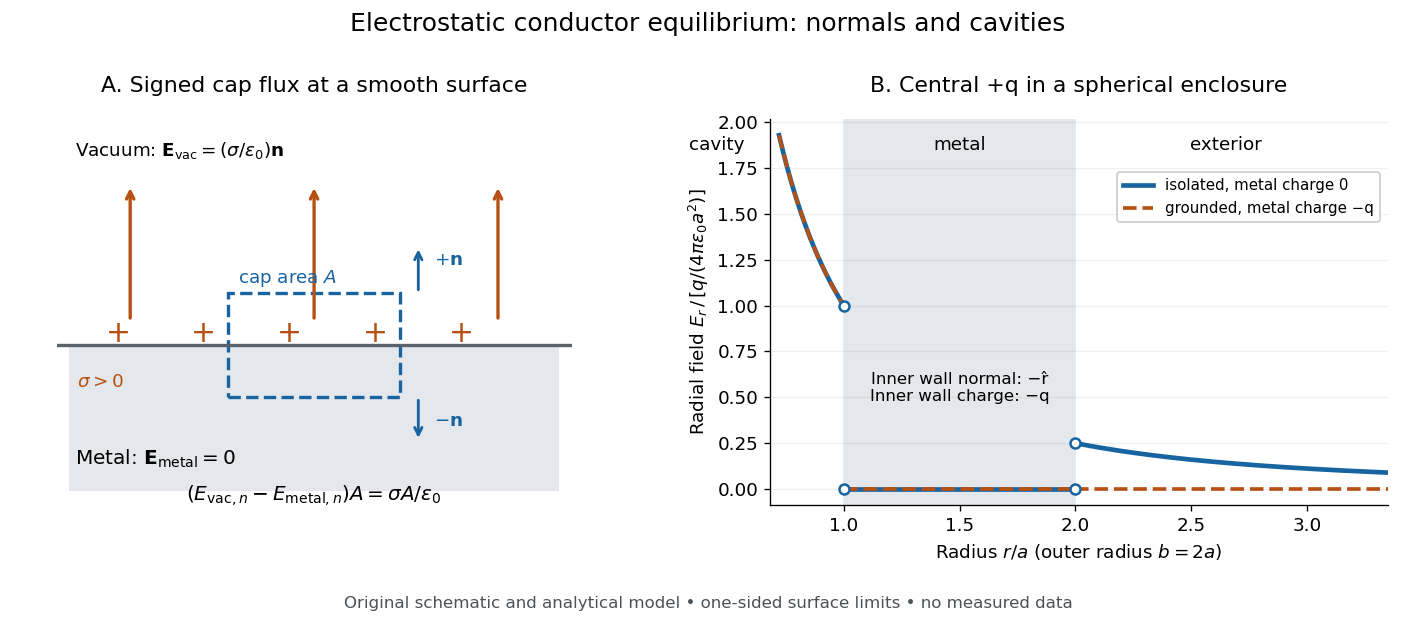
Signed Gaussian pillbox accounting and an analytical charged cavity in a conductor
. Original schematic and analytical model, not measured data. Left: the two cap normals give the normal electric field jump at a positive metal–vacuum surface. Right: a central positive point charge in a spherical enclosure with ; solid blue is an isolated initially neutral enclosure, and dashed orange is a grounded enclosure. Both have zero electric field in the metal and the same nonzero electric field in the cavity in a conductor. The jumps show one-sided limits, with the point-source singularity excluded. Details.
As a numerical sign check, stipulate , , and . The inner electric field is approximately along , but and . An isolated neutral enclosure has on the outer wall, approximately and just outside. Multiplying each surface charge density by its spherical surface area recovers the signed wall electric charges.
The local result uses the total electric field, including all induced and imposed sources. The factor follows from the zero metal-side electric field; a symmetric isolated sheet in vacuum instead has magnitude on each side. [ref]
https://www.feynmanlectures.caltech.edu/II_05.html#Ch5-S9. Feynman, Leighton and Sands, II.5.9: why a conductor differs from an isolated charge sheet
. At sharp corners, limiting electric fields can be singular and the smooth local pillbox argument needs care. In material outside the metal, use the normal free-charge jump of the electric displacement field and the material's permittivity, as in electrostatic interface boundary conditions. [ref]https://farside.ph.utexas.edu/teaching/em/lectures/node70.html. Richard Fitzpatrick, Boundary conditions for E and D: free and bound surface charge
. Past exam of the mathematics course of the University of Cambridge 2020 ii Paper 4 36D b i Solution Created 2026-09-24 Updated 2026-09-29
For a time-independent field, Faraday's law gives . Integrating around a thin rectangular loop crossing and shrinking its height gives continuity of the tangential component:A thin Gaussian pillbox and give continuity of the normal electric displacement field:These are the electrostatic cases of the dielectric-interface boundary conditions.
Use a cross-section normal to the sheets' line of intersection: the positive sheet is , and the negative sheet is . A Gaussian pillbox gives a single infinite sheet's electric field magnitude on either side. Superposition consequently gives, away from the sheets,The electric field points away from the positively charged sheet and towards the negatively charged sheet, bisecting each right angle. The electric field lines are straight within each quadrant: in the first quadrant, for example, , so is constant along a line. They start on and finish on . At a sheet, the normal component has the usual surface-charge jump, so the quadrant formula specifies the appropriate one-sided limits rather than a unique electric field on the charged surface.
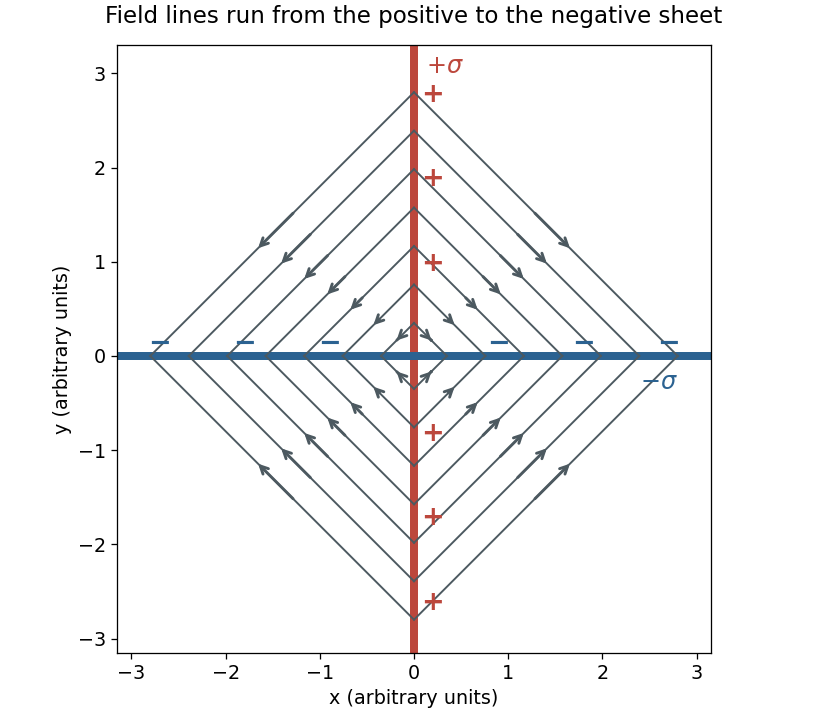
Cross-section of the electric field between perpendicular oppositely charged sheets
. Each arrow starts on the positive sheet and terminates on the negative sheet; the diagram is an original schematic of the derived field. Details.
In vacuum, Gauss's law states that the outward electric flux through a closed surface is the enclosed electric charge divided by the vacuum permittivity:Take opposite electric charges on the two electrical conductors, with surface charge densities . A Gaussian pillbox crossing one isolated large sheet gives , so each sheet contributes on either side. By the superposition principle, the electric fields add between the sheets and cancel outside. Ignoring the fringing field of a capacitor, the gap electric field is . The electric potential difference and capacitance of this parallel-plate capacitor are consequentlyThe approximation requires much smaller than both transverse sheet dimensions. A uniform filling with permittivity replaces by .
Past exam of the physics B course of the University of Cambridge 2011 Paper 2 Section B B6 Solution 2026-10-20
Apply Faraday's law to a shrinking rectangular loop crossing the interface. For bounded fields the magnetic-flux term vanishes with its area, giving . A shrinking Gaussian pillbox similarly gives . Thus normal is continuous when no free surface charge is present, even though a bound polarization charge may remain. These are the assumptions needed for the stated dielectric-interface boundary conditions.
Write , and . Use each region's own permittivity in its Coulomb potential:At , continuity of potential and normal displacement givesSolving,This permittivity convention for transmitted image charges matters: if the vacuum Coulomb prefactor is used even for , its combined effective source is instead. The physical potential is the same. The two numbered leaves identify how these sources satisfy the equations in their respective regions.
The real charge feels only the image contribution after removing its own singular self-field. The image at is separated from it by , soFor the bound charge, the outward normal of the dielectric is and . Differentiating at gives . ThereforeIts integral over the plane is , consistent with the external image representation. For both the image force and induced surface charge vanish.
Let point from medium 1 to medium 2. Integrate over a thin Gaussian pillbox crossing the interface. As its thickness tends to zero, the side contribution vanishes and any free surface charge density givesApply to a thin rectangular loop spanning the same interface. Its short sides vanish in the limit, so the tangential electric field is continuous:For a clean dielectric interface with no free surface charge density, these electrostatic interface boundary conditions reduce to and . In particular ; the normal electric field itself need not be continuous. Bound polarization charge is already incorporated into .
Let the unit normal point from material 1 to material 2, and let their relative magnetic permeabilities be , so for linear isotropic media. Apply Gauss's law for magnetism to an infinitesimal Gaussian pillbox straddling the interface. The side contribution vanishes as its height tends to zero, leavingThe normal magnetic flux density is continuous.
Next use a narrow rectangular Amperian loop crossing the interface. The two short-side contributions vanish in the zero-height limit. The magnetostatic Ampère law for magnetic field intensity giveswhere is any free surface current density. Thus, if there is no free surface current density on the interface, the tangential magnetic field intensity is continuous. In that case the component relations areThe distinction between free and bound electric currents matters: bound currents due to magnetization are already incorporated in the definition of magnetic field intensity. A change of magnetic permeability alone does not make the tangential magnetic flux density continuous.
Past exam of the physics course of the year 1 of the natural sciences course of the University of Cambridge 2018 Section A 6 Solution Created 2026-10-18 Updated 2026-10-20
Put the charged sheet at and the grounded plates at . By symmetry the electric field points away from the positive sheet with equal magnitude in the two gaps. A Gaussian pillbox crossing the sheet givesThe plate boundary conditions fix their electric potentials to zero. For the charged sheet between grounded parallel plates, the central potential isWith vacuum permittivity , . An electron has electric charge , so moving from a grounded plate to this positive potential decreases its potential energy by . Conservation of energy then givesThe unrounded value is , about . Either plate gives the same speed. The ideal calculation neglects the electron's disturbance of the prescribed field and image-force effects at its release point, consistently with treating it as a test particle.