Without free surface charge or current, the tangential components of and and the normal components of and are continuous across an interface.
Equality of the boundary fields for every tangential position and time forces equal frequency and equal tangential wavevector for incident, reflected, and transmitted plane waves.
Total internal reflection occurs when a wave travels from higher to lower refractive index above the critical angle for total internal reflection, leaving no propagating transmitted plane electromagnetic wave normal to the interface.
At an infinite planar interface, total internal reflection returns all incident normal power in the reflected plane electromagnetic wave. Assume homogeneous dielectrics with isotropy, linearity, no dielectric loss, magnetic permeability , and positive real refractive indices . Above the critical angle for total internal reflection, both TE polarization and TM polarization have unit optical reflectance despite the external evanescent wave.[ref]
Interactive Optics by Sander Konijnenberg, Aurèle J.L. Adam and H. Paul Urbach. Basic Electromagnetic and Wave Optics, Total Internal Reflection and Evanescent Waves, equations (153)–(158)
This makes total internal reflection useful for guiding light in an optical fiber: suitable internal incidence angles keep energy inside successive boundaries. Its more surprising feature is that perfect optical reflectance coexists with an external electric field. The evanescent field in total internal reflection can interact with a nearby object, as the frustrated total internal reflection experiment demonstrates.
For an original idealized example, choose , at vacuum wavelength . At angle of incidence , Snell law for electromagnetic waves gives an angle of refraction , so a transmitted light ray still emerges. At , its direction becomes tangent to the boundary. At , the proposed sine of a real angle of refraction would be : the transmitted wavevector must instead have an imaginary normal component. These are predictions for the stipulated media, not measured properties of a particular block.
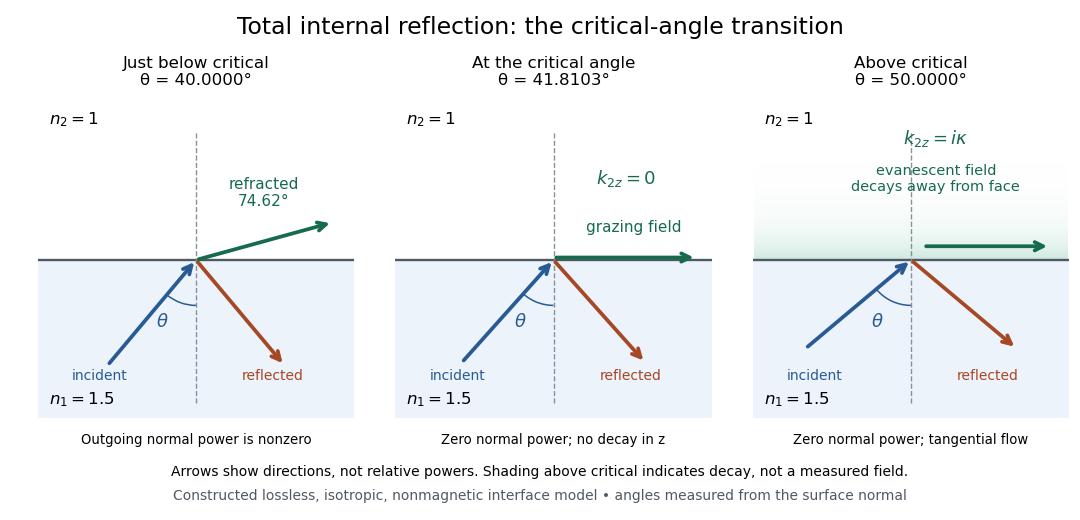
Constructed ray geometry just below, at, and above the critical angle for refractive indices 1.5 and 1; arrows indicate directions rather than relative powers
. Details. 
A real semicircular-block experiment isolates this threshold. The University of Maryland laboratory instructions place a laser, motor-driven rotation stage and photodetector together; an aperture limits the detector voltage. The semicircular block is centered on the rotation axis, with the photodetector aligned along its flat face. The instructions identify a strong grazing-beam signal and a weaker signal just before the critical angle for total internal reflection. The readout is detector voltage versus stage angle. Retracing the incident laser beam identifies normal incidence for alignment.[ref]
Snell’s law and total internal reflection laboratory instructions, University of Maryland Department of Physics. pp. 1–2, alignment procedure and Total Internal Reflection apparatus and detector instructions
The semicircular shape supplies a geometric control: a light ray passing radially through the curved face enters at normal incidence, avoiding additional entrance refraction. The weaker signal near the flat face locates a limiting angle of refraction; a vanishing remote-detector signal alone would not establish that the external electric field vanishes. Beam width and alignment limit angular resolution; no measured threshold or decay depth is supplied.[ref]
Snell’s law and total internal reflection laboratory instructions, University of Maryland Department of Physics. p. 1, beam-position uncertainty prompt; p. 2, semicircular-block geometry and near-critical signal
For refractive indices , the critical angle for total internal reflection satisfies . Above it, the transmitted normal wavenumber is imaginary and the transmitted field is an evanescent wave.
The critical angle for total internal reflection is the boundary between outgoing refraction and an evanescent wave, rather than an angle at which the external electric field abruptly disappears. Write and . At the threshold, Snell law for electromagnetic waves has , henceHere inverse sine selects . For and , and . The threshold is independent of polarization of an electromagnetic wave under the stated assumptions.
A short proof using phase matching at a planar wave interface reveals all three cases at once. Choose a Cartesian coordinate system with boundary , incident medium , and transmitted medium . With vacuum wavenumber , the shared tangential wavevector component is . The dispersion relation in medium two givesBelow , choose the positive real square root for an outgoing plane electromagnetic wave. At , : there is a grazing wave, with zero normal average power but no exponential confinement in . Above , choose with , so the wave amplitude decays into the second half-space.
If , no nongrazing angle of incidence produces this threshold. As from below, ; as that ratio tends to zero, . These limits explain why a larger refractive index contrast permits confinement over a wider range of internal angles.
The evanescent field in total internal reflection oscillates and advances in wave phase along the boundary while its wave amplitude decays away from it. With the coordinates above and time dependence , a TE polarization has complex amplitudeThe physical electric field is . The decaying sign excludes a field that grows without bound at . Dielectric-interface boundary conditions determine ; for nongrazing incidence it is generally nonzero.[ref]
Interactive Optics by Sander Konijnenberg, Aurèle J.L. Adam and H. Paul Urbach. Total Internal Reflection and Evanescent Waves, equations (154)–(158), decaying sign and parallel energy flow
Zero normal energy flux follows directly from Maxwell equations. The wavevector is ; the relation givesConsequently, the cycle-averaged Poynting vector isThe electric field and are a quarter-cycle apart, so their product has zero cycle average. Tangential energy flux survives. This is a local calculation for the single decaying evanescent wave in the infinite second half-space.
To check reflected power independently, put . The existing transverse-electric Fresnel reflection coefficient becomes . Its numerator and denominator are complex conjugates, so , while supplies the surface electric field relative to the incident wave amplitude. Thus a unit optical reflectance does not require a zero transmitted field. The same normal power balance holds for TM polarization; its reflected wave phase generally differs from the TE polarization phase. A mixture can therefore change its polarization of an electromagnetic wave on reflection even though all normal incident power returns.
Define the amplitude evanescent penetration depth as the distance at which the electric field wave amplitude falls to of its surface value:The squared-field envelope decays twice as fast:The same normalized exponential decay describes the tangential average Poynting vector for the TE polarization above. An intensity penetration depth convention often means ; it must not be confused with amplitude depth or interpreted as outgoing normal light intensity.
For the stipulated , , and ,At the normalized wave amplitude is approximately , and its squared envelope is approximately . At , these become and , respectively. The quantity inside the square root is dimensionless, so has inverse-length units and both depths have length units.
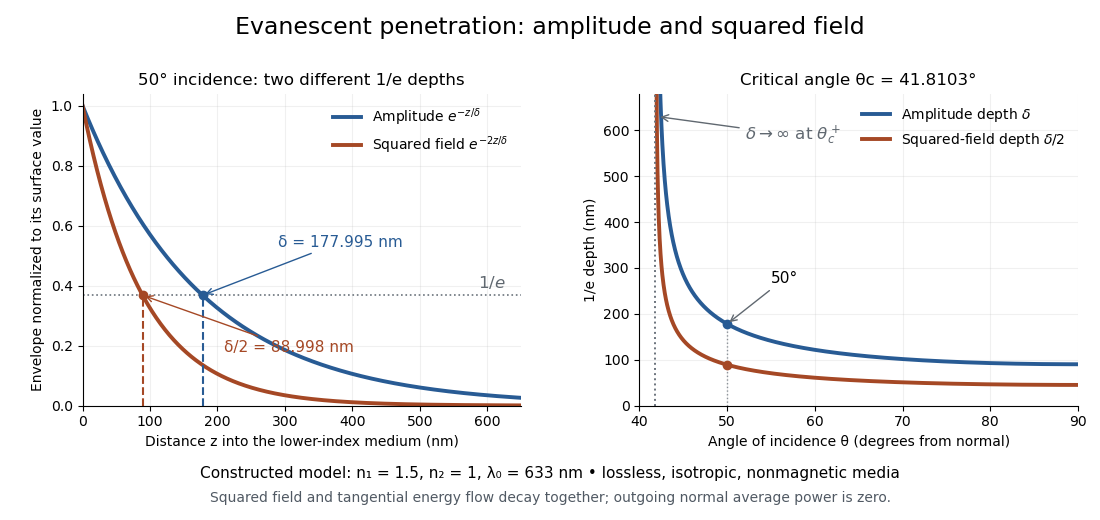
Constructed evanescent-field model at 633 nm: amplitude and squared-field decay at 50 degrees, and their penetration depths as incidence increases above the critical angle
. Details. 
The sharp angular dependence has a simple explanation. For with small and measured in radians, a first-order Taylor expansion givesThus as : exponential confinement disappears continuously. With fixed refractive indices, decreases as the angle of incidence increases and approaches as . This is a limit of the normalized depth; exactly grazing incidence supplies zero incident normal power. Real beam widths, angular spreads and optical dispersion matter when applying these ideal plane electromagnetic wave predictions near the threshold.
Frustrated total internal reflection occurs when a nearby second high-index dielectric couples to the evanescent field in total internal reflection, allowing power to cross a finite low-index gap. The extra boundary changes the dielectric-interface boundary conditions; the gap field need not be a single decaying evanescent wave. Consequently, the zero normal Poynting vector calculation for two infinite half-spaces does not forbid transmission in this three-medium geometry.
Harvard’s actual demonstration uses two right-angle glass prisms, a helium-neon laser, a small clamp and two perpendicular screens as detectors. The contact faces are cleaned and placed opposite each other, with the clamp protecting the corners. Increasing pressure narrows the intervening air film; the observed beam routing changes gradually from total internal reflection toward onward transmission. The broad-gap reflecting configuration supplies the comparison for the narrow-gap transmitting configuration. This is a qualitative readout: the page explicitly says the gap is not measured.[ref]
Frustrated Total Internal Reflection by Harvard Natural Sciences Lecture Demonstrations. How it works and Setting it up: two prisms, HeNe laser, perpendicular screens, pressure adjustment and unmeasured gap
The inference is that the lower-index region can mediate electromagnetic energy transfer when another boundary is nearby. The demonstration does not determine a numerical evanescent penetration depth, resolve gap uniformity, or establish a three-layer transmission coefficient. For the constructed example, identifies the scale over which the isolated-interface field remains appreciable; substituting for a gap transmission fraction would omit the changed boundary fields and their interference. A quantitative gap calculation must solve the full Maxwell equations with both boundaries.
The Fresnel equations give reflection and transmission amplitudes for both transverse-electric and transverse-magnetic polarization of an electromagnetic wave at a planar interface. They follow by applying interface conditions for electromagnetic fields to incident, reflected and refracted plane electromagnetic waves.
The specular reflection of a wave at a planar dielectric interface with amplitudes described by the Fresnel equations. Below the critical angle, the reflected fraction is generally nonzero even when transmission is allowed; above the critical threshold, ideal lossless total internal reflection has unit reflected power. The reflected electric-field sign depends on polarization and the chosen basis conventions.
With one fixed tangential electric-field direction, normal-incidence reflection from impedance to gives . Using one fixed tangential magnetic-field direction reverses the reflected wave's sign, giving . Reversing the chosen reflected basis can produce the same change. The reflectance is invariant, but coherent amplitudes require a consistent convention throughout. Two internal reflections at identical opposite interfaces give the same round-trip product in either convention.
For a ray meeting an interface at nonzero incidence angle, the plane spanned by the incoming wavevector and the surface normal. transverse electric polarization has electric field perpendicular to this plane, while transverse magnetic polarization has electric field in it. At exact normal incidence, the surface normal and ray alone do not select a unique plane.
For reflection or refraction at a flat isotropic interface, p-polarization has its electric field in the incidence plane and perpendicular to its wavevector. At a lossless nonmagnetic dielectric interface, its reflected amplitude vanishes at Brewster's angle. This does not mean that its field is generally parallel to the interface surface.
For reflection or refraction at a flat isotropic interface, s-polarization has its electric field perpendicular to the plane containing the incident wavevector and interface normal. At an isotropic dielectric boundary it is an eigenpolarization of the Fresnel reflection problem. The label is relative to the specified interface, not an absolute direction in space.
For real wave impedances at normal incidence, the electric-field transmission coefficient gives transmitted power fraction . Reflection gives . Enforcing both tangential electric and magnetic boundary conditions gives and , which satisfy .
For an interface between two lossless, isotropic, nonmagnetic media with unequal refractive index values , Brewster's angle is the incidence angle at which the reflected amplitude in transverse magnetic polarization vanishes. The Fresnel equations and Snell's law give ; the reflected and transmitted rays are perpendicular there. The usual formula assumes equal magnetic permeabilities.
For sunlight reflected from a horizontal flat dielectric interface, incidence angle is measured from the vertical while solar elevation is measured from the horizontal. The Brewster condition therefore gives . Reflected light has its electric field perpendicular to the vertical incidence plane, so its surviving linear polarization is horizontal. This ideal result assumes real refractive indices, negligible absorption, nonmagnetic media and a smooth interface.
At a transparent nonmagnetic dielectric interface, the Fresnel reflection coefficients differ for s and p linear polarization. At Brewster incidence the reflected p amplitude vanishes and reflected unpolarized light becomes s polarized. For a horizontal reflecting surface this is horizontal glare. Away from Brewster incidence it is generally partial polarization. Refraction and internal reflection in droplets also select the two components differently, explaining polarization of rainbow light without a biological mechanism.
A vacuum ray incident normally on a dielectric moving parallel to its surface becomes oblique in the material rest frame, with . For a transparent nonmagnetic dielectric, the rest-frame Brewster angle satisfies , giving . The reflected electric field is perpendicular to the plane containing the ray and the velocity. A real refractive index is assumed; dispersion makes the condition implicit through the rest-frame frequency, and absorption generally removes exact extinction.
In the sharp planar, nonmagnetic ionosphere model with frequency above the plasma frequency, the refractive index is . From air, the Brewster angle satisfies . At that angle the reflected p-polarized wave vanishes, while s polarization retains a nonzero reflected component. A ground-to-ground single reflection from height spans . This is below the critical angle for total internal reflection for total internal reflection, which reflects both polarizations in this lossless isotropic model. The distinction diagnoses ordinary Brewster reflection rather than total internal reflection.
When the permeabilities agree, the signed reflected-to-incident electric-field ratio for polarization normal to the plane of incidence isFor incidence from lower to higher refractive index it never vanishes.
For equal permeabilities on the two sides of an interface, tangential-field continuity and Snell law for electromagnetic waves givefor consistently signed electric amplitudes normal to the plane of incidence.
Articles by others on the same topic
There are currently no matching articles.