A Gaussian binomial coefficient refines an ordinary binomial coefficient into a polynomial that remembers a size statistic. For nonnegative integers and , writeThe product represents a polynomial; it is not an instruction to divide by zero when or a denominator vanishes. The Gaussian binomial coefficient recurrence gives a way to compute it with only addition and multiplication. The empty product for is one, and as well. Setting after obtaining the polynomial recovers .
For example,At this gives six objects, but its coefficients reveal how those six objects are distributed across sizes : there are two of size two and one of each other size. The lattice-path interpretation of Gaussian binomial coefficients makes that information visible. Take unit steps north or east from to . A north step at horizontal coordinate contributes shaded cells to its left. The six step words have total shaded areas .
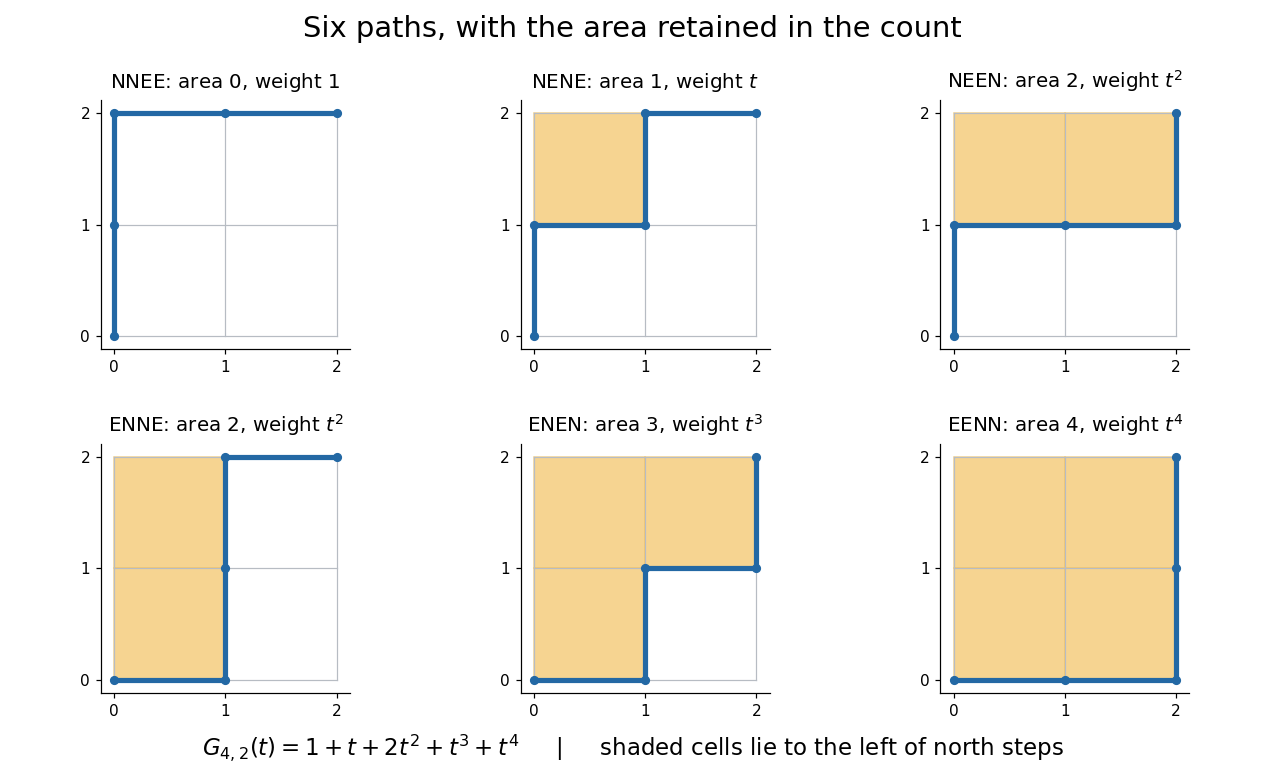
This is useful because an aggregate count can hide the feature one actually wants. A generating function retains the distribution of a statistic, so coefficient extraction answers questions such as “how many allowed diagrams contain exactly two cells?” The partition interpretation of Gaussian binomial coefficients makes every coefficient a nonnegative integer without relying on cancellation in the product formula.
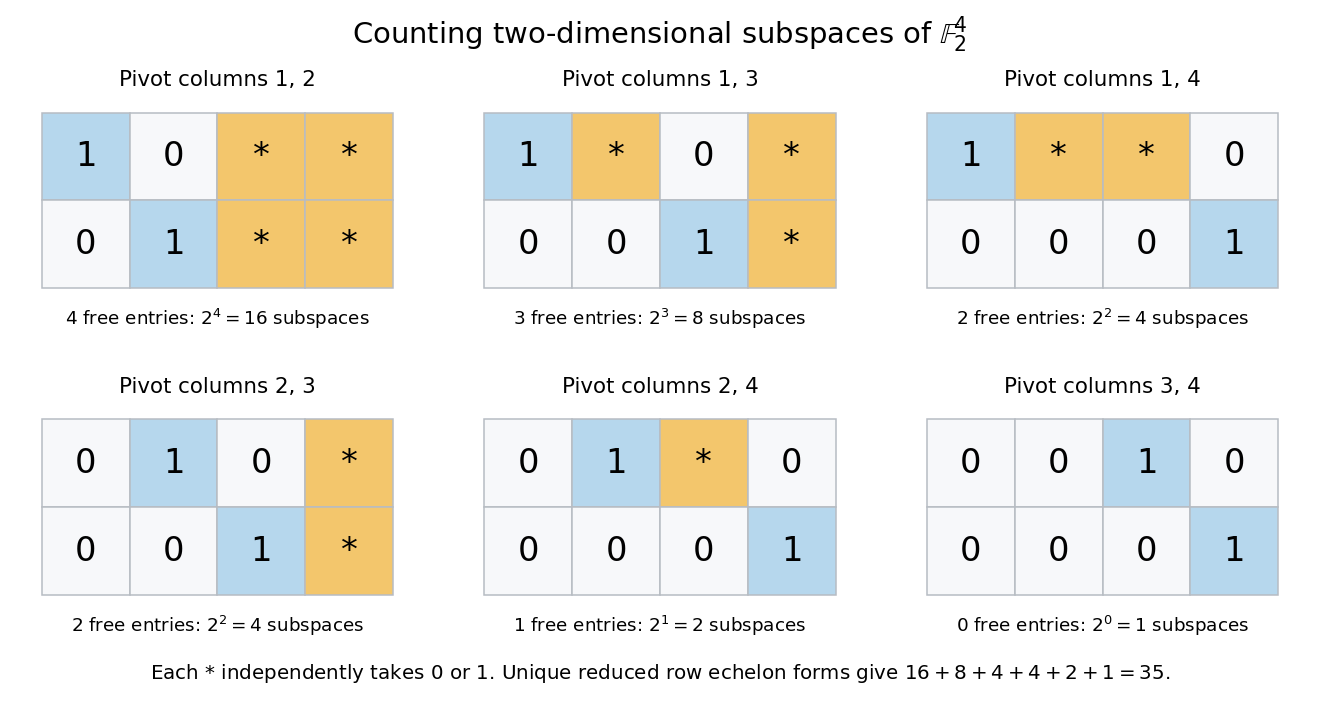
An unexpected second use comes from linear algebra. If is a prime power, the value counts the -dimensional vector subspaces of . Thus the same expression that counts six paths at counts 35 two-dimensional subspaces of at . The Gaussian binomial coefficient counts finite-field subspaces article explains why selecting a vector subspace differs from selecting a subset of coordinates. [ref]
This relationship illustrates a q-analogue: the parameter can encode a statistic in one interpretation and the size of a finite field in another. Here denotes the formal variable, while denotes a finite field's cardinality when we evaluate the polynomial. The interpretation using a finite field requires to be a prime power; evaluating the polynomial at an arbitrary number does not construct a field of that size.
An exact weighted-subset formula isThe exponent measures how far the selected positions lie beyond the earliest possible choices . Split the subsets according to whether they contain . Those without it give ; deleting it from those with it removes exactly from their exponent. This gives the displayed recurrence relation, explaining why it builds polynomials with nonnegative integer coefficients.
Use lattice paths with north steps and east steps, beginning at . Let be the sum of the horizontal coordinates of its north steps, equivalently the number of unit cells to their left inside the -by- rectangle. A north step in zero-based word position has earlier north steps, so its horizontal coordinate is . The Gaussian binomial coefficient recurrence therefore counts these lattice paths with weight .
For , the words
NNEE, NENE, NEEN, ENNE, ENEN, EENN have respective areas . The word NEEN contributes because the two north steps occur at horizontal coordinates zero and two. These paths never move south or west; allowing such extra steps would change the collection being counted.The Young diagrams of partitions in a rectangle with at most rows and at most cells in each row correspond to the lattice paths in the lattice-path interpretation of Gaussian binomial coefficients. Read the shaded row lengths from top to bottom; the result is a nonincreasing list of nonnegative integers. This bijection preserves the number of cells.
In a two-by-two rectangle, the possibilities are the empty integer partition, , , , , and . Their sizes are , giving . In particular, there are two allowed diagrams of size two, explaining the middle coefficient.[ref]
Pad a partition in a rectangle with zero rows until it has entries, and put . The complementary rotated diagram has row lengths . This is again a partition in a rectangle, and its size is . Repeating the operation recovers the original integer partition, so it gives a bijection between diagrams of size and diagrams of size . Consequently the coefficients of the Gaussian polynomial read the same in either direction. The displayed identity can be interpreted as an identity of Laurent polynomials; it does not require substituting at .
For the two-by-two rectangle, the empty diagram pairs with , and pairs with ; and each map to themselves. This establishes symmetry, while unimodality of Gaussian binomial coefficients is a stronger statement about the growth and decrease of successive coefficients.
For a prime power and , count ordered lists of linearly independent vectors in . The first has choices. After independent choices, their linear span contains vectors, so the next has choices. Every -dimensional vector subspace has exactly ordered bases. Dividing the list count by this common multiplicity givesThe notation refers to the Grassmannian, here considered simply as the finite collection of these vector subspaces.[ref]
For , there are ordered independent pairs. Each two-dimensional vector subspace has ordered bases, leaving vector subspaces. There are only coordinate-selected vector subspaces; most of the 35 also contain vectors combining coordinates.
A unique reduced row echelon form gives another count. Its six possible pivot-column patterns have freely chosen entries. Each free entry lies in , giving vector subspaces, respectively. The diagram fixes the zero entries required to make each pivot the first nonzero entry in its row and the only nonzero entry in its column. Different choices describe different row spaces.
For , let be the -dimensional irreducible sl2 Lie algebra representation. Its weights are . A wedge basis shows , where is the Gaussian binomial coefficient. By the Weyl complete reducibility theorem, this character is a nonnegative sum of irreducible strings . All its weights have parity , so their coefficients increase toward zero and decrease afterward. Consequently the coefficients of are symmetric and unimodal. The symmetric quantum binomial coefficient is this character, a Laurent polynomial; its coefficients are unimodal on the occupied parity. The full integer-exponent sequence need not be unimodal, as demonstrates.
The quotient is the displayed shifted Gaussian binomial coefficient. It is the formal character of , where is the -dimensional irreducible sl2 Lie algebra representation. Indeed its exterior-power weights are sums of distinct terms of . Parity unimodality of an sl2 character proves unimodality after removing the intervening zero coefficients; equivalently, the ordinary Gaussian polynomial has unimodal coefficients.
Articles by others on the same topic



The Gaussian binomial coefficient, also known as the Gaussian coefficient or q-binomial coefficient, is a generalization of the ordinary binomial coefficient that arises in the context of combinatorics, particularly in the theory of finite fields and polynomial rings.