The Newtonian potential of a point mass at the origin isIt is the free-space Green function of the Laplacian with the normalization of the Poisson equation for Newtonian gravity. Differentiating gives inward gravitational acceleration . With , the normalized Newtonian gravitational potential is ; at it equals .
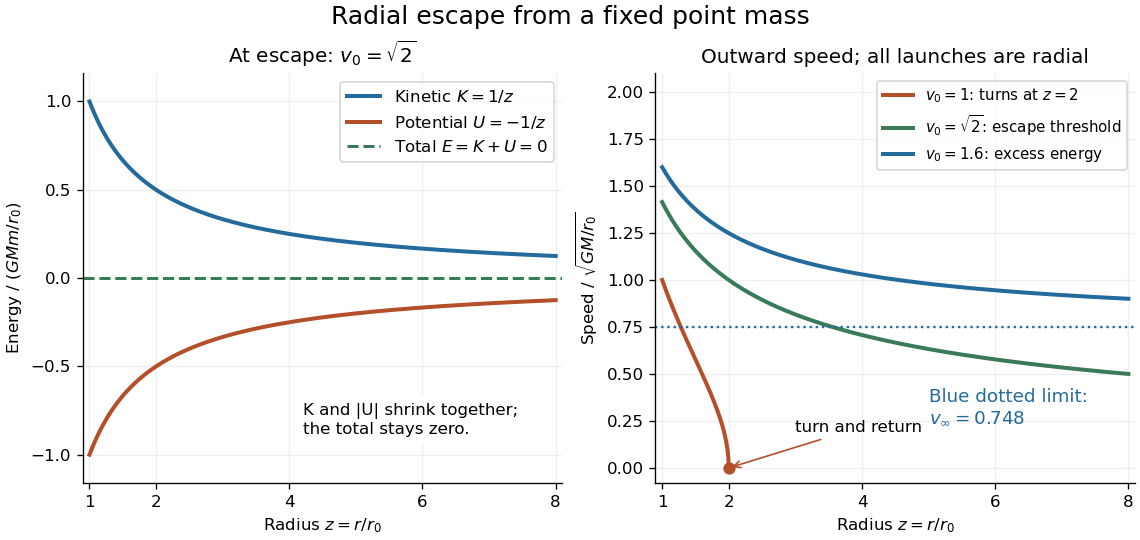
For a radially outward launch from , conservation of mechanical energy in the fixed-source test particle approximation gives the minimum escape velocity:At this threshold the speed tends to zero only at infinite separation. The model neglects air resistance, external tidal forces, and general relativity. [ref]
A circular orbit at instead requires tangential speed . Choosing units with gives , , and . A radial launch at speed reaches and returns; the same speed directed tangentially gives a circular orbit. [ref]

A shell of fixed mass and radius has self-energy . Its inward generalized force opposing an increase of radius is . Including this in a swept-gas shell threshold changes an interior-only factor to when the original total mass is held fixed.
The sphere for has and , with zero potential at infinity. Its finite central potential contrasts with the logarithmic central divergence of a truncated inverse-square density.
Consider a uniform-density cylinder with an axisymmetric radial Fourier mode . Its displaced boundary gives a first-order surface mass density , although the interior density perturbation vanishes. The gravitational Poisson equation reduces to Laplace equation away from the interface. Regularity internally and decay externally give and . Continuity at and the derivative jump , together with , give the title amplitude. The prime differentiates the modified Bessel function argument. This axial mode is different from an azimuthal mode on a gravitational potential of a displaced cylindrical interface.
Articles by others on the same topic
There are currently no matching articles.