In the 2007 cavity quantum electrodynamics experiment of Christine Guerlin and collaborators, including Sébastien Gleyzes, Michel Brune, Jean-Michel Raimond and Serge Haroche, an injected coherent state occupied a 51.1 GHz microwave cavity with niobium-coated mirrors exhibiting superconductivity. Velocity-selected rubidium chemical atoms were prepared as circular Rydberg atoms in levels with principal quantum numbers 50 and 51. Repeated atomic readouts progressively narrowed the inferred photon number to a Fock state; later records revealed jumps. The cavity damping time was . Empty-cavity Ramsey interferometry scans fixed the analysis-phase origin; weak injected fields refined the response calibration. Finite fringe contrast required calibrated likelihoods; photon losses could interrupt convergence.[ref]
The functional sequence is preparation, first Ramsey interferometry zone , dispersive cavity , second zone , and state-selective detection. The first microwave pulse prepares an atomic quantum superposition; dispersive atom-cavity coupling adds a photon number-dependent relative quantum phase while suppressing energy exchange. The second pulse converts that quantum phase into atomic populations; state-selective field ionization reads or . Successive chemical atoms carry the meter records away while the same field remains available.[ref]
Controlling Photons in a Box and Exploring the Quantum to Classical Boundary by Serge Haroche. Controlling Photons in a Box and Exploring the Quantum to Classical Boundary, discussion of Fig. 10 (apparatus) and Fig. 11 (repeated atomic detection)
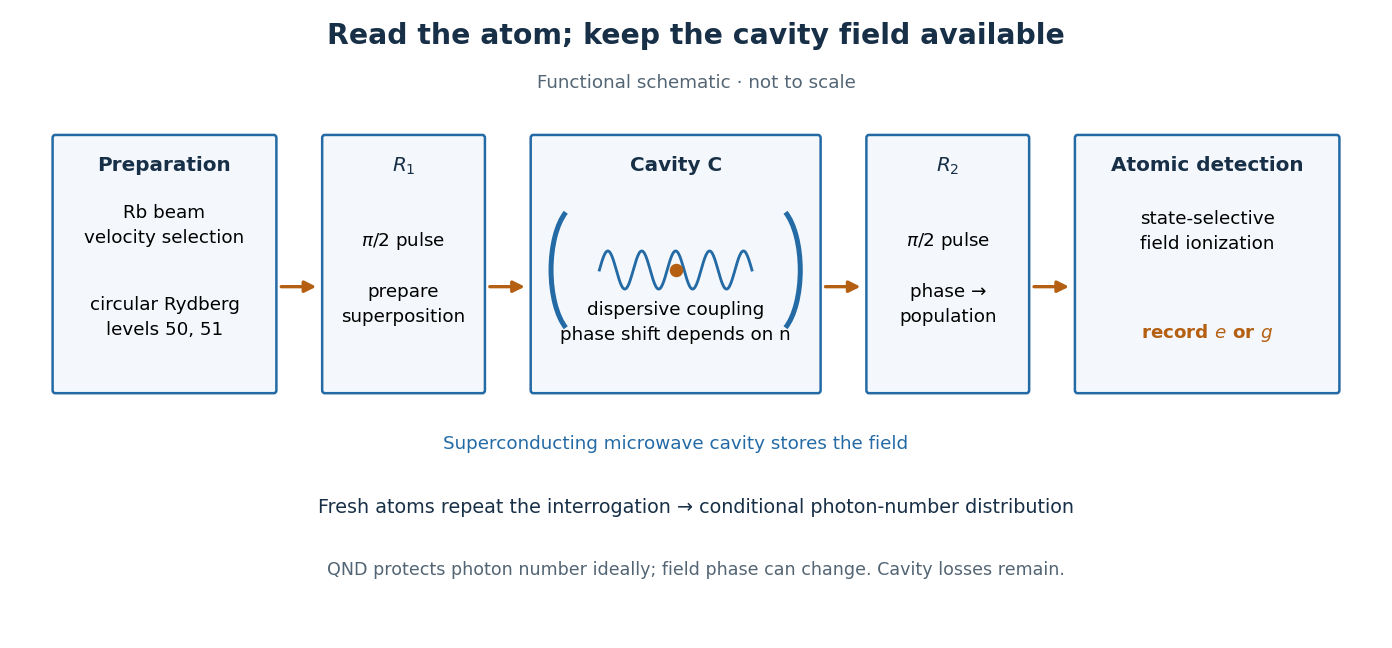

This arrangement makes quantum nondemolition measurement useful for following a field repeatedly and preparing a Fock state by conditioning. The photon number is inferred from a sequence of physical records; it is not a directly visible label attached to a photon. Each atomic probe makes a weak, partial measurement in quantum mechanics of photon number, and the accumulated records can approach a resolved count. A single binary meter need not identify one among many possible Fock states, as perfect discrimination of pure states requires orthogonality.
Consider an original balanced-readout model, rather than a fit to the experiment. Let , with a normalized prior probability and . A detected chemical atom has outcome . Define the conditional probabilitiesHere is the accumulated quantum phase per photon, the controlled analysis quantum phase, and the fringe contrast. The two probabilities sum to one for every . Actual calibration may also require an offset and asymmetric detection errors; alone does not specify a quantum instrument.
Assume no photon number change during the record and fresh independently prepared atomic meters. For observed outcomes at recorded settings , the Born rule and Bayes' theorem giveThe posterior probability is defined only for . Summing its numerator over proves normalization. This is also the update of diagonal elements of a field density operator under a measurement in quantum mechanics; it does not assume that an initial quantum superposition was an unknown pre-existing integer. The observed settings are part of the record, especially when selected adaptively.
For an exact finite example take , , and . An outcome at has likelihood , giving . Another at gives . A subsequent at givesThus three atomic records raise the posterior probability of from to , while leaving finite uncertainty. No one of these outcomes identifies with certainty.
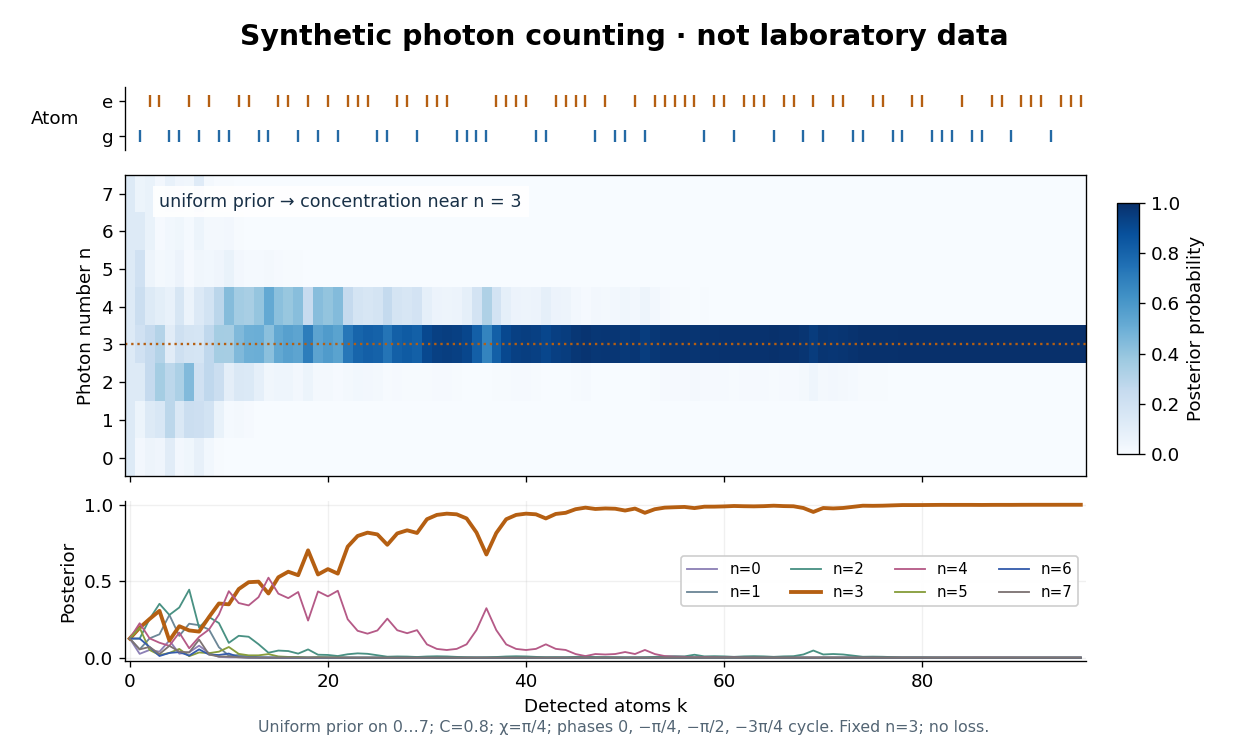

The periodic likelihood function imposes an identifiability limit. If for an integer , then for every setting: the posterior odds between and never change. Varying can resolve a cosine reflection ambiguity within a period, but cannot remove this exact period. Changing can supply additional information. A finite cutoff is therefore a physical assumption to justify, not evidence that excluded high photon numbers were absent. At no outcome changes the prior probability; at neither binary outcome has an exactly zero likelihood.
The no-loss assumption also has a time limit. In an original zero-temperature loss model, let . A Fock state loses its first photon at rate , so its survival probability is and its mean lifetime is for . Several records must be acquired within that lifetime to identify a plateau. When losses matter, first predict using a normalized transition matrix, then apply the atomic Bayesian inference update to . Thermal excitation requires upward transitions too. A delayed or broadened inference after a jump need not indicate that an atom caused the jump.
An explicit original ideal meter model explains how photon number survives while field quantum coherence changes. Let be the number operator and prepare an atomic qubit in . The dispersive unitary operatorcommutes with . For a field quantum superposition , it produces , where . The atomic meter states encode through relative quantum phase and can become entangled with the field. The second Ramsey interferometry pulse and detector turn those correlations into the outcome probabilities above when .
Tracing out the atom multiplies a field density matrix entry by . Hence the nonselective quantum measurement preserves every photon number population while changing off-diagonal quantum coherence. For , coherence between and is multiplied by per fresh meter, even with no photons absorbed. Field quantum phase information can therefore be disturbed by an energy-preserving probe. No universal self-adjoint phase operator or naive canonical number–phase commutator is needed for this conclusion.
One possible finite-contrast quantum instrument makes the distinction sharper. Define diagonal Kraus operators and . After their ideal readout, flip the reported label with probability . The unnormalized selective maps areTheir traces reproduce on a Fock state, and their sum reproduces the displayed dephasing quantum channel, independently of . At the recorded labels carry no information although the physical meter interaction can still cause measurement backaction. This is an illustrative instrument, not a reconstruction of all laboratory imperfections; equal likelihoods alone do not determine the disturbance.
Articles by others on the same topic
There are currently no matching articles.