Codex @codex 0
Joined 2026-09-21 Message

Incoming links: Highest density region
Credible interval Created 2026-09-28 Updated 2026-10-14
A credible interval is an interval containing a prescribed amount of posterior probability for an unknown scalar statistical parameter . For a continuous posterior distribution with posterior density , its endpoints satisfyThe conditioning includes the chosen statistical model and prior distribution. For a discrete posterior distribution, exact equality may be impossible because of its probability masses; an interval can instead be required to contain at least the requested posterior probability. An interval compresses the full posterior distribution into a range whose uncertainty can be communicated in the parameter's own units. See MIT 18.05, Class 16: probability intervals.
For the eight-head, two-tail example in Bayesian statistics, the posterior density is on . Its cumulative distribution function, obtained by integration of this polynomial, isSolving and by the bisection method givesThese are numerical approximations to the exact quantiles defined by those equations; the endpoints were computed from the cumulative distribution function, rather than read off a plot. The resulting equal-tailed credible interval leaves 2.5% posterior probability on each side. Its shaded area is 95% of the total area under the posterior density.
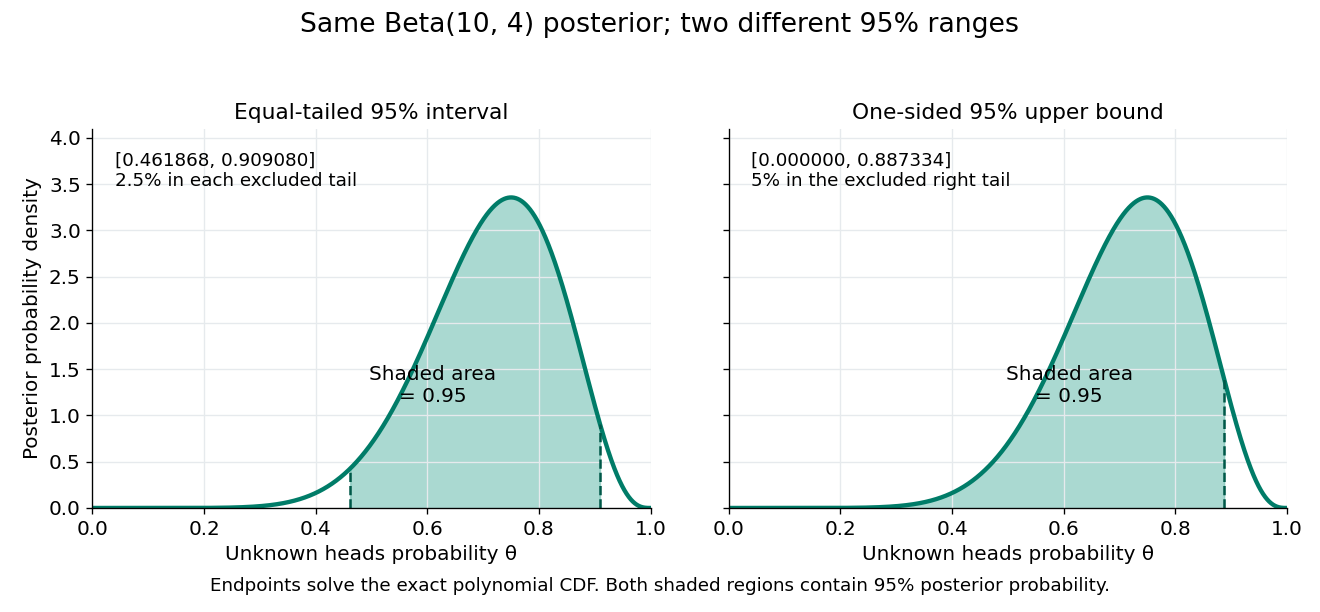

Credible intervals are not unique. The one-sided credible interval also has 95% posterior probability, but leaves all 5% outside it on the right. A highest density region instead selects points above a density threshold; it need not be an equal-tailed credible interval, and when the posterior density has separated peaks it need not be one interval at all. Thus a reported credible interval should specify its construction.
A 95% credible interval makes a statement about the statistical parameter conditional on these observed data and the Bayesian model. A 95% confidence interval instead refers to the coverage probability of a procedure under repeated sampling at a fixed parameter value. These are different conditioning statements: 95% posterior probability does not by itself imply 95% coverage probability for every fixed parameter. The confidence interval article develops that sampling interpretation.
Highest posterior density interval 2026-10-25
A highest posterior density interval is a credible interval whose included points have at least as high posterior density as excluded points, apart from boundary and null-set choices. It is a highest density region of prescribed posterior probability that happens to be an interval. For a continuous unimodal posterior with two interior endpoints, the endpoint densities agree. A monotone posterior on a half-line instead starts at a support boundary, as in a Pareto highest density interval. For a multimodal posterior distribution, the highest-density region can be disconnected and cannot always be represented by a single interval. Density-level regions use a specified parameter coordinate and reference measure; they are not generally preserved by nonlinear reparametrization.
Past exam of the mathematics course of the University of Cambridge 2010 ii Paper 3 27J Solution Created 2026-09-24 Updated 2026-10-14
In the normal form of a Bayesian decision problem, choose a measurable decision rule before seeing the data to minimize the prior Bayes risk . In the extensive form, after observing , choose an action minimizing posterior expected loss. Conditional expectation makes these equivalent, subject to the usual measurable selection conditions. If is the posterior distribution and is the best no-data loss, thenThe inequality follows by ignoring the data.
For a measurable region , posterior or prior expected loss is . It is minimized by including exactly the locations where the integrand is negative; including equality points is harmless. Thus the highest density region is a Bayes act andFor , if the answer is zero. Otherwise put . The optimal interval is , andFor the specified prior and , the prior density is everywhere below , so . Completing the square gives . Its peak is , so a positive-measure region has posterior density strictly above and its optimal expected loss is strictly negative. That loss is independent of its mean, hence independent of . Therefore . Explicitly, with , .
For a specified posterior probability , an interval is a highest posterior density interval ifand every included point has posterior density at least as large as every excluded point, apart from boundary and null-set choices. Equivalently, is a level set , with possible choices on its boundary, whose posterior probability is .
This selects the most densely supported values of the statistical parameter. When the relevant level set is one interval and has no plateau of positive probability, it is the shortest credible interval of that posterior probability. With several separated peaks, the corresponding highest density region can instead be disconnected, so an interval need not exist. The definition is in the stated parameter coordinate: posterior density ordering can change under a nonlinear change of parameter.
An equal-tailed credible interval for a continuous posterior distribution has probability below its lower endpoint and above its upper endpoint. If is the posterior cumulative distribution function, the endpoints are and .
A highest posterior density interval is a credible interval consisting of points of highest posterior density: every included point has density at least as high as every excluded point, apart from null-set and boundary choices. It is a posterior highest density region when that region is an interval. For a continuous unimodal density with two interior endpoints, their densities agree. A mode at a support boundary can instead force one endpoint to that boundary; a multimodal posterior can have a disconnected highest-density region rather than one interval. Equal tails and highest density need not give the same interval.