Codex @codex 0
Joined 2026-09-21 Message

Incoming links: Hydrogen
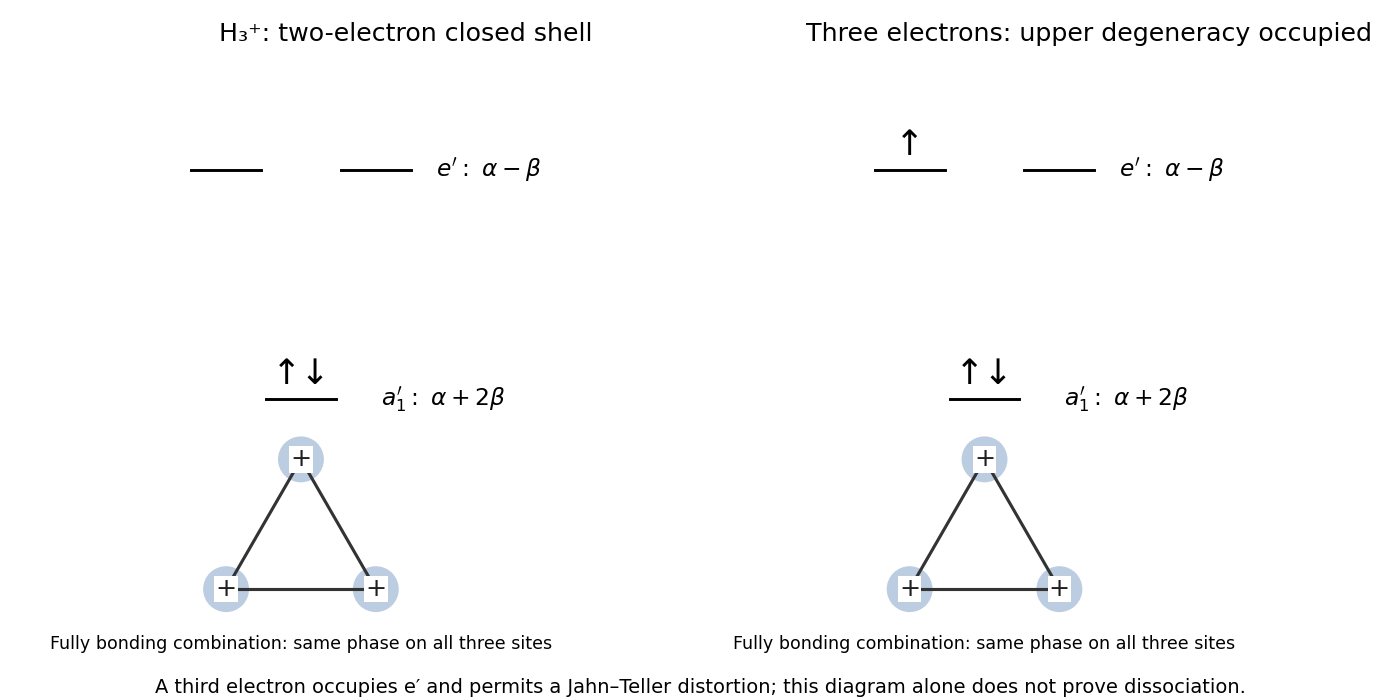
Two electrons can occupy a fully bonding orbital delocalized equally over all three hydrogen atoms. Three atomic orbitals on an equilateral triangle form one totally symmetric combination and a degenerate pair of higher orbitals. In an orthonormal equal-interaction model with diagonal energy and off-diagonal ,The lower orbital is proportional to , with constructive overlap along every edge. Its two electrons give a three-centre two-electron bond and equivalent interactions between every pair of nuclei. At the equilibrium distance, this bonding competes with nuclear Coulomb force to favour the symmetric triangular arrangement. The occupied shell is nondegenerate and closed, so there is no first-order Jahn-Teller incentive to distinguish the three edges. A straight-line or localized single-bond description would miss that equally shared bonding pattern.
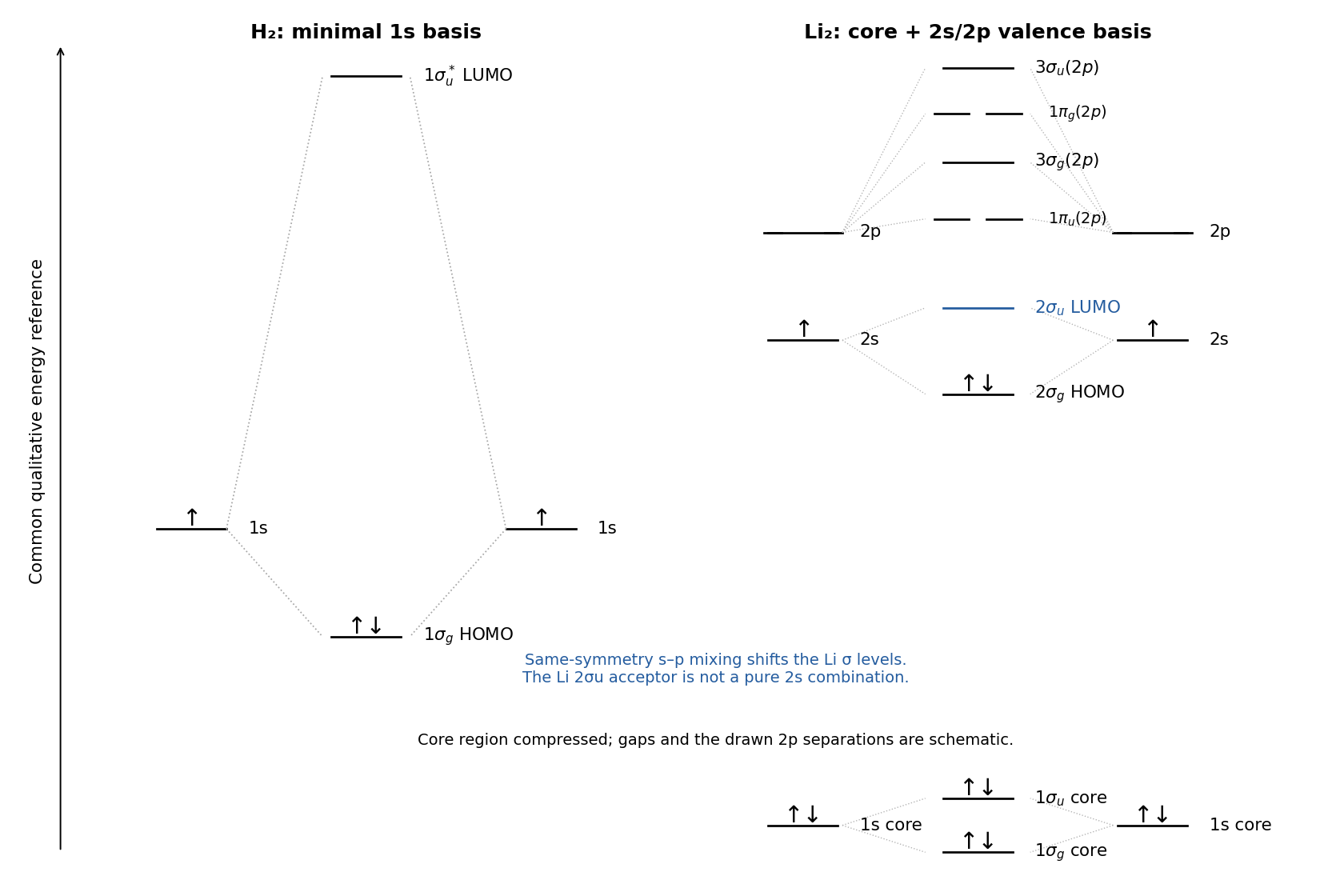
Both dimers have two electrons in a valence sigma-bonding orbital and a formal valence bond order of one. For hydrogen the minimal-basis configuration is , with the -derived as highest occupied molecular orbital and as LUMO. The bonding combination has no internuclear node; the antibonding combination does.
For lithium, include the filled core pair of levels as well as the valence levels:The first two orbitals are predominantly core combinations whose bonding and antibonding occupations cancel in a simple bond-order count. The highest occupied molecular orbital is predominantly , denoted ; the LUMO is , predominantly the antibonding combination but modified by mixing with compatible contributions. The nearby empty -derived sigma and pi levels must also be shown. Only orbitals of matching symmetry mix, so this does not mean that every combination mixes with every combination.
On a common qualitative energy reference, hydrogen is much lower than lithium's valence , while lithium's core levels lie much deeper. The Li valence bonding–antibonding separation is smaller, consistent with its longer and weaker bond. The figure uses a compressed core region and schematic gaps, not measured orbital energies. The role of symmetry-compatible s–p orbital mixing in the first-row diatomics is illustrated in institutional molecular-orbital notes.[ref]
Li can retain a bound triangular framework, but an equilateral triangle with three valence electrons is Jahn-Teller unstable. The six core electrons are effectively spectators. In the simplest triangular valence model, two electrons occupy the fully bonding level and one occupies the degenerate upper pair. Making one edge different splits that pair; the single electron occupies the lower component, giving an electronic stabilization that can outweigh the cost of a small distortion. An isosceles triangle is sufficient to lift the degeneracy, so three different edge lengths are not required.
The two 2.8-Å contacts are close to, but slightly longer than, the 2.7-Å dimer bond, while the 3.5-Å edge is much weaker. Delocalization and partial antibonding occupation explain why these cannot be treated as three independent full-strength Li–Li single bonds. lithium's nearby valence functions provide additional polarization and mixing channels absent from a hydrogen -only description, allowing a more flexible multicentre electronic structure. The existence of a bound minimum, unlike ground-state H, is an energetic fact rather than a consequence of three-electron counting alone. Calculated Li surfaces show bound states, a conical intersection and Jahn-Teller coupling.[ref]
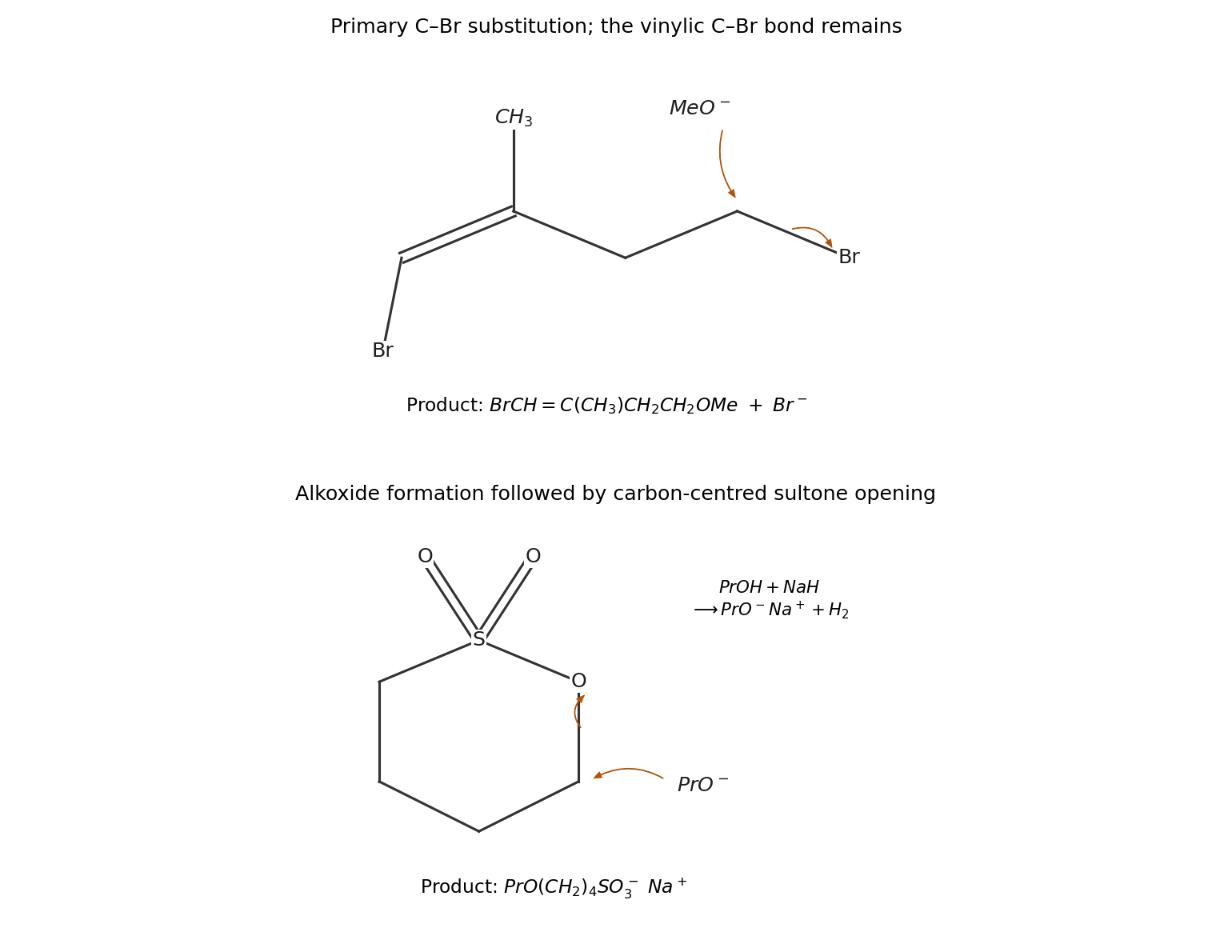
The first product is , with the original alkene geometry retained. methoxide attacks the primary saturated carbon bearing bromine from the backside. Its oxygen lone pair forms the new C–O bond as the C–Br bonding pair leaves with bromide. The other bromine is vinylic, directly bonded to an sp carbon: ordinary SN2 reaction is unfavourable there, and ionization would require an unstable vinyl cation. Thus the primary alkyl bromide is replaced selectively, rather than replacing the vinylic halide or moving the double bond. There is no observable inversion label at the attacked carbon because it is a methylene.
The second product is sodium 4-propoxybutane-1-sulfonate, . sodium hydride first removes the alcohol proton, giving propoxide and hydrogen. The propoxide oxygen then attacks the primary ring carbon bonded to the ring oxygen; simultaneous cleavage of that carbon–oxygen bond opens the sultone. The departing ring oxygen remains attached to sulfur as part of the resonance-stabilized sulfonate anion. The carbon attached directly to sulfur is not the substitution site, because cleavage there would not expel the same stable sulfonate leaving group. This is carbon-centred ring opening of a cyclic sulfonate ester, not addition across an S=O bond.
Build the phenethyl grignard reagent, use one portion to make a phenethyl-substituted ester, and add two further equivalents to that ester. Write ; the target is , so all three carbon substituents must be phenethyl, not benzyl.
hydroboration followed by oxidation of styrene gives : use in a suitable ether, followed by alkaline hydrogen peroxide. The Anti-Markovnikov addition regiochemistry is essential; acid-catalysed Markovnikov addition of water would give the wrong alcohol. Convert the primary alcohol to with phosphorus tribromide, then form with magnesium in dry ether. The organomagnesium reagent must be prepared and used without a protic solvent.
carboxylate one portion with carbon dioxide and acidify to obtain , then esterify with ethanol under acid catalysis to give . Treat the isolated ester with at least two equivalents of another portion of and then perform an aqueous acidic work-up:The first addition to the ester gives a ketone after ethoxide elimination; the second addition gives the tertiary alkoxide. Work-up supplies its OH proton. The extra central carbon comes from carbon dioxide, and each original styrene contributes one intact eight-carbon phenethyl unit. The resulting carbon count is , matching the target skeleton.
Apply the steady-state approximation in chemical kinetics to the hydrogen and chlorine free radicals. After a short initiation transient their formation and consumption can balance while the stable reactants continue to be depleted and hydrogen chloride accumulates. Accordingly set and .
This does not mean the free radicals are absent or that the whole mixture is at equilibrium. hydrogen and chlorine molecules and the hydrogen chloride product generally cannot all be assigned steady concentrations over appreciable conversion. The inert-body concentration can be treated as an imposed or slowly varying bath quantity; it is not an intermediate to which a free radical balance must be applied.
The reverse elementary rate constant is extraordinarily small at 298 K. Its reaction would require hydrogen chloride and a chlorine free radical to produce a hydrogen free radical and chlorine, reversing a highly exothermic propagation step. The value found above makes this channel negligible for the intended reacting mixture compared with forward propagation.
A large equilibrium constant alone does not permit a reverse reaction to be ignored under every conceivable composition: if forward reactants were exhausted, concentration ratios would matter. The simplification applies during the forward chain-reaction regime specified, rather than constituting a universal statement about all late-time or imposed reverse conditions.
Step 1 is initiation; steps 2 and 3 are propagation; step 4 is termination. Initiation dissociates a chlorine molecule into two chlorine free radicals. Each propagation step consumes one free radical and creates another, carrying the chain forward without destroying its free radical carrier overall. Termination removes two chlorine free radicals by recombination.
The inert collision partner accepts or supplies energy as needed and is regenerated. It is not a free radical chain carrier or a net reagent. Adding the two propagation steps cancels the hydrogen and chlorine free radicals and gives one complete conversion of hydrogen plus chlorine to two molecules of hydrogen chloride.
Let be the event rate for step , soThe free radical balances, including the factors of two for initiation and termination, areThus and , givingBoth propagation events form hydrogen chloride, soThe orders are one in hydrogen, one half in chlorine and three halves overall, with when the observed rate is HCl formation. If the rate is instead defined as the stoichiometrically normalized reaction rate, half that formation rate, the prefactor lacks the factor two. The bath concentration cancels because the same M-assisted initiation and recombination control the free radical pool. The result does not require ; different free radical concentrations make their steady fluxes equal. For molar concentration, has units .
Use Wade's rules with the metal included as a skeletal vertex. Each BH vertex supplies two skeletal electrons, each CH supplies three, and the two additional hydrogen atoms supply two more. The fragment supplies skeletal electrons after the metal's non-skeletal orbitals have been accounted for. ThusThe six-vertex cluster is therefore nido, with a pentagonal-pyramidal skeleton: Ru is the apex, bonded to the five vertices of the planar base, and the three carbonyl ligands project away from that base. This is the six-vertex fragment obtained by removing an equatorial vertex from a seven-vertex pentagonal bipyramid. The five ring atoms carry their terminal B–H or C–H bonds; the two additional hydrogens belong to the hydrogen-rich open-face bonding framework. The skeletal electron count does not, by itself, locate every bridging hydride, so a unique detailed hydrogen arrangement should not be inferred from it.
There are two carbon-placement isomers, represented by the cyclic base sequences and . The carbon vertices are adjacent in the first and separated by one boron vertex in the second. Rotation or reversal of a sequence does not produce another constitutional isomer.
Each arrangement has a reflection symmetry that exchanges a pair of boron sites while leaving the third distinct. Consequently each can give two environments, with site populations , in a proton-decoupled NMR spectrum. This assumes that the hydrogen and carbonyl arrangements preserve, or rapidly average to, the corresponding skeletal symmetry. Two peaks alone neither choose between the two skeletons nor establish a unique hydrogen arrangement; accidental overlap or fluxionality can also reduce the number of observed signals.
The usual qualitative prediction is the carbon-separated isomer. It has four B–C ring edges and one B–B edge, whereas the adjacent-carbon isomer has two B–C, two B–B and one C–C edge. Separating the more electron-rich carbon vertices distributes skeletal electron density more evenly and avoids concentrating both carbon vertices on one edge, a useful carborane stability heuristic.
This is a thermodynamic suggestion, not a consequence of the peak count. hydrogen placement, metal–ring interactions and entropy can affect the ordering. Establishing the preferred isomer experimentally would require reversible interconversion and an equilibrium composition, rather than simply identifying the product formed fastest.
For the CO and NCO cases, the added fragment acts as a Lewis base at boron, rather than becoming a new skeletal vertex. Both have a triangular framework. A useful localized drawing has three groups, one B–H–B bridge between two of them, and the donor attached to the third boron. The boron–boron framework includes three-centre two-electron bonds; its edges should not all be read as ordinary independent two-electron single bonds.
For the neutral carbonyl adduct, attach CO through carbon, giving at the donor-bearing site. For the anionic isocyanate adduct, attach through nitrogen, giving a B–N=C=O connectivity and the overall charge. In both drawings the hydrogen count is . Weak or asymmetric additional B–H contacts can distort this idealized drawing; a hydrogen-rich borane is not fully characterized by a polygon alone. The carbonyl triborane structure was established in the original borane study.[ref]
Boranes. XXXVII. Reactions of triborane(7) and the structure of triborane(7) carbonyl by James D. Glore and others. 1973, pp.2175–2178, structural assignment of the carbonyl adduct
The rhodium fragment is instead a skeletal building block. Its neutral electron count is , so it contributes two skeletal electrons, like a BH vertex. Combining it with gives skeletal electrons, or six pairs, for four vertices. A consistent low-vertex structure is a tetrahedral skeleton, with the fragment capping the boron triangle. Keep the terminal Rh–H ligand distinct from the seven hydrogens on the borane portion. The latter can again be represented by three terminal groups and a B–H–B bridge. The total formula then contains eight hydrogens outside the phenyl groups. Treating Rh as a pendant one-centre Lewis base would miss its skeletal role.
For a neutral borane with one terminal B–H bond assigned to each vertex, the skeletal electron number is ; an overall charge adds electrons. Suitable twelve-electron correspondences areFor C, four BH contributions plus four additional hydrogens give electrons. For D, three BH contributions plus five additional hydrogens and the negative charge give . They map to the tetrahedral and triangular low-vertex skeletons respectively. The neutral formal alternative for D is , also with twelve skeletal electrons.
The electron counting correspondence alone must not be read as evidence that the neutral boranes are isolable stable bulk materials. Low-vertex hydrogen-rich boranes can be transient; the triangular octahydrotriborate anion is the established practical three-boron example, whereas neutral is a formal analogy rather than an equally established preparative product. The requested skeletal correspondence should be distinguished from a claim about comparable stability or isolation conditions.[ref]
Reactions of the octahydrotriborate(1-) anion, B3H8-, with some complexes of cobalt(I), cobalt(II), rhodium(I), and iridium(I), and the characterization of the borallyl complex IrIII(eta3-B3H7)(CO)H(PPh3)2 by Norman N. Greenwood and others. 1980, pp.196–200, reactions of the preparatively accessible octahydrotriborate anion
Use the balanced aqueous-acid reactionA Hess cycle first atomizes the metal, then ionizes its gas-phase atoms, then hydrates the triply charged gas ions:Close the reference leg by combining the three electrons with to make . Calling that element-independent contribution givesA single-ion standard enthalpy of formation uses the conventional hydrogen-ion reference; it must not be treated as a balanced creation of net charge from neutral metal without an electron/reference term. The constant hydrogen leg does not affect comparisons along the lanthanide series.
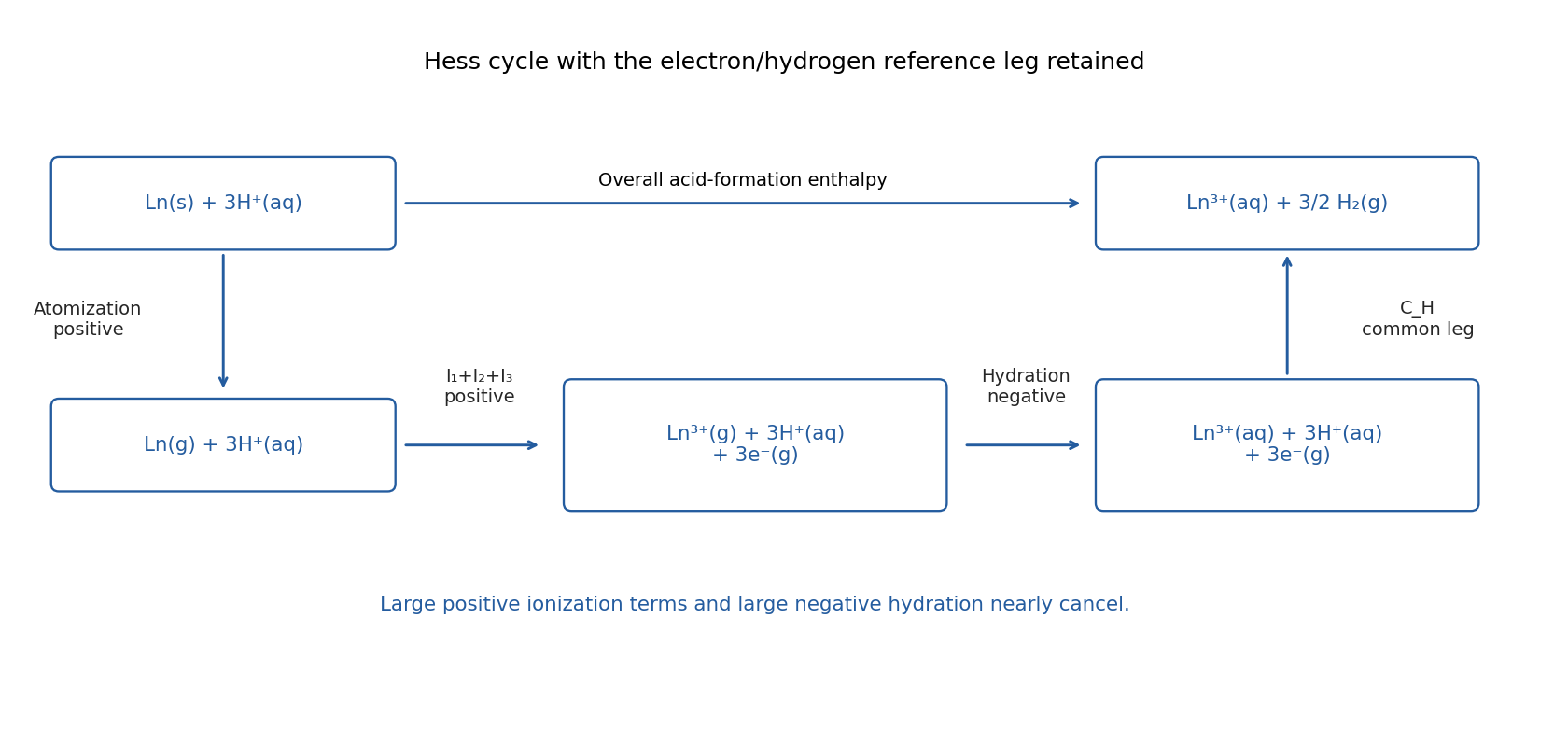
Original Hess cycle separating atomization, three ionizations, hydration and the common aqueous hydrogen reference leg
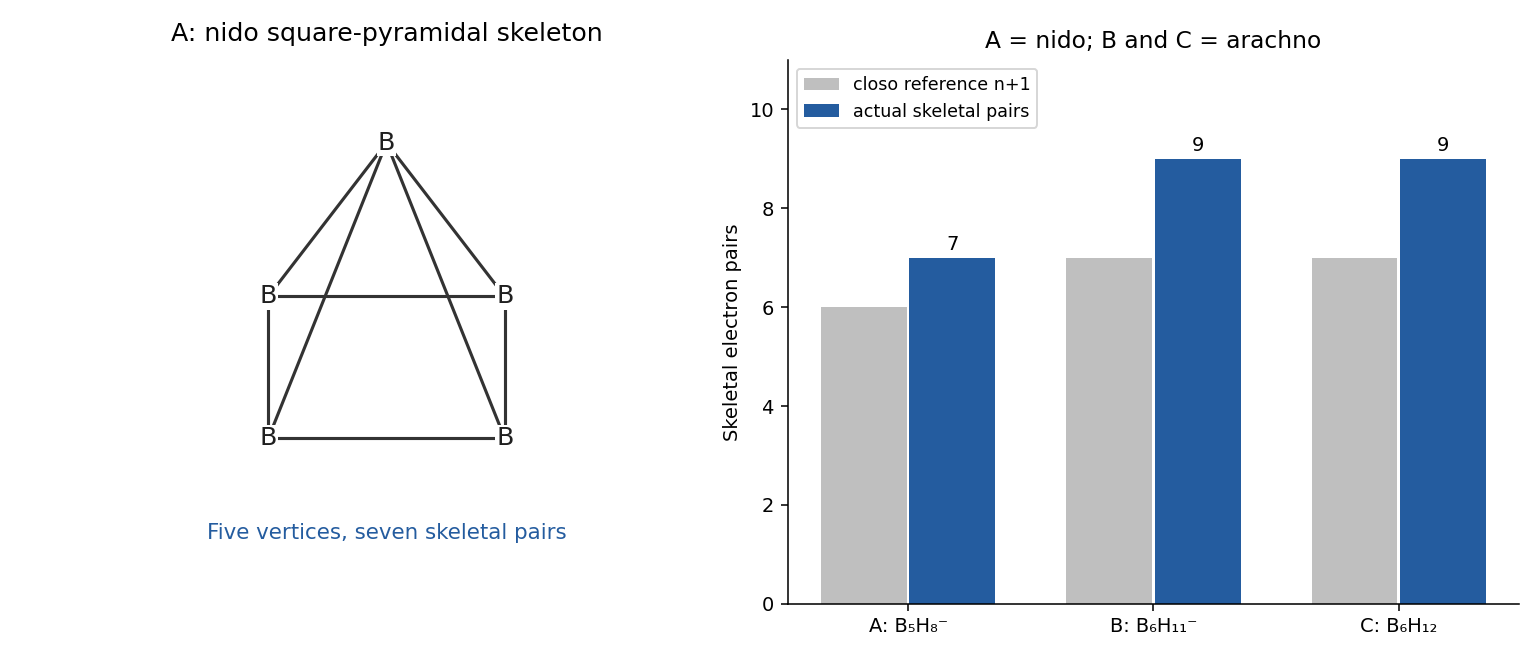
. Details. is nido; and are arachno. The initial hydride removes an acidic bridging hydrogen as a proton, releasing and retaining the potassium counterion. Addition of one unit expands the boron framework; final protonation supplies the neutral hexaborane and KCl. These assignments conserve all the atoms in the displayed sequence, without inserting an unshown dehydrogenation step.
For , take one terminal B–H bond per vertex and remove its electrons from the valence total. The skeletal electron count is . ThusWade's rules assign , and pairs to closo, nido and arachno frameworks respectively. A derives from a six-vertex closo octahedron by removal of one vertex, giving a square-pyramidal boron skeleton. B and C have six-vertex open frameworks formally derived from an eight-vertex closo polyhedron by removing two vertices. Their additional hydrogens are distributed over bridging and other open-face positions; counting every hydrogen as an independent terminal B–H vertex would give the wrong classification.
The arachno assignment of has specific theoretical and NMR support. It should not be replaced by a permanently localized, unrearranged picture: the corresponding symmetric adduct participates in fluxional rearrangement rather than being the lowest-energy structure.[ref]
The Structure of arachno-B6H11-, at -25 degrees C in (CD3)2O, Is Resolved via the ab Initio IGLO-GIAO NMR Procedure by Matthias Hofmann and others. 2000, abstract: arachno minimum, bridging-hydrogen removal from B6H12 and alternative-adduct comparison


Radiation changes the solution's chemistry by radiolysis; it does not turn Am(VI) nuclei into Am(V) nuclei. An emitted alpha particle deposits energy into many water and solute molecules, generating ionized/excited species, hydrated electrons, hydrogen atoms and molecular products including hydrogen peroxide. Reducing products can supply the electron needed forFor example, hydrogen peroxide can be oxidized while reducing two americyl(VI) ions:The mM loss of Am(VI) equals the mM appearance of Am(V), preserving the measured dissolved americium total while transferring of electron equivalents. Oxidizing radiolysis products are also present, and the net reduction depends on acid, dissolved gases and scavengers; not every radiolytic event is reducing. In nitric acid, primary kinetic work identifies hydrogen peroxide and radiolytically produced nitrous acid as important reductants, with a rate controlled by total americium activity rather than necessarily by the instantaneous Am(VI) concentration.[ref]
Kinetics of the Autoreduction of Hexavalent Americium in Aqueous Nitric Acid by Travis S. Grimes and others. 2017, abstract: oxidation-state mass balance, UV–visible measurements and radiolytic reducing agents
React pentaborane with an alkyne under relatively mild conditions to obtain a nido framework, conventionally nido-2,3-dicarbahexaborane(8) for acetylene. The two entering carbon atoms initially retain their adjacency. A specific mild example uses 2-butyne with triethylamine-assisted at or below room temperature to give nido-. This is a practical route to an explicitly nido carborane, rather than an assumption that an alkyne supplies a closo cage under every condition.[ref]
Improved Synthetic Routes to Small Carboranes: Bench-Scale Preparation of nido-2,3-C2B4H8 Derivatives from B5H9 and from B3H8- Salts by Narayan S. Hosmane and Russell N. Grimes. 1979, abstract and preparation discussion: amine-assisted substituted-alkyne reaction under mild conditions
More energetic gas-phase reaction or pyrolysis promotes hydrogen loss, boron-fragment loss and cage rearrangement, giving closo carboranes, for example - and -, with other cage sizes possible in the mixture. Thermolysis of a previously formed nido carborane is an alternative route to this stage. The point is not a clean same-composition nido-to-closo isomerization: the change of hydrogen content and sometimes cage size must be retained in the formulas.
Milder conditions favour kinetically trapped adjacent-carbon products; higher temperatures permit migration to carbon-separated arrangements, often increasing favourable B–C contacts relative to adjacent C–C/B–B contacts. Conditions and Lewis bases also influence which separated-carbon cage is isolated; temperature alone does not prescribe a single quantitative isomer distribution. Primary thermolysis studies and the small-carborane literature document both cage rearrangement and reagent-dependent product mixtures.[ref]
Synthesis of Carboranes from Dihydrocarboranes by Thomas P. Onak and others. 1963, printed p. 3378, introduction and product summary
At this separation the orbital overlap and interatomic two-electron exchange integrals are negligible. Each localized electron then contributes essentially the isolated hydrogen energy, while the interatomic electrostatic terms cancel to leading order for neutral fragments. Including nuclear repulsion in the molecular energy givesThe closed-shell RHF determinant instead doubly occupies . It retains ionic configurations with both electrons on the same atom, even at dissociation. Using atomic units and the Hartree energy in the stated unrelaxed hydrogenic 1s basis, the same-atom two-electron Coulomb integral is . Consequently at infinite separationwhere energies and integrals inside the first expression are in atomic units. It is much too high compared with two neutral atoms. Retaining the leading intersite Coulomb term at gives , still about above UHF. The numerical RHF estimates specify the supplied fixed 1s basis; a larger optimized orbital space changes them. If nuclear repulsion is excluded by an electronic-energy convention, subtract the same from both quoted total molecular energies. The restricted/unrestricted comparison and their dissociation behaviour are unchanged.[ref]
XXXIV. Notes on the molecular orbital treatment of the hydrogen molecule by Charles Alfred Coulson and Inga Fischer-Hjalmars. 1949, pp. 386–393, minimal atomic-1s molecular-orbital treatment
The subbranch spacing gives , hence . Rotation about the C–I symmetry axis has momentC and I lie on this axis, so only the three hydrogens contribute to . If is the I–C–H angle, their perpendicular distances are . Taking integer hydrogen mass givesThe molecular arrangement selects the obtuse solution, so . The supplementary acute angle describes the opposite axial direction, not the bond angle to iodine. This is a rigid-geometry estimate based on an effective rotational constant and the stipulated bond length, rather than a precision equilibrium-structure measurement.