For liquid–gas phase coexistence, make two distinct approximations: the gas obeys the ideal gas law, , and its molar volume greatly exceeds the liquid molar volume, . Here is the molar gas constant and is the saturation pressure of the pure substance. Substitution into the Clapeyron equation giveswhere is any fixed reference pressure, making the logarithm dimensionless. Constant latent heat is a further approximation, needed for the elementary Integrated Clausius-Clapeyron relation below.[ref]
Statistical Physics by David Tong. §5.1.2, “An Approximate Solution to the Clausius-Clapeyron Equation”: the three assumptions and the exponential solution
The neglected liquid molar volume has a transparent error estimate. If the gas is ideal but is retained, thenThus ignoring the liquid molar volume underestimates this slope by a relative amount . This estimate does not bound errors from treating a real gas as ideal or from freezing . Near a thermodynamic critical point, the gas and liquid molar volumes approach each other and these dilute-vapor assumptions fail.
If the molar latent heat is approximately constant on the chosen temperature interval, the Ideal-vapor Clausius-Clapeyron approximation integrates toFor , higher absolute temperature gives higher saturation pressure. A plot of against inverse temperature is a straight line of slope . One reference pair fixes its intercept. On a per-unit-mass basis replace by , with and the molar mass; using in with the molar would give incompatible units.
If only the constant-latent heat approximation is relaxed, the same ideal-vapor model instead givesConsequently an apparent straight-line fit across a broad temperature range need not represent a single material constant. The simple exponential also approaches a finite value as ; this is a property of the stipulated formula, not a prediction that liquid–gas phase coexistence extends beyond a thermodynamic critical point.
Consider an unnamed model substance with molar latent heat and saturation pressure at . Stipulate the Ideal-vapor Clausius-Clapeyron approximation throughout , constant , and . These parameters define an illustrative model, not a measured dataset or a fit to water. At ,At the reference state the gas molar volume is , and the local slope is . The tangent estimate is much lower than the integrated result: a local derivative should not be extrapolated over this whole interval. By contrast, over a small temperature increment, the fractional sensitivity is .
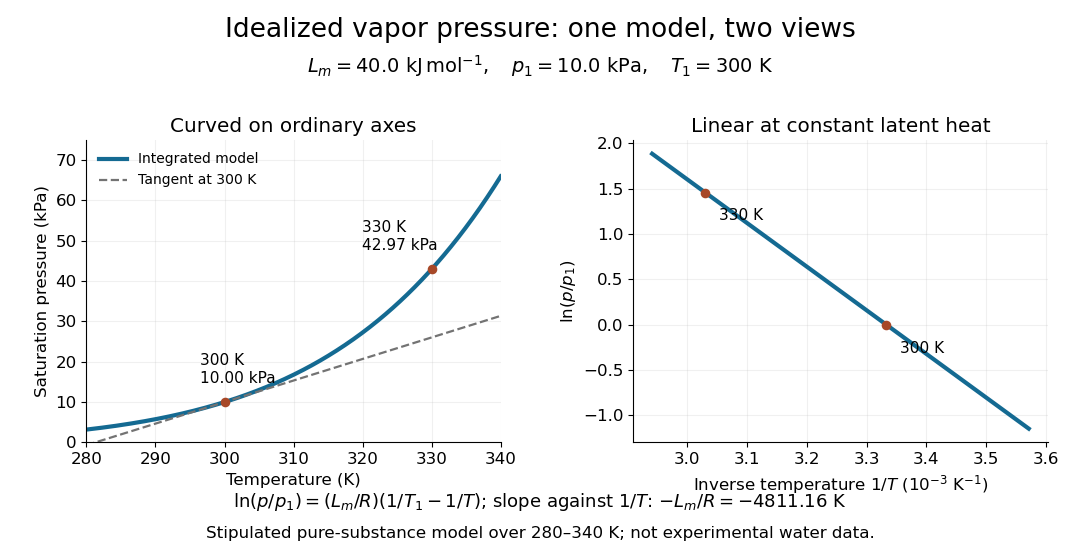
Stipulated saturation pressure versus temperature and its linear logarithm versus inverse temperature
. Details. 
Within the Ideal-vapor Clausius-Clapeyron approximation, a local slope of the natural logarithm of saturation pressure against inverse temperature estimates the molar latent heat:In the stipulated vapor-pressure calculation, the slope is , which recovers . For variable , a two-point estimate gives an average weighted by , rather than the latent heat at an arbitrary midpoint. Differentiating noisy pressure measurements amplifies their errors. Outside the ideal-vapor regime, use independently determined molar volumes in ; a straight-looking graph alone cannot establish that the gas is ideal.
Articles by others on the same topic
There are currently no matching articles.