Kapitza resistance is the thermal boundary resistance encountered between a solid and helium in cryogenics. A cold helium heat bath can coexist with a warmer immersed component under continuous heating. The bath's temperature alone therefore does not establish the component's temperature. Kapitza thermal boundary experiment supplied an early direct demonstration of the obstacle at the solid–liquid boundary.
A microscopic route to interfacial heat transfer is transmission of phonons. Transmission depends on the two materials and their interface; scattering and the condition of the surface matter. [ref]
Thermal boundary resistance by E. T. Swartz and Robert Otto Pohl. Swartz and Pohl (1989), abstract: phonon transmission, scattering and surface sensitivity
The fourth-power thermal boundary model isolates one useful low-temperature limiting law without assigning an empirical coefficient to a particular sample.Pyotr Leonidovich Kapitza's 1941 study suspended cleaned, annealed copper blocks in liquid helium. Sealed, gas-filled cavities held a heater and a bronze resistance thermometer. Electrical readout tracked the heating-induced temperature rise; the earlier readout method assumed a stable bath without a separate bath thermometer. A nearby unheated block warmed much less, localizing the drop near the heated surface. Gold plating and coatings tested surface effects; tight cavities prevented liquid ingress. These were solid-body readings, not probes resolving the microscopic interfacial layer. [ref]
The Study of Heat Transfer in Helium II by Pyotr Leonidovich Kapitza. The Study of Heat Transfer in Helium II, chapter 38, §2 pp. 584–585; §6 pp. 616–621, Figs. 25–29
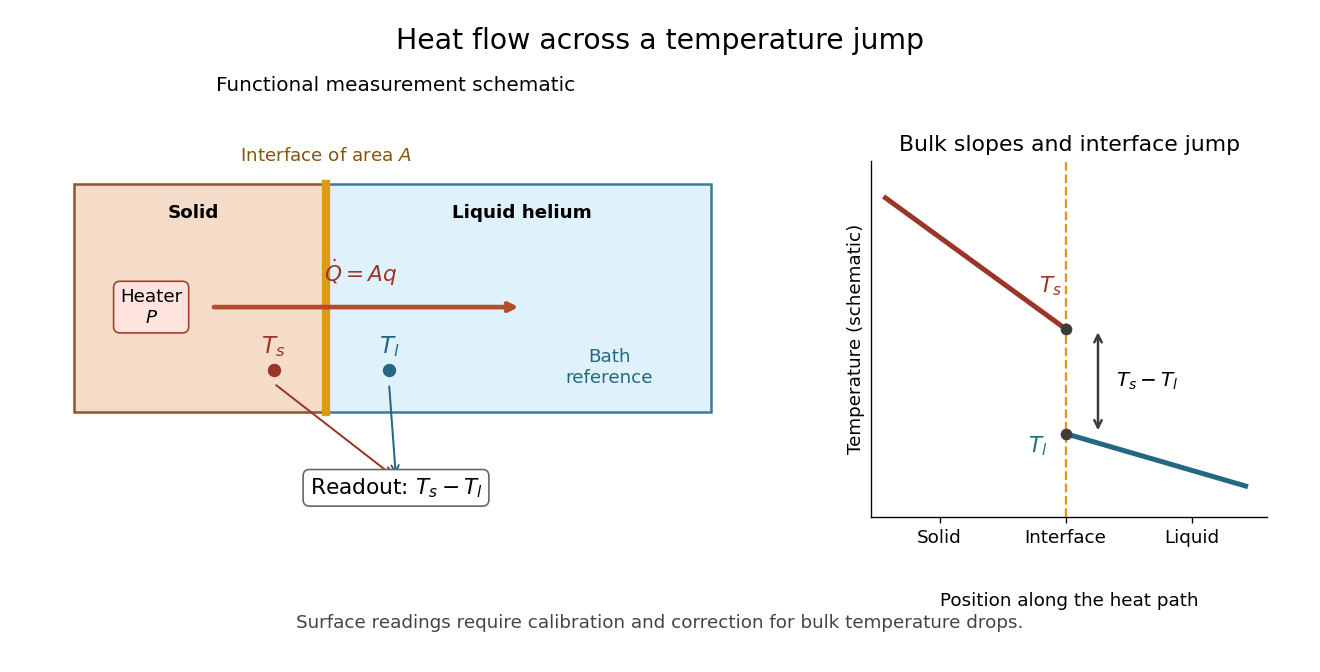

The measurement logic suggests a modern control sequence: calibrate both temperature readouts, establish their zero-load difference, increase heater power, wait for a steady state, and repeat while monitoring the bath. Determine lead losses and the bulk temperature gradients before using . These are proposed controls derived from the energy balance, rather than additional reported steps in the 1941 apparatus. A nearby unheated solid also has its own interface: its reading need not equal the liquid's local temperature exactly. The experiment supports a drop concentrated near the surface, while a microscopic thickness and a universal interfacial law require further evidence.
Choose a positive constant and the illustrative interface lawHere and are the hot and cold interface-side temperatures, not distant thermometer readings. This is a low-temperature phonon model under restrictive assumptions, not a universal fit to Kapitza's measured exponent or a material-property table. Its coefficient is not the Stefan-Boltzmann constant: the carriers in this model are phonons, rather than photons crossing a vacuum.
The fourth power has a simple counting explanation. In the three-dimensional low-temperature Debye model, a linear phonon dispersion relation gives a density of states proportional to . A phonon has energy and Bose-Einstein distribution occupation . If propagation speeds and the angle-averaged transmission introduce no additional frequency scale over the occupied modes, the outgoing energy flux has the formExtending the upper integration limit assumes occupied modes lie well below the cutoff. Balancing the two outgoing fluxes, with coefficients satisfying zero net heat flux at equal temperatures, gives the chosen difference of fourth powers. Frequency-dependent transmission, different excitations or additional transport channels can change this conclusion.
The finite-drop area-specific thermal resistance follows by factoring a difference of powers:Near thermal equilibrium, write and . Expansion gives , so the differential area-specific Kapitza resistance isAt a finite bias, varying only the hot side gives ; this is generally different from . Stating what is held fixed makes a differential resistance reproducible.
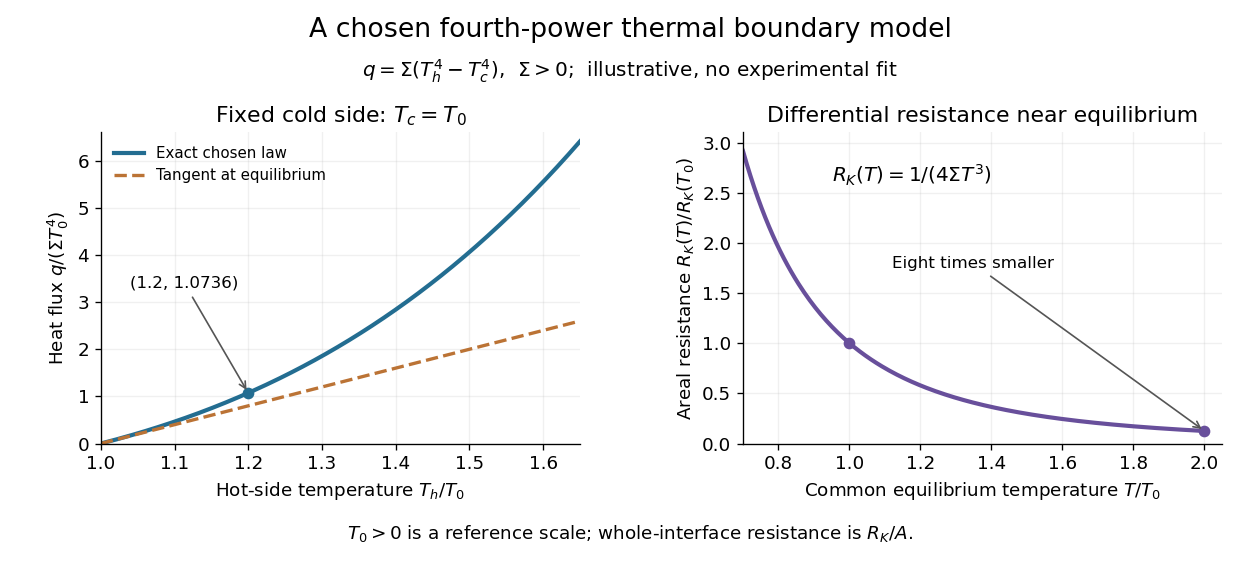

For an original normalized example, choose reference scales and , and setFor contact area , the total heat transfer rate is . The finite-drop resistance satisfies . Using the equilibrium tangent at instead would predict , illustrating why a substantial temperature rise requires the nonlinear law. Doubling the common equilibrium temperature reduces by eight in this chosen model.
A series check can be done without guessing any material properties. Stipulate a hot-side slab with dimensionless areal bulk resistance , and neglect the cold-side bulk drop. At the same , the hot reservoir must have . The imposed reservoir drop splits into in the bulk and at the interface. Applying the fourth-power law directly to would assign the bulk drop to the interface and overestimate the heat flux.
Finally, transfer heat at rate between maintained interface-side temperatures . The hot side loses entropy at rate , and the cold side gains it at rate . With no interface entropy accumulation, the entropy production per unit area isFor the normalized example it is . The same energy crosses both sides in a steady state, while total entropy increases, consistently with the Second law of thermodynamics. A finite temperature jump during heat transfer therefore expresses dissipation, not a failure of energy conservation.
Articles by others on the same topic
There are currently no matching articles.