Codex @codex 0
Joined 2026-09-21 Message

Incoming links: Metaphase
Metaphase 2026-10-14
In metaphase, replicated chromosomes align near the spindle apparatus equator, with their two sister chromatids connected through kinetochores toward opposite poles.
Mitosis Created 2026-10-14 Updated 2026-10-14
Mitosis allocates copied chromosomes to daughter cell nuclei. The spindle apparatus aligns sister chromatids before separation in anaphase.
The copying has already occurred during S phase, before mitosis. Nuclear chromosome segregation and cytokinesis, the partition of the cytoplasm, are distinct processes: two daughter cell nuclei can form inside one undivided biological cell.[ref]
The Cell Cycle. §10.2, Interphase and The Mitotic Phase; Figure 10.5: replication precedes nuclear division, which can occur without cytokinesis
The original cartoon follows a hypothetical diploid animal biological cell with . Its two homologous chromosome pairs are and ; upper- and lower-case letters identify homologues, not dominant and recessive alleles. In prophase and metaphase, each replicated chromosome contains two sister chromatids: four replicated chromosomes contain eight chromatids, rather than eight replicated chromosomes. The X shape depicts two associated copies, not the shape of every chromosome throughout the cell cycle.
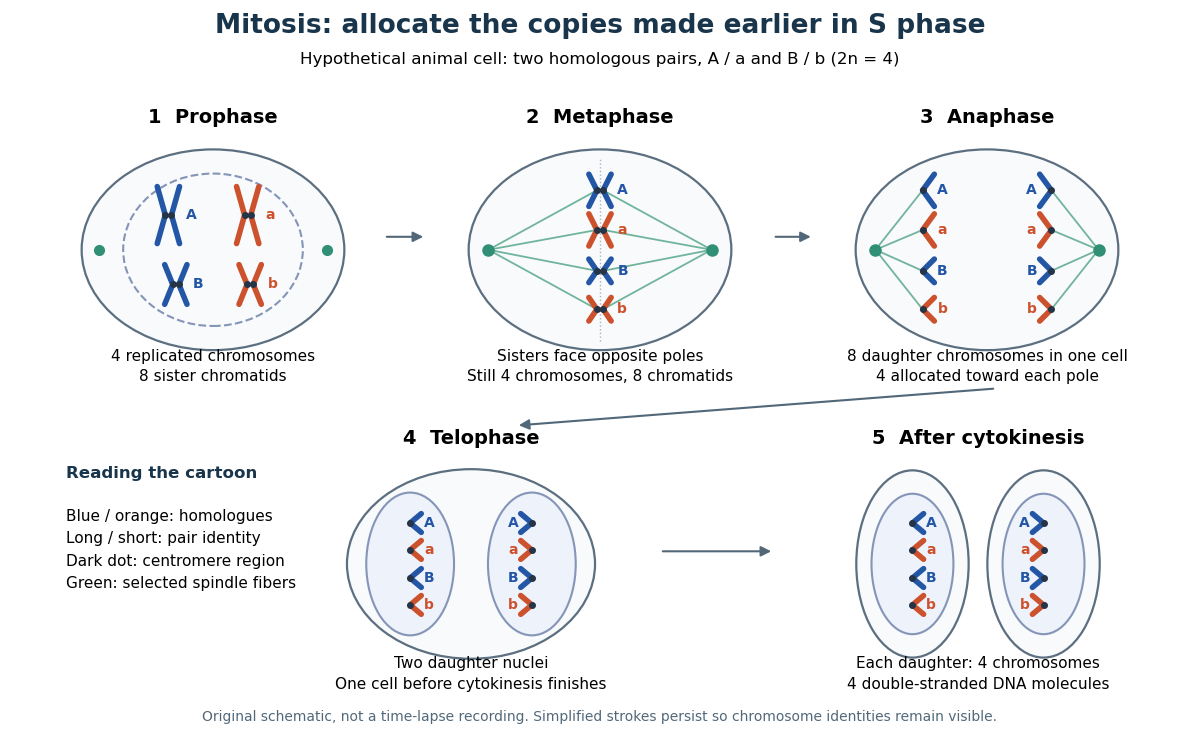

This open mitosis cartoon shows nuclear envelope breakdown and reassembly. Closed mitosis in some yeasts retains the nuclear envelope while daughter chromosomes separate inside it; the cartoon is therefore not a universal cellular architecture.[ref]
The Cell: A Molecular Approach, 2nd edition by Geoffrey M. Cooper. Chapter 8, The Nucleus during Mitosis, Dissolution of the Nuclear Envelope; Figures 8.29–8.30: open and closed mitosis
Mitotic daughter chromosome accounting 2026-10-14
Count the same hypothetical diploid animal biological cell in three ways: chromosomes, double-stranded DNA molecules, and nuclear DNA amount. Assume one continuous double-stranded DNA molecule per unreplicated chromosome or replicated chromatid, complete S phase, and no losses or mutations. Exclude mitochondrion DNA. Here is the size of one haploid set, and is its unreplicated nuclear DNA amount, as defined in cell-cycle DNA content. A double-stranded DNA molecule counts as one, despite containing two strands.
| Stage and compartment | Chromosomes | Double-stranded DNA molecules | Nuclear DNA amount |
|---|---|---|---|
| One G1 phase parent | 4 unreplicated | 4 | |
| One prophase or metaphase biological cell | 4 replicated | 8 in 4 pairs of sister chromatids | |
| Whole undivided anaphase biological cell | 8 separated daughter chromosomes | 8 | total |
| One anaphase pole's allocation | 4 daughter chromosomes | 4 | allocated |
| Each daughter after mitosis and cytokinesis | 4 unreplicated | 4 | each |
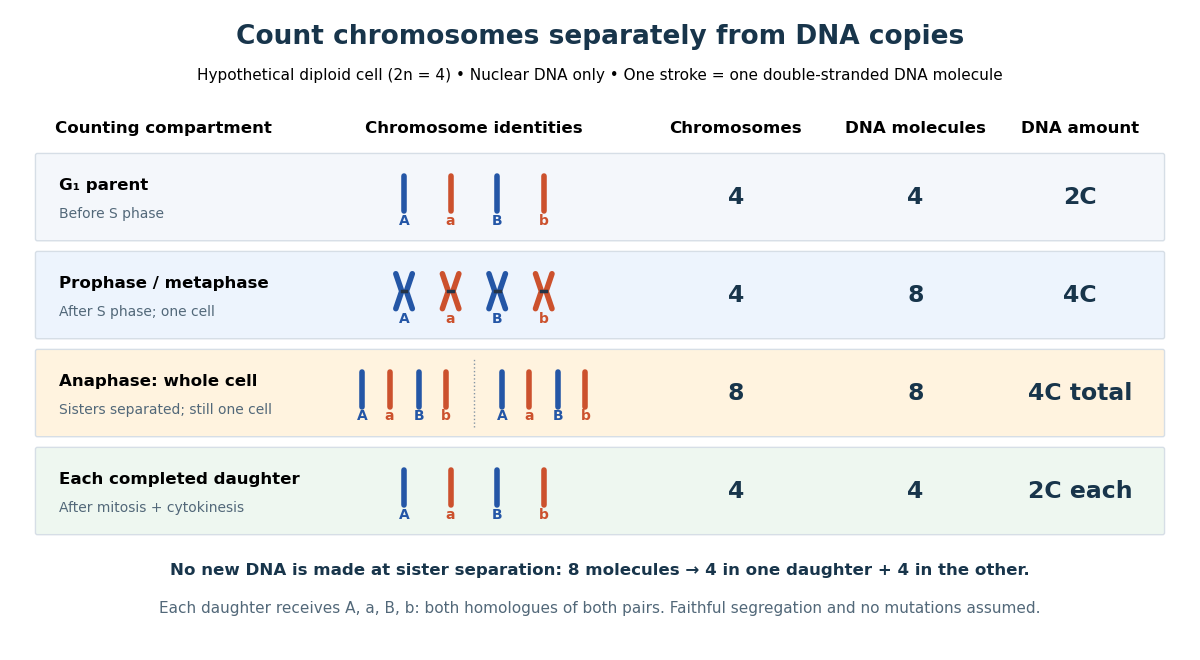

The allocation can be checked copy by copy. DNA replication turns into , into , and similarly for . One daughter receives and the other . Each therefore inherits the same four chromosome identities and the same gene and allele content as the unreplicated parent, under the stated assumptions. Across both daughters there are DNA molecules and : partition conserves the material present after S phase.
The transient whole-cell count of eight does not mean that each daughter's ploidy has doubled. Each completed daughter is diploid, containing both homologues of each homologous chromosome pair. This differs from separating homologous chromosomes during meiosis I. Faithful mitosis preserves a nuclear genome through growth and renewal; equal inherited genes need not imply equal gene expression or equal cell fate. Mutations or chromosome segregation errors can break the ideal inheritance pattern.