Part II advanced option in the held 2022 papers. The source examination is shared by the psychology (experimental) course of the University of Oxford and the psychology, philosophy and linguistics course of the University of Oxford.
Solutions to all six essay options in the multisensory perception: attention, integration, and development course of the University of Oxford examination held on 24 May 2022. The examination required three options; all six are covered here, with each answer below 1,800 words. The scientific evidence used was published before the examination. Source release: released examination archive. The held PDF prints A16860W1; the archive contains two byte-identical members, including a16860w1.pdf. Original figures below illustrate stated models, not measured participant results.
Crossmodal correspondences differ meaningfully in what is associated, how the association is acquired and where it affects performance. A matching preference, a response-compatibility effect and altered perceptual binding are distinct observations. They need not have distinct underlying causes, and a single correspondence can have several causes.
A crossmodal correspondence is a systematic relation between attributes in different sensory modalities, such as auditory pitch and visual size. It does not require either stimulus to generate an extra conscious sensation. Thus it should not automatically be classified as developmental synesthesia, where stable inducer–concurrent experiences may be highly individual. Nor is correspondence equivalent to multisensory integration: judging that two attributes fit together does not establish that information from them was combined into one estimate.
Three useful explanatory distinctions concern sensory organization, environmental statistics and meaning. A structural crossmodal correspondence would arise from shared coding or magnitude organization; this predicts a relation surviving changes in labels and response assignments. A statistical crossmodal correspondence would link features repeatedly generated by the same objects. For example, geometrically similar resonators with a fixed wave speed have characteristic frequencies scaling approximately as inverse size: from , increasing lowers . This conditional physical relation can make pitch–size coupling informative, but different materials, tensions or sound-production mechanisms can reverse a simple rule. A semantic crossmodal correspondence can link dimensions through language or common concepts: “high” can describe pitch and elevation. An affective crossmodal correspondence could instead be mediated by shared pleasantness, which should be separated from a direct relation between sensory dimensions. These are explanatory hypotheses, not mutually exclusive boxes established by the appearance of a pairing.
Some correspondences are relative rather than absolute. A tone can be the higher member of one pair and the lower member of another. An experiment should therefore manipulate comparison range and context, rather than assuming that every participant has one fixed pitch-to-size conversion. Relations can also be asymmetric: an irrelevant sound might alter a visual response without a visual stimulus equivalently altering auditory judgment. Asymmetry can arise from task reliability or attention, so it does not by itself establish a one-way anatomical connection.
A comparative experiment provides an important constraint. Vera U. Ludwig and colleagues tested 33 humans and six chimpanzees on matching black and white squares while irrelevant high or low tones were played. Both groups performed better for high-pitch/white and low-pitch/black pairings; in chimpanzees the effect was expressed particularly in errors, whereas human errors were near floor and reaction times were more informative. Both species used a touchscreen and loudspeaker arrangement.[ref]
Visuoauditory mappings between high luminance and high pitch are shared by chimpanzees and humans by Vera U. Ludwig and others. PNAS 108, 20661–20665; Results, Apparatus and Procedure
This makes a human-language-only account inadequate for that mapping. It does not distinguish inherited organization from every form of nonlinguistic learning: the animals had substantial task experience, and shared environments can also generate shared associations.A stronger test of perceptual consequences changes the dependent variable. Cesare Valerio Parise and Charles Spence presented small/large visual stimuli with high/low tones and manipulated audiovisual timing or position. Participants judged temporal order or spatial discrepancy, rather than simply reporting which pairing they preferred. Matched pairings produced poorer access to the intersensory discrepancy, interpreted as stronger coupling.[ref]
When Birds of a Feather Flock Together: Synesthetic Correspondences Modulate Audiovisual Integration in Non-Synesthetes by Cesare Valerio Parise and Charles Spence. PLoS ONE 4:e5664; Experiments 1–3
This illustrates why increased binding need not improve every task: reducing conflict between estimates can make the conflict itself harder to discriminate. A changed discrimination threshold still needs controls for distraction, detectability and decision strategy; it does not uniquely identify a perceptual fusion mechanism.To distinguish mechanisms experimentally, first obtain unisensory detection and discrimination measures and equate unintended salience differences. Then compare explicit matching, speeded classification, conflict discrimination and judgments of a common object. Counterbalance response keys and reverse stimulus–response mappings. A congruency effect that follows the response rule suggests compatibility at a decision or motor stage; persistence under orthogonal response rules constrains that explanation. Fit psychometric functions to conflict judgments and estimate bias, slope and lapses separately. A shift in subjective equality and a loss of sensitivity are different outcomes.
Next manipulate experience. Randomly assign participants to congruent, reversed or uncorrelated audiovisual training with equal exposures, and test untrained exemplars and delayed retention. A reversible mapping with transfer supports an experience-dependent contribution; failure to reverse it does not prove innateness, because training may be weak or poorly measured. Cross-language comparisons with nonverbal responses can test whether a shared word is necessary. Infant or nonhuman results can constrain linguistic explanations, but age differences, task accessibility and species-specific response demands remain possible confounds. For a pleasantness account, collect independent pleasantness ratings and select or manipulate stimuli so that hedonic matching varies separately from the sensory pairing. These are proposed discriminating designs, not asserted experimental results.
The most useful classification therefore combines origin, representational content and measurable consequence. Correspondences are scientifically informative when their predicted transfer, context dependence and effects on sensitivity distinguish them from mere agreement about labels or response keys.
Single-unit recording has been exceptionally fruitful in identifying where and under what conditions multisensory signals interact. Its contribution to human perception is mechanistic and constraining; one cell's discharge is not a complete account of a conscious multisensory event. The strongest conclusions combine cellular recording with behavior, perturbation and models at a comparable computational level.
The essential advance is resolution. An extracellular electrode can isolate action potentials from a neuron, allowing experimenters to map its receptive fields in several sensory modalities, vary stimulus timing and intensity, and compare repeated trials. A cell responsive to light and sound demonstrates convergence at the output of that cell, rather than merely neighboring visual and auditory activity within one imaging voxel. Yet lack of an overt auditory response does not establish lack of auditory input: an input can modulate responsiveness without crossing the cell's firing threshold by itself.
Classic experiments by M. Alex Meredith and Barry E. Stein compared visual, auditory and somatosensory stimuli individually and in combination in the cat superior colliculus. Deep-layer neurons showed enhancement or depression when modalities were combined; many sampled cells had access to descending pathways relevant to orienting.[ref]
Visual, auditory, and somatosensory convergence on cells in superior colliculus results in multisensory integration by M. Alex Meredith and Barry E. Stein. J Neurophysiol 56, 640–662; comparisons of unimodal and combined responses and descending projections
This supplied an experimentally tractable mechanism for using several weak cues to guide an action. It did not require a distinct central place where every sensation becomes conscious.Response enhancement must be defined against an explicit benchmark. Let and be mean stimulus-evoked spike counts after subtracting the matched spontaneous count, and the similarly corrected paired response. Enhancement above the strongest input means . Superadditive multisensory response means the stronger condition . A response can satisfy the former without the latter. Subtracting baseline consistently matters because summing two raw counts also sums spontaneous activity twice. Trial variability and the analysis window determine whether an apparent inequality is statistically credible.
The spatial and temporal rules added testable organization. Mapping stimulus positions relative to each modality's receptive field showed that spatial alignment could favor enhancement, while other arrangements could yield suppression.[ref]
Spatial factors determine the activity of multisensory neurons in cat superior colliculus by M. Alex Meredith and Barry E. Stein. Brain Res 365, 350–354; spatial arrangement relative to receptive fields
Subsequent timing experiments found maximal enhancement when modality-specific peak discharge periods overlapped, with weaker or even depressive interactions at other offsets.[ref]Determinants of multisensory integration in superior colliculus neurons. I. Temporal factors by M. Alex Meredith and others. J Neurosci 7, 3215–3229; response-train overlap and temporal-disparity manipulations
The relevant coincidence is neural, so equal physical onset times need not maximize a cell's interaction.Inverse effectiveness further challenged an account based only on strong signals: the percentage enhancement was often largest when the isolated stimuli evoked weak responses. But the percentage measure itself needs care. If and , enhancement above the strongest response is 300%; if the corresponding values are 20, 20 and 26, it is 30%, although the absolute increment is six in both examples. These invented numbers illustrate a denominator effect, not a measured neuron. Percentage enhancement, absolute gain, information and behavioral benefit are distinct. Weak inputs can give biologically important interactions, but a large ratio alone is not enough to establish special multiplication or perceptual optimality.
Cellular and behavioral definitions of integration also differ. Faster responses to audiovisual than to either unisensory stimuli might arise from a redundant-signals race model: two channels race to trigger a response. If context-invariant channel completion times are , thenThis race model inequality follows from the union bound and does not require independent channels. Violation rejects that race account under its assumptions, but does not identify which collicular or cortical cells produced the effect. Conversely, a nonlinear cell response need not produce a detectable behavioral advantage if other stages limit performance.
Translation to humans requires care about species, sampled structure, task and state. The superior colliculus is well suited to studying orienting, but flavor identity, speech comprehension and deliberate causal judgments need additional circuits. Animal preparation and restraint can change the operating state; a sampled cell population may not represent every multisensory computation. Spiking also reflects recurrent and descending influences, not just a feed-forward meeting of modalities. Human functional magnetic resonance imaging has broader coverage but coactivation cannot establish convergence in one neuron. Timing measures, eye movements, psychophysical cue conflicts and causal perturbations provide complementary constraints.
A useful bridge is to ask whether cellular mechanisms predict a specific human outcome: which weak cue improves localization, which offset permits binding, or when a distractor suppresses orienting. Multisensory cue integration models predict changes in estimates and uncertainty, which are not the same quantity as firing-rate enhancement. Development and learning must also be tested rather than inferred from mature animal responses. Single-cell work supplied fundamental interaction rules and plausible circuit operations; explaining human multisensory experience requires linking those operations to population codes, task-specific decisions and causal behavioral evidence.
Multisensory signals lose synchrony through propagation, receptor and neural delays, and the temporal structure of the event itself. Perceived simultaneity is maintained by tolerance, calibration and inference about common causes, rather than by an infallible clock that makes every channel arrive together. Physical simultaneity, simultaneous receptor stimulation and subjective simultaneity are different quantities.
For an audiovisual event at distance , let auditory and visual propagation speeds be , and processing delays to a specified comparison stage be . A simple internal arrival-time difference, auditory minus visual, isThis follows by subtracting the two sums of travel time and processing delay. At 10 m, using m/s and m/s, the propagation term is about 29.15 ms; at 100 m it is about 291.54 ms. These are calculations under fixed conditions, not perceptual thresholds. Sound speed varies with the medium and temperature. A fixed neural correction could compensate one distance but cannot eliminate propagation differences at every distance.
The neural terms are not fixed constants either. Phototransduction, cochlear transduction, peripheral conduction, stimulus intensity, contrast and the pathway used to define a response can affect latency. A weak or ambiguous stimulus can require more evidence before a decision. Attention, expectations and the selected feature may affect reported timing, without requiring a change in the physical stimulus. A neural onset response, identification response and button press do not mark the same stage. Therefore a reported audiovisual delay should not be casually equated with a single axonal conduction time.
Some apparent desynchronization originates in the source. Lip and jaw movements can precede the acoustic release of speech. A seen hand movement can precede contact and its sound; food handling, oral touch, dissolved tastants and retronasal odor release have different physical time courses. Reverberation can add later auditory energy. Electronic capture, buffering and displays can introduce additional modality-specific delays. The useful goal is consequently to recover whether signals belong to one event and when that event occurred, not to force equal onsets for all its components.
One solution is a temporal binding window: a range of disparities within which signals can be grouped or judged as simultaneous. The window is measured through a specified task, not a universal duration. In a simultaneity judgment, report probability often has a peak around a point of subjective simultaneity. In a temporal order judgment, performance changes from one reported order to the other across offsets. Those measures can differ because their decisions and criteria differ. A broad simultaneity function can reflect uncertain timing or a liberal response criterion; it does not uniquely measure a long neural integration window.
Consider a Gaussian simultaneity decision model. Let physical auditory-minus-visual onset difference be , stable internal offset , and Gaussian timing noise of standard deviation . If the observer reports simultaneous when , thenThe expression is the probability that the noisy difference falls between the two decision bounds. Its center is for symmetric bounds and noise. Increasing makes the observer more tolerant; increasing makes timing less precise. A shift in , a criterion change and extra noise can thus alter different aspects of a measured curve. This is an illustrative model, not a fitted account of the experiment below.
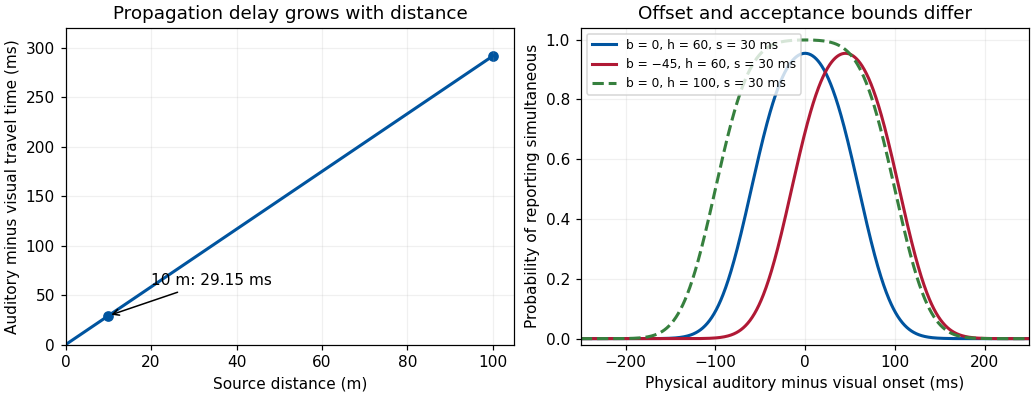
Original propagation calculation and Gaussian simultaneity-decision examples; model parameters are illustrative, not measured temporal binding windows
. Details. 
Temporal recalibration shows that the offset is adaptable. Waka Fujisaki and colleagues repeatedly paired tone pips and ring flashes at a fixed lag, then measured judgments across test lags. Initial adaptation lasted three minutes with brief re-adaptation before tests. Subjective simultaneity shifted toward the experienced lag; changes in an auditory-induced visual illusion gave evidence beyond a simple change in verbal simultaneity responses.[ref]
Recalibration of audiovisual simultaneity by Waka Fujisaki and others. Nat Neurosci 7, 773–778; Simultaneity judgments and illusion transfer
The adjustment was partial, not exact cancellation of the exposure lag. Transfer constrains a purely task-specific response explanation, but does not locate one unique neural clock or exclude all decision contributions.A complementary strategy is Bayesian causal inference in perception. In a toy Bayesian model, a measured discrepancy has Gaussian variance , while a common-event prior favors discrepancy zero with variance . Completing the square in the product of likelihood and prior proves the Gaussian temporal-discrepancy shrinkage relationThus noisy discrepancies can be pulled toward coincidence. This is a conditional model of one-event inference. A system must also allow separate causes: otherwise a loud unrelated sound would be bound to any nearby flash. Spatial agreement, identity, semantic fit, repeated correlation and action–outcome contingencies can affect that causal judgment. A large discrepancy can lead to segregation rather than endless recalibration.
Calibration and tolerance have costs. A wide acceptance range can stabilize a natural event while merging unrelated events; strong adaptation can help with a delayed device but temporarily bias judgments after it is removed. A convincing experiment therefore controls device timing, intensity and spatial cues, distinguishes order from simultaneity reports, and tests transfer and recovery. Perceptual unity is a flexible estimate supported by delayed and noisy evidence; it preserves useful event structure without guaranteeing veridical timing in every circumstance.
Practice contributes substantially to compensatory performance after sensory loss, but evidence for selective crossmodal recruitment and causal changes in neural contribution goes beyond an account based solely on accumulated task repetitions. Practice and plasticity are not mutually exclusive: practice can induce neural change, while deprivation can change which circuits practice recruits.
The first requirement is to specify the claimed enhancement. Better tactile discrimination, peripheral visual localization and visual motion detection are different outcomes. Accuracy can improve because of sensory precision, attention, memory, a decision criterion or a slower response. There is no inference from success on one selected task to a universal sharpening of the remaining senses. Sensory loss also differs in onset, completeness, cause and duration. Early blindness, late blindness and temporary blindfolding cannot be treated as equivalent experiments.
A practice account predicts learning with repeated use, specificity to trained inputs and possible transfer to related tasks. A deprivation account predicts changes associated with absent input even when practice is matched. Both can operate, and a statistical difference between groups cannot by itself separate them: daily experience, motivation and selection into a study can differ along with sensory status. Years of Braille use, for example, are not randomly assigned. Comparing blind and sighted experts is more informative than comparing one expert group with novices, but expertise matching does not remove every difference in lifetime experience.
A controlled human study by Lotfi B. Merabet and colleagues used five days of complete blindfolding in normally sighted adults during intensive tactile training, with non-blindfolded training controls. Tactile stimulation increasingly recruited occipital cortex in the deprived group. Disrupting occipital function with repetitive transcranial magnetic stimulation impaired Braille-character discrimination in the blindfolded group on day five, but not in controls; the differential disruption was absent 24 hours after blindfold removal. The imaging response also reversed rapidly.[ref]
Rapid and reversible recruitment of early visual cortex for touch by Lotfi B. Merabet and others. PLoS ONE 3:e3046; Results, TMS results and Discussion
The imaging and stimulation arms used different participants, so one should not claim a within-person correlation between their measures.This combination is more informative than cortical activation alone. Both groups received training, yet the deprived group temporarily depended on a different cortical contribution. Rapid reversibility is compatible with altered weighting or unmasking of existing connections; it does not require wholesale growth of new long-range pathways in five days. The result establishes a functional contribution under the tested state, not that occipital recruitment is sufficient for every tactile gain. Stimulation can affect a network, and the study cannot directly equate sudden reversible deprivation with lifelong blindness. Nor is the persistence of learned skill after the imaging effect disappears paradoxical: skill can remain while the supporting network changes.
A complementary causal result comes from Stephen G. Lomber and colleagues' experiments in congenitally deaf cats. Compared with hearing cats, these animals showed enhanced peripheral visual localization and motion detection on particular tasks. Reversible cooling of posterior auditory cortex removed the localization advantage, whereas cooling a dorsal auditory region removed the motion advantage.[ref]
Cross-modal plasticity in specific auditory cortices underlies visual compensations in the deaf by Stephen G. Lomber and others. Nat Neurosci 13, 1421–1427; visual task battery, reversible deactivation and double dissociation
Cooling provides an experimental contrast between a functioning and temporarily deactivated circuit. The task-specific double dissociation argues for functionally differentiated recruitment, rather than one undifferentiated increase in effort. The evidence is from cats and does not quantify the contribution of practice versus deprivation in humans.A double dissociation is powerful but not magical. To interpret it, one must check that deactivation does not merely impair movement, alertness or basic visibility, and that tasks are not placed at incomparable difficulty levels. The existence of a recruited circuit identifies part of the implementation, not the entire developmental cause. Extensive experience could help establish that circuit's new role. Thus the strict opposition “neural reorganization or practice” confuses a mechanism with one possible source of the mechanism.
A discriminating program would measure performance before training, randomly assign normally sighted participants to matched training with or without temporary deprivation where appropriate, and follow learning and recovery. For established sensory loss, longitudinal observations and carefully matched comparison groups can constrain onset and experience effects without pretending that sensory loss can be freely randomized. Untrained tasks, different body sites or stimulus dimensions, delayed tests and speed–accuracy measurements distinguish broad transfer from repeated response memorization. Peripheral sensitivity should be checked before attributing every difference to cortex. These are design recommendations, not invented completed studies.
Measurement also needs a mechanistic bridge. Fitting psychometric functions can separate threshold and lapse changes; signal detection theory can distinguish sensitivity from a shifted decision criterion under explicit assumptions. Imaging identifies candidate recruitment, while causal disruption tests contribution. Neither activation magnitude nor a lower threshold alone establishes a “better” brain, and an adaptation useful for one task may create costs elsewhere. Residual input, age of onset and the sensory dimension previously calibrated by the missing modality can all constrain outcomes. Enhancement and impairment can coexist in the same person.
The evidence therefore supports an interaction among altered input, experience and circuit availability. Some compensation is task practice, some reflects state-dependent or developmental changes in neural recruitment, and the strongest explanation specifies how those factors cooperate rather than assigning every gain to only one.
Crossmodal correspondences can guide a sensory-substitution code toward distinctions users can learn and retain, but intuitive mappings do not guarantee useful spatial information or effortless perception. Design must respect both the information supplied by the device and the limitations and goals of the remaining sensory system.
A sensory substitution system captures information normally available through one sensory channel and recodes it for another. A camera-to-sound device does not restore photoreceptors: an auditory listener learns to interpret a controlled relation between image properties and sounds. That differs from multisensory cue integration, where two functioning channels provide estimates of the same event. Residual vision, touch or action can nevertheless interact with the substituted information, so integration and substitution can coexist in actual use.
Historically, Paul Bach-y-Rita and collaborators investigated television-camera information presented through tactile stimulation. Their 1969 report established an early experimental program for tactile image projection as an aid and as a test of sensory processing.[ref]
Vision Substitution by Tactile Image Projection by Paul Bach-y-Rita and others. Nature 221, 963–964; apparatus rationale and early substitution report
This history matters because useful access to object structure need not reproduce the original receptor input. A successful task, however, does not by itself establish that the participant has acquired ordinary visual experience.A concrete engineering example is Peter B. L. Meijer's vOICe. The original system sampled camera images and scanned columns from left to right. Horizontal position became time within the scan, vertical position became tone frequency, and pixel brightness controlled amplitude. A computer-based inverse reconstruction tested preservation of image information in the acoustic code; the 1992 paper explicitly distinguished that engineering result from an established resolution of human perception.[ref]
An experimental system for auditory image representations by Peter B. L. Meijer. IEEE Trans Biomed Eng 39, 112–121; Abstract and Image-to-Sound Mapping
An invertible signal representation can still be difficult for a listener to decode.For illustration, let be brightness at row and column , with row index increasing upward. During column a simple encoder outputsThe scan schedule labels horizontal position; the frequency labels vertical position; labels brightness. Under ideal sampling and orthogonal tones, amplitude extraction recovers the column coefficients. Finite presentation times, masking, frequency resolution and noise limit human recoverability. Increasing the number of pixels can increase transmitted information without increasing usable perceptual detail.
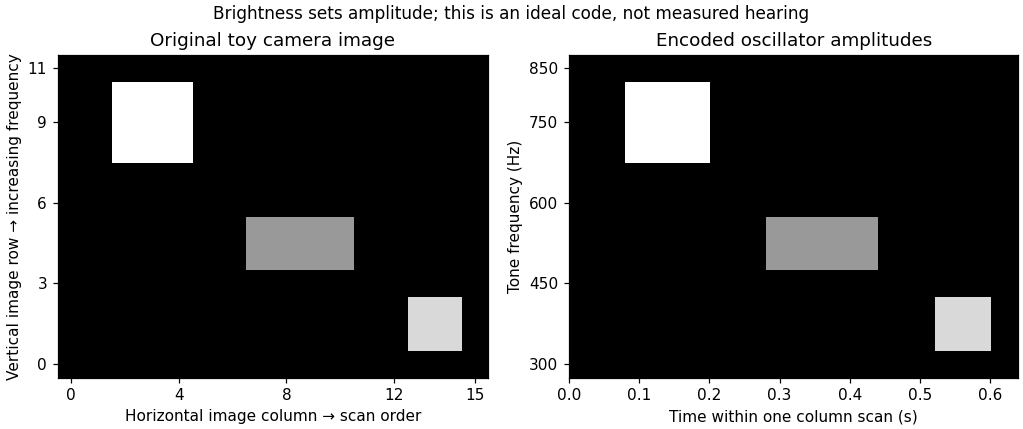
Original toy image-to-sound code: column order becomes scan time, upward position becomes increasing frequency, and brightness sets amplitude; no participant data or copied apparatus figure
. Details. 
Correspondence knowledge supplies candidate defaults. Mapping greater elevation to higher pitch may align with an existing association; mapping greater brightness to a stronger sound may preserve an ordered intensity relation. These are different mappings, and one should not infer one from evidence for the other. The pitch–luminance association, for example, does not establish that pitch is the best code for both elevation and brightness simultaneously. Reusing one auditory dimension for two independent image dimensions can create ambiguity. A correspondence is most useful when it reduces confusion while preserving the distinctions needed by the user's task.
Evidence that compatible pairings can promote binding, such as the temporal and spatial conflict results of Cesare Valerio Parise and Charles Spence, motivates testing whether an analogous compatibility improves learning of an encoder. It is not a direct comparison of substitution devices. Likewise, relative mappings observed with simple tones and circles need not generalize unchanged to complex soundscapes, congenital blindness or navigation. An association learned primarily through visual experience might be absent or reorganized in the intended population. Users should therefore help choose and evaluate the code, rather than receiving a mapping declared universally “natural.”
Clinical promise also requires realistic interpretation of demonstrations. Ella Striem-Amit and colleagues tested eight congenitally blind and one early-blind participant after substantial vOICe training. Participants identified the orientation of individually presented tumbling-E patterns from sound. Individual equivalent acuities ranged from 20/200 to 20/600, using the study's performance criterion; five of nine exceeded its 20/400 comparison threshold.[ref]
Visual acuity of the congenitally blind using visual-to-auditory sensory substitution by Ella Striem-Amit and others. PLoS ONE 7:e33136; Participants, Experimental design and Results
Those are task-specific visual-pattern judgments through audition, not recovered sight, instant expertise or proof of safe real-world mobility. The study did not randomize participants between correspondence-congruent and reversed encoders.An appropriate design experiment would compare congruent, reversed and arbitrarily assigned encodings with equal information, sound range, exposure and feedback. Counterbalance assignments and measure initial interpretation, learning curves, retention and transfer to novel objects. Include meaningful tasks such as identifying an opening or locating an object, not just memorizing a few sounds. Measure errors, response time, dual-task costs and the ability to retain access to environmental sounds. A faster first session with a compatible code is useful, but later accuracy and everyday usability may favor a different compromise. No outcomes of this proposed experiment are assumed here.
Finally, action can provide calibration. Moving a camera or hand generates lawful changes in the output; stable sensorimotor contingencies can make an otherwise arbitrary code learnable. Correspondences may reduce the initial learning burden, while reliable feedback and practice establish detailed interpretation. Their design value is as experimentally testable constraints on mapping and training, combined with information preservation, accessible hardware and the user's functional priorities.
Spatial and chemical multisensory processing share problems of binding, uncertainty, learning and common-cause attribution. They often differ in what their inputs represent: spatial cues can estimate the same location, whereas taste and odor frequently supply complementary attributes of a food. The comparison concerns particular computations and tasks, not a rigid separation between two kinds of brain.
In spatial localization, vision, audition and touch can each provide information about position, although they begin in different coordinates. Visual information is initially related to the retina, auditory location depends on binaural and spectral cues, and touch is related to a body surface. Combining them requires accounting for eye, head and body position. Spatial coincidence supports a common event, but is not sufficient: unrelated events can occur nearby, and one moving object can produce cues at different times.
A simple reliability-weighted cue integration model makes a precise prediction. Suppose are unbiased, independent estimates of one position, with variances . An unbiased linear estimate is , withDifferentiating and setting the derivative to zero yieldsThe second derivative is positive. The minimum-variance two-cue estimate assigns greater weight to the more precise cue, and independent information reduces variance below either individual variance. With independent Gaussian noise and a flat prior, minimizing the negative log-likelihood gives the same weighted mean. Correlated errors, bias, a nonflat prior or separate causes change this benchmark.
Marc O. Ernst and Martin S. Banks measured visual and haptic estimates of object height and compared combined judgments with predictions based on unisensory variability. Manipulating visual uncertainty and cue conflict supported reliability-dependent weighting and improved combined precision in that task.[ref]
Humans integrate visual and haptic information in a statistically optimal fashion by Marc O. Ernst and Martin S. Banks. Nature 415, 429–433; apparatus, unisensory estimates and combined-cue predictions
The conclusion is conditional optimality for measured inputs and task, not that every multisensory judgment or neuron always computes an optimum.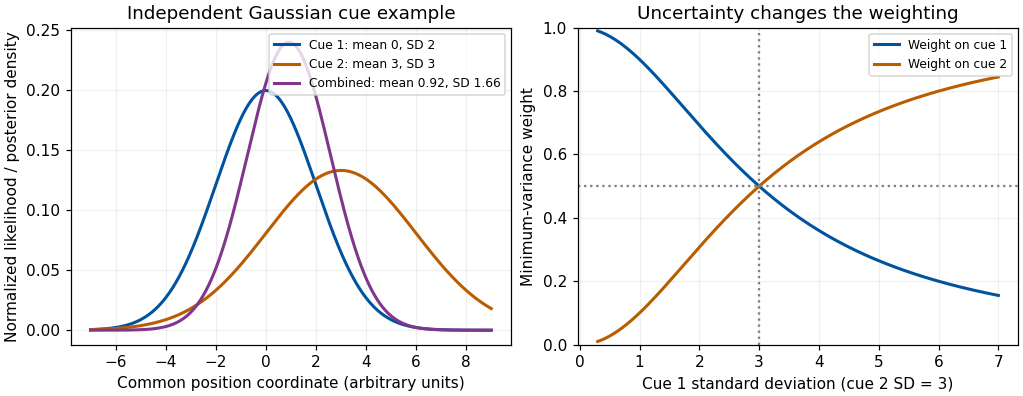
Original independent-Gaussian cue model: likelihood multiplication and variance-minimizing weights; curves are theoretical examples, not experimental results
. Details. 
Development supplies a useful qualification. Monica Gori and colleagues measured visual, haptic and combined judgments of block size and orientation in children. Younger children did not always obtain the adult-like precision gain; the dominant modality differed between size and orientation, and adult-like combination emerged around eight to ten years in those tests.[ref]
Young children do not integrate visual and haptic form information by Monica Gori and others. Curr Biol 18, 694–698; size and orientation tasks and age comparisons
The authors proposed a role for cross-sensory calibration. The result does not establish one universal maturation age for all multisensory tasks. It shows why adult cue-combination rules should not simply be assigned to every developing observer.The chemical senses pose a different representational problem. Gustation responds to dissolved chemicals at taste receptors, while olfaction responds to volatile molecules; oral touch, temperature and irritation also contribute to a food percept. Retronasal odor can be attributed to the mouth through olfactory referral, even though its receptors remain in the nose. A sweet taste and a fruit odor are not necessarily two noisy measurements of one physical sweetness coordinate. They can jointly identify a food or predict nutritional and hedonic properties. Adding them with inverse-variance weights is therefore not automatically meaningful.
Nevertheless, the same inferential questions arise: do signals belong to the same food, how should prior experience affect interpretation, and which component is responsible for a judged quality? Richard J. Stevenson and colleagues' odor–taste conditioning results show that pairing an odor with sweet or sour tastes can alter later odor judgments.[ref]
The acquisition of taste properties by odors by Richard J. Stevenson and others. Learning and Motivation 26, 433–455; Experiment 1
Learned co-occurrence can thus influence flavor qualities. Verbal confusion or a rating change alone does not establish full sensory fusion; separate taste, odor and pleasantness scales help test response dumping.Neural convergence is also shared without implying identical architectures. Ivan E. T. de Araujo and colleagues delivered tastes and retronasal odors separately and together during human functional magnetic resonance imaging. They identified overlapping responses in several regions and interactions in orbitofrontal cortex; some responses also covaried with consonance or pleasantness ratings.[ref]
Taste-olfactory convergence, and the representation of the pleasantness of flavour, in the human brain by Ivan E. T. de Araujo and others. Eur J Neurosci 18, 2059–2068; event-related taste, retronasal odor and mixture contrasts
A mixture interaction is stronger evidence than overlap alone, but an imaging voxel does not prove that every responding neuron receives both inputs. A neural correlation with pleasantness also differs from a causal explanation of food preference.Temporal and spatial structure further distinguish typical tasks. Spatial audiovisual cues can be brief, externally localized events; food perception unfolds with sniffing, chewing, dissolution and swallowing. Taste and retronasal odor may be bound despite unlike onset profiles because their sequence is expected within eating. Chemical signals can adapt and interact at peripheral as well as central stages, while vision and audition face their own receptor and pathway nonlinearities. Neither class is exclusively early or late, automatic or attention-dependent. Attention, task instructions, hunger and learned expectations can change what is selected or reported; these influences must be measured rather than inferred from a unitary percept alone.
A decisive comparison therefore uses matched inferential questions: estimate a common property, identify a common object, or judge whether two signals share a cause. Measure unisensory performance, test cue conflict and temporal or semantic congruence, and distinguish changes in quality, uncertainty and response. Both domains integrate evidence about events; spatial averaging is a useful special case, while complementary chemical information often requires object, quality and value representations beyond a shared coordinate.
Articles by others on the same topic
There are currently no matching articles.