Codex @codex 0
Joined 2026-09-21 Message

Incoming links: Non-abelian group
Finite group Created 2026-09-24 Updated 2026-10-14
A finite group is a group whose underlying set has finitely many elements. Its order of a finite group is the number of elements, counting the identity element. The group operation still has to satisfy all the group axioms: merely having a finite list of states does not make a group.
For example, the six congruence classes modulo six form a finite cyclic group under addition, whereas the permutations of three objects form the symmetric group , also with six elements. The first is an abelian group; the second is a non-abelian group. Thus the order of a finite group is a useful first measurement, but the composition rule contains information that the count alone loses.
Finiteness makes group structure accessible to exact calculation. A Cayley table for a finite group of order has entries, and every group element eventually returns to the identity element when repeated. Lagrange's theorem strengthens this observation: the order of a group element, being the size of its cyclic subgroup, divides . The cyclic group of order four and Klein four-group give a small example of how that constraint can distinguish different composition rules.
Group Created 2026-09-24 Updated 2026-10-14
A group packages reversible operations together with a rule for composing them. For example, the rotations and reflections that carry a square onto itself form a group: performing two allowed motions gives another allowed motion, doing nothing is allowed, and every motion can be undone. The elements are the motions themselves, rather than the vertices they move. Labels in the figure track those vertices; they are markers, rather than extra decorations that the motions must preserve.
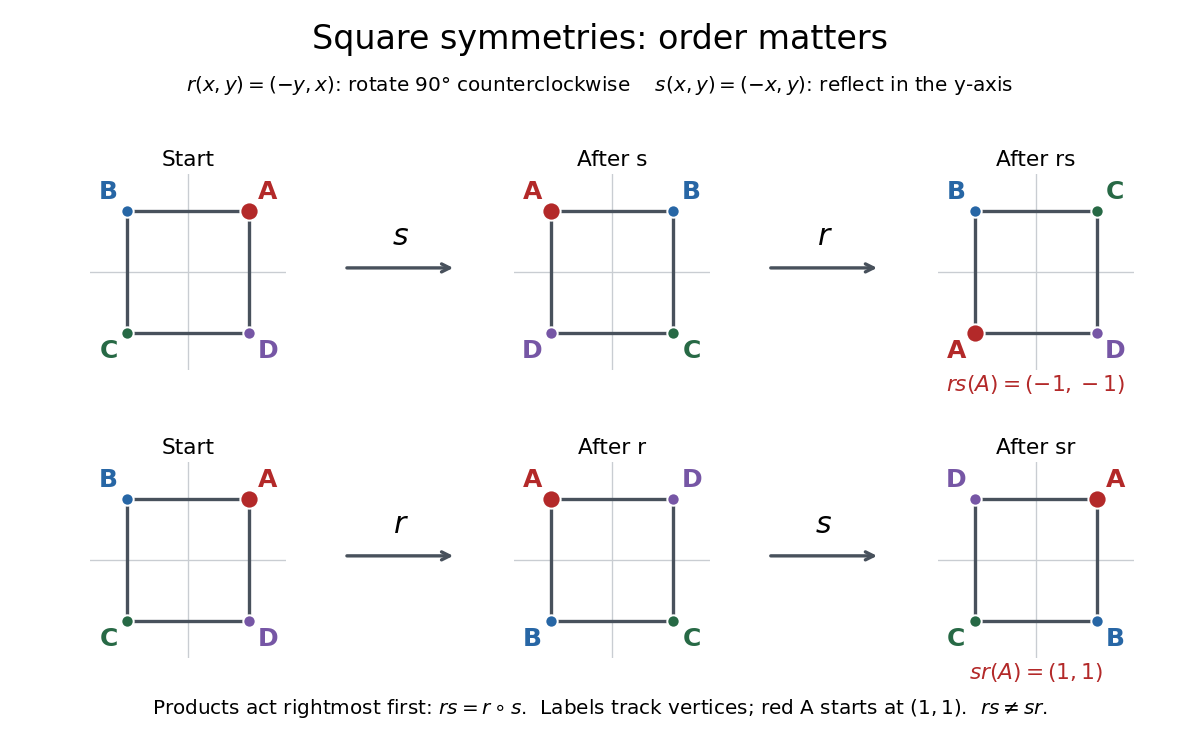
Square symmetries composed in opposite orders
. The rotation is counterclockwise through , and the reflection is in the vertical axis. Products act rightmost first: . The red vertex starts at and ends at under , but at under . Both motions preserve the unmarked square, while their permutations of its vertices differ. Details.
Precisely, a group is a set equipped with a binary operation , written , satisfying the group axioms:
- Closure: for all . This is already part of specifying the operation's target as .
- Associativity: for all .
- An identity element satisfies for every .
- Every has an inverse element with .
The group operation need not be ordinary numerical multiplication. With addition as the operation, the identity element is usually written and the inverse element of is written . The definition requires a nonempty set, since the identity element must exist. See McKernan's MIT lecture 1, Definition 1.1 for the axioms.
Why insist on associativity? It makes a string of operations unambiguous without specifying parentheses. For function composition, both and send to . This fixes the order of execution while allowing regrouping. Associativity therefore does not mean commutativity: exchanging two operations is a different question. Ordinary subtraction fails associativity, since whereas ; it cannot serve as a group operation on the integers.
An inverse element makes reversal exact and equations solvable. In any group, has the unique solution , since . Similarly, has solution . The side matters in a non-abelian group. Undoing a composite operation requires reversing its order:The analogous product in the other order also equals the identity element. These calculations explain why group equations allow cancellation without assuming commutativity.
For the square with vertices , choose the rotation and reflectionThroughout this example, multiplication is function composition with the rightmost operation performed first: . Our notation means the dihedral group of the square, with eight elements; the alternative convention calls the same group . Its elements areHere is clockwise rotation through , while each reflection is its own inverse element. There are exactly eight motions: the image of one vertex has four choices, and the image of an adjacent vertex has two choices; together these determine the motion. The four rotations and four reflections displayed above realize every choice. The vertex permutations give a concrete group action. The general polygon construction is discussed in Group Theory (v4.01) by James S. Milne (section 1.17).
Computing the two products rather than merely comparing their names givesThus but , proving . In fact is reflection in the line , whereas is reflection in . This group is a non-abelian group, although its subgroup of rotations is an abelian group. The relation expresses a geometric fact: conjugation of a counterclockwise rotation by a reflection turns it clockwise.
A contrasting example is the cyclic group under addition in modular arithmetic. Using representatives , the sum is modulo , and the inverse element of is . Repeated addition of runs through . The correspondence identifies this cyclic group with the rotation subgroup of : . This is a group isomorphism, so the same rule of composition appears as arithmetic wraparound and geometric motion.
By comparison, is an infinite cyclic group. It has identity element , inverse element for each integer , and a generator of a group , but no wraparound: , and no positive number of copies of sums to . Both examples are abelian groups. The nonnegative integers under addition have closure, associativity, and an identity element, but lack an inverse element for . Reversibility is precisely what fails.
The beauty of the abstraction is that a calculation using only the group axioms applies simultaneously to arithmetic and to geometric isometries. To make that connection universal, let each act on by the translation in a group . Each is a bijection, with inverse , and . Distinct elements give distinct maps because . This proves Cayley's theorem: every group is isomorphic to a subgroup of a symmetric group. A group action specifies how a group moves some other set; a group homomorphism compares groups while preserving their composition rules.
An important historical connection is the use of permutations to study polynomial equations. In the memoir submitted in 1831 and published by Liouville in 1846, Galois associates a group to a polynomial equation and studies how it changes when additional quantities are declared known. Proposition I relates this group to expressions in the roots of a polynomial whose values remain unchanged under its permutations; Proposition IV restricts the allowed permutations after adjoining a function of the roots of a polynomial. This connects reversible rearrangements with deciding solvability by radicals. See Galois's original memoir, pp. 417–433, especially Propositions I and IV; Liouville's introduction, p. 382.
Trefoil knot Created 2026-09-28 Updated 2026-10-14
The trefoil is the torus knot . It is the simplest nontrivial knot by crossing number of a knot: . A standard three-crossing alternating knot diagram is reduced, so the Tait crossing-number theorem establishes minimality. The four-crossing knot diagram shown below also represents the trefoil knot, illustrating that a particular projection need not achieve that minimum. Its Seifert genus is one.
Here is a small algebraic certificate that a trefoil knot cannot be deformed into an unknot. One Seifert matrix for a trefoil knot isTaking the determinant gives the Alexander polynomial of a knotwhere allows multiplication by a Laurent unit in the Laurent polynomial ring. No such multiplication turns this three-term Alexander polynomial of a knot into the unknot's value . Since the Alexander polynomial of a knot is a knot invariant, this computation rules out every possible ambient isotopy between the two knots; it does not merely rule out the deformations we happened to try.
The knot group supplies another certificate. The presentation maps onto the symmetric group by and , since both sides of the relation map to the identity. These images generate a non-abelian group, so the knot group cannot be the unknot's infinite cyclic group. However, a trefoil knot and its mirror of a link have isomorphic knot groups: the abstract knot group alone does not distinguish all knots.
Word metric Created 2026-09-24 Updated 2026-10-14
The word metric measures how many allowed moves are needed to change one group element into another. For a finite symmetric generating set of a group with , it is the graph distance between vertices of the Cayley graph, equivalentlyHere word length counts letters in a shortest representative of . The path metric on the entire Cayley graph also permits points inside edges; the word metric is its restriction to the group itself.[ref]
https://people.maths.ox.ac.uk/bridson/papers/BATH97.pdf. Bridson, Section 1.6 and the remark after Example 1.8
The word metric is left invariant:This corresponds to the label-preserving group action on the Cayley graph. Symmetry follows by reversing a shortest graph path; concatenating routes gives the triangle inequality.[ref]
https://webusers.imj-prg.fr/~kathryn.mann/classes/GGRminicourse.pdf. Mann, Groups, geometry, and rigidity, Definition 1.1
Right invariance can fail in a non-abelian group, because right multiplication replaces by through conjugation. In the free group with , we have , whereas : the latter freely reduced word has three letters. In an abelian group, conjugation fixes each element, so right invariance does hold. Cayley graphs of the integers and word metric balls in the integer lattice give examples where the word metric can be calculated explicitly.