Source PDF: mmathphys.physics.ox.ac.uk/sites/g/files/vzsiac2991/files/mmathphys/documents/media/a15271h1.pdf
Solutions to both questions and all nine parts. The two-sphere calculation uses the leading free-draining approximation, with negligible connector drag; the limitations of that approximation are made explicit.
To first order in fluid velocity divided by the speed of light, the Lorentz transformation of electromagnetic fields gives . Applying Ohm's law in the local fluid frame gives . Neglecting the displacement current in Ampère's law, . Substitution in Faraday's law givesHere is the magnetic diffusivity; the paper's is electrical resistivity, rather than magnetic diffusivity. Expanding the curl with the solenoidal magnetic-field constraint gives the resistive induction equation in its compressible form:The left side is the material derivative of the magnetic field. The three right-hand terms respectively describe field-line stretching and reorientation, amplification or dilution by compression or expansion, and magnetic diffusion. In particular, compression has and amplifies a field component perpendicular to the compression.
The assumptions are nonrelativistic bulk motion, the low-frequency approximation permitting omission of the displacement current, a conducting-fluid continuum, isotropic local Ohm's law with spatially constant scalar electrical resistivity, constant magnetic permeability , and . Hall, electron-pressure and other non-Ohmic corrections to the generalized Ohm's law are excluded. Incompressible flow is not required: imposing it would remove the compression term.
Let be the total magnetic energy. Multiply the curl form of the resistive induction equation by and integrate over the fixed volume. The identityfollows from the divergence theorem. The stated zero boundary fields remove its surface term. Applying it to the motional and resistive contributions yields the magnetic energy balance in resistive magnetohydrodynamics:The first term is the negative of the mechanical power delivered to the fluid by the Lorentz force density. It transfers energy between fluid motion and the magnetic field, with either sign. The second is the nonpositive magnetic contribution to Joule heating. A nonzero positive electrical resistivity therefore dissipates magnetic energy at rate ; it does not force the total magnetic energy to decrease when fluid motion supplies a larger positive power.
Choose a magnetic vector potential with . The resistive induction equation permits the evolution equationA gauge transformation changes by a surface integral of the normal magnetic field, which is zero here. Thus the integrated magnetic helicity has gauge invariance under the stated boundary conditions.
Differentiate both factors in . Use the stated vanishing-boundary assumption to remove the helicity surface flux; this can be implemented in the usual closed-boundary gauge , or by extending the localized field and integrating over all space with sufficient decay. The curl integration by parts identity then givesThe motional term is zero pointwise because . The scalar-potential term integrates to zero by and the boundary condition. The resistive magnetic-helicity balance is thereforeUnlike the resistive magnetic energy contribution, this signed integral need not have a fixed sign.
A magnetic field varying over a length has of order . Consequently, the resistive magnetic energy loss contains two inverse powers of , while the resistive magnetic-helicity balance contains only one. Small-scale gradients can therefore dissipate substantial magnetic energy while retaining an approximately conserved large-scale magnetic helicity.
A dimensionally consistent version is the selective decay bound for magnetic helicity. With , the Cauchy-Schwarz inequality givesFor bounded and bounded, possibly nonvanishing as , the resistive change in magnetic helicity tends to zero, even though resistive magnetic energy loss may remain finite. Magnetic energy is preferentially dissipated, while magnetic helicity is approximately conserved in this bounded-energy, bounded-dissipation limit.
This is not a comparison of quantities with different physical units or a universal ordering of fractional decay rates. For a single Beltrami field satisfying , both integrated quantities have fractional decay rate without fluid motion. The boundedness assumptions and distribution of magnetic helicity across spatial scales matter.
The stress tensor of the incompressible Newtonian fluid is , where is the rate-of-strain tensor. The homogeneous Stokes equations give . Apply the divergence theorem to the fluid between the body and a surrounding sphere . If points from the body into the fluid, the fluid-domain normal on the inner boundary is . HenceThis is the force flux at infinity in Stokes flow. A nonzero resultant force must be supported by a stress of order on a surface of area of order . More precisely, the leading exterior solution is a Stokeslet with force on the fluid :Thus , and . These are leading generic orders for a translating body with nonzero drag; the integral alone does not determine every angular component, and force-free disturbances may decay faster.
For two Stokes flows in the same fluid domain with the same dynamic viscosity, symmetry of the Newtonian fluid stress tensor and incompressibility give the local reciprocal identityIn index notation, its remaining cross-gradient terms are both . On the remote sphere the integrated reciprocal flux tends to zero: the velocity is , the stress tensor is and the area is . On the body, the no-slip boundary condition makes the two velocities the constants . The Lorentz reciprocal theorem therefore givesBy the Linearity of Stokes flow, the sum of the two velocity-pressure fields satisfies the boundary conditions for body velocity . Uniqueness of the exterior Stokes flow identifies it with the third solution. Since the stress tensor and its surface integral are linear too, ; scalar multiplication follows in the same way. Thus for a fixed-orientation hydrodynamic resistance matrix . Substituting arbitrary in the reciprocal identity yieldsThe minus sign is natural because viscous dissipation gives for nonzero rigid translation in an otherwise stationary fluid; is a positive-definite matrix.
Use the free-draining approximation: neglect the hydrodynamic interaction between the widely separated spheres and neglect the connector's viscous drag. Stokes law gives for each sphere. Their resultant isThis is the leading two-sphere approximation, not an exact finite-separation hydrodynamic resistance matrix. Writing and , the first Stokeslet reflection gives, if the connector remains negligible,The negative correction expresses reduced drag from fluid entrainment by the other sphere. A very thin but arbitrarily long rod need not have negligible total drag: its typical transverse drag scales as for rod radius . Thus the simple boxed result uses the intended negligibly dragging connector limit as well as ; the two printed size inequalities alone do not specify a uniform limit in which rod drag vanishes.
Hold the two-sphere object fixed in a uniform stream . In the free-draining approximation, its drag forces are , with . The hydrodynamic torque about isTo make it zero for every incoming-stream direction, choose the hydrodynamic centre of a two-sphere dumbbell:It lies closer to the larger sphere, whose larger drag requires a shorter lever arm. Uniform translation does not spin an isolated sphere, so no additional isolated-sphere spin torque enters this leading approximation.
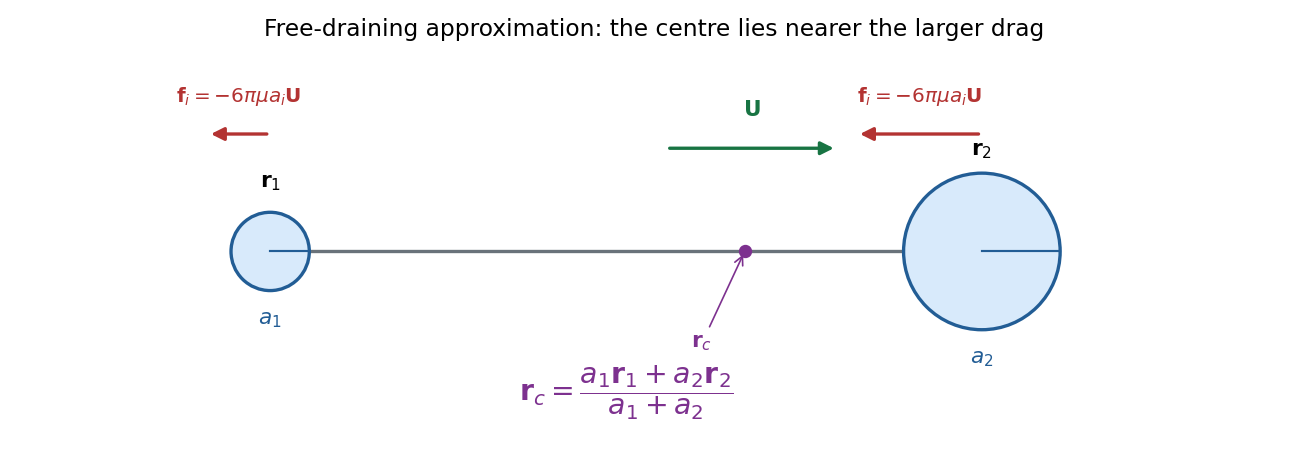

Finite-separation hydrodynamic interactions and connector drag can change the displayed location; the calculation has the same approximation as part c.
For rotation about the hydrodynamic centre of a two-sphere dumbbell, the sphere centres have velocities . Their resultant drag force in the free-draining approximation isEach sphere also experiences a spin drag torque, but its isolated rotation causes no net force. Those spin contributions therefore do not alter the cancellation.
This illustrates translation-rotation reciprocal coupling. About any fixed origin, write the fluid's rigid-body force and torque asThe transposed cross-blocks follow from the Lorentz reciprocal theorem. If pure translation causes zero torque about an origin for every , then , hence pure rotation about that origin causes zero force. This implication is general for linear Stokes flow; the existence and leading location of such an origin here use the two-sphere geometry and the approximation in part c.
Articles by others on the same topic
There are currently no matching articles.