A Bravais lattice is the translation set generated by primitive lattice translation vectors. Translating by any member of leaves its surroundings equivalent. A crystal structure requires both this lattice and an atomic basis attached to every lattice point. The basis can lower the symmetry of the bare point lattice; a familiar-looking geometrical arrangement of atoms is not necessarily itself a Bravais lattice. For example, the diamond cubic structure is a face-centred cubic lattice with an identical-atom basis at fractional positions and in conventional cubic coordinates. The displacement between those two basis atoms is not itself a lattice translation.
The seven three-dimensional crystal systems are triclinic, monoclinic, orthorhombic, tetragonal, trigonal, hexagonal and cubic; the distinct translation types give 14 Bravais lattices. A conventional cell can contain several lattice points, while a primitive unit cell contains one. Simple cubic primitive lattice translation vectors can be chosen along the cube edges; for face-centred cubic they can be , and . Their primitive volume is , explaining the four lattice points per conventional face-centred cell.
A crystallographic point group comprises the orthogonal parts of the crystal's spatial symmetry operations. It constrains possible rotations, reflections, inversion and their combinations, while forgetting translations. Lattice preservation restricts proper rotational orders in three dimensions to ; a fivefold axis cannot be a symmetry of a periodic three-dimensional lattice. One quick argument restricts a rotation's integral lattice representation through , an integer trace, producing these orders. There are 32 crystallographic point-group types. Examples are the cubic full octahedral group with Hermann–Mauguin symbol , the tetrahedral class with symbol , and the polar tetragonal class with symbol .
The space group retains the full isometry. In Seitz notation acts by , and multiplication isIts translation subgroup is normal and the quotient is the crystallographic point group. A screw axis combines rotation with translation along the axis; for example, applying a screw twice gives one whole lattice translation. A glide plane combines reflection with a translation parallel to the plane; applying the glide twice likewise gives a translation. These operations can preserve the complete crystal without their rotation or reflection alone preserving it.
A symmorphic space group admits an origin and representatives for which the point-group operations have no translation component. A nonsymmorphic space group has essential fractional translations that cannot all be removed by moving the origin. There are 230 three-dimensional space-group types, distinguished more finely than their point groups. These counts refer to ordinary, nonmagnetic periodic space groups; magnetic and aperiodic generalizations are different classifications.[ref]
International Tables for Crystallography, Volume A: Space-group symmetry. 2016 edition, overview and Part 1 introduction to crystallographic and space-group symmetry
For concrete comparisons, a monatomic simple-cubic crystal has space group and point group . Rock salt has a face-centred cubic lattice, a two-species basis and symmorphic space group . Diamond has the same cubic point group and translation-lattice type, but its basis leads to nonsymmorphic . Replacing the two diamond basis sites by distinct species gives the zinc blende structure, exemplified by GaAs, with and point group ; inversion that would interchange the species is no longer a symmetry. The lattice specifies translations, the point group specifies the linear symmetry classes, and the space group specifies their complete spatial implementation. These examples show why none alone uniquely describes an atomic structure.
A quantum dot confines electronic motion in all three directions. A semiconductor dot can be thin enough that only one transverse subband is occupied, with discrete lateral states controlled by gates. In a rectangular hard-wall model,A smooth circular lateral confinement is often better approximated by , giving above the transverse ground energy. Shell contains orbitals, twice that many electrons before interactions split the spin degeneracy. Hence closed-shell electron numbers are . These are single-particle quantum numbers; an interacting dot's states are many-electron eigenstates, not simply one orbital occupied by a whole charged island.
A perpendicular magnetic field changes the harmonic spectrum to the Fock-Darwin spectrum. For an electron of charge , take and in the usual symmetric gauge. ThenReversing the definition of the angular label changes the displayed sign of its orbital term, not the set of energies. The Zeeman term lifts spin degeneracy, while exchange can favor parallel-spin filling in partially filled shells. These effects are distinguished by how peaks evolve with field rather than by identifying every irregular peak spacing with one-particle confinement.
For electrostatics, let and , where represents a fixed offset charge in the chosen convention. The constant interaction model givesThe charging energy is conventionally , whereas adjacent charge-state potentials differ byThis addition energy separates a capacitive contribution from orbital spacing. Exchange, nonuniform screening and correlations are corrections to the constant interaction model; a change in dot shape or effective capacitance can also alter spacings.
Connect the island weakly to source and drain reservoirs through tunnel barriers. sequential tunnelling is suppressed in a charge-stable region when neither adding nor removing an electron is energetically accessible. Sweeping the gate brings a charge electrochemical potential through the reservoir Fermi level, giving a Coulomb-blockade conductance peak. The gate lever arm is , so locally if the capacitances and level spectrum do not vary appreciably. At finite source-drain bias, alignment with either reservoir defines the boundaries of a Coulomb diamond. Its slopes constrain capacitance ratios, and lines parallel to its edges can reveal excited-state transport. The conversion from a diamond's bias height to an energy depends on bias convention; a full-height/half-height factor must not be assumed without declaring the circuit.
A clear charging spectrum requires and tunnel broadening smaller than the relevant addition energy; resolving individual orbital levels additionally requires them smaller than the orbital spacing. Tunnel resistances large compared with suppress strong charge fluctuations in the usual weak-junction regime. Blockade is not an assertion of mathematically zero current: higher-order cotunnelling can remain, and strong coupling or low-temperature spin correlations can invalidate the sequential model. An experimental check therefore combines gate sweeps with bias spectroscopy, temperature dependence and barrier tuning to separate level structure from broadening or uncontrolled charge traps.
In a primary vertical-dot experiment, gate-controlled current oscillations were converted into addition energies using finite-bias diamond spectroscopy; varying magnetic field then followed shell and spin filling. Reproducing enhanced addition energies at electron numbers 2 and 6 in several devices strengthened the shell assignment. The electron temperature was independently estimated above the refrigerator base temperature, an essential distinction when judging spectral resolution. Field-dependent reordering also revealed exchange effects beyond a purely spin-degenerate orbital model.[ref]
Shell Filling and Spin Effects in a Few Electron Quantum Dot by S. Tarucha and others. pp. 3613–3616, gate control, finite-bias calibration, sample comparisons, electron-temperature estimate and field-dependent spin filling
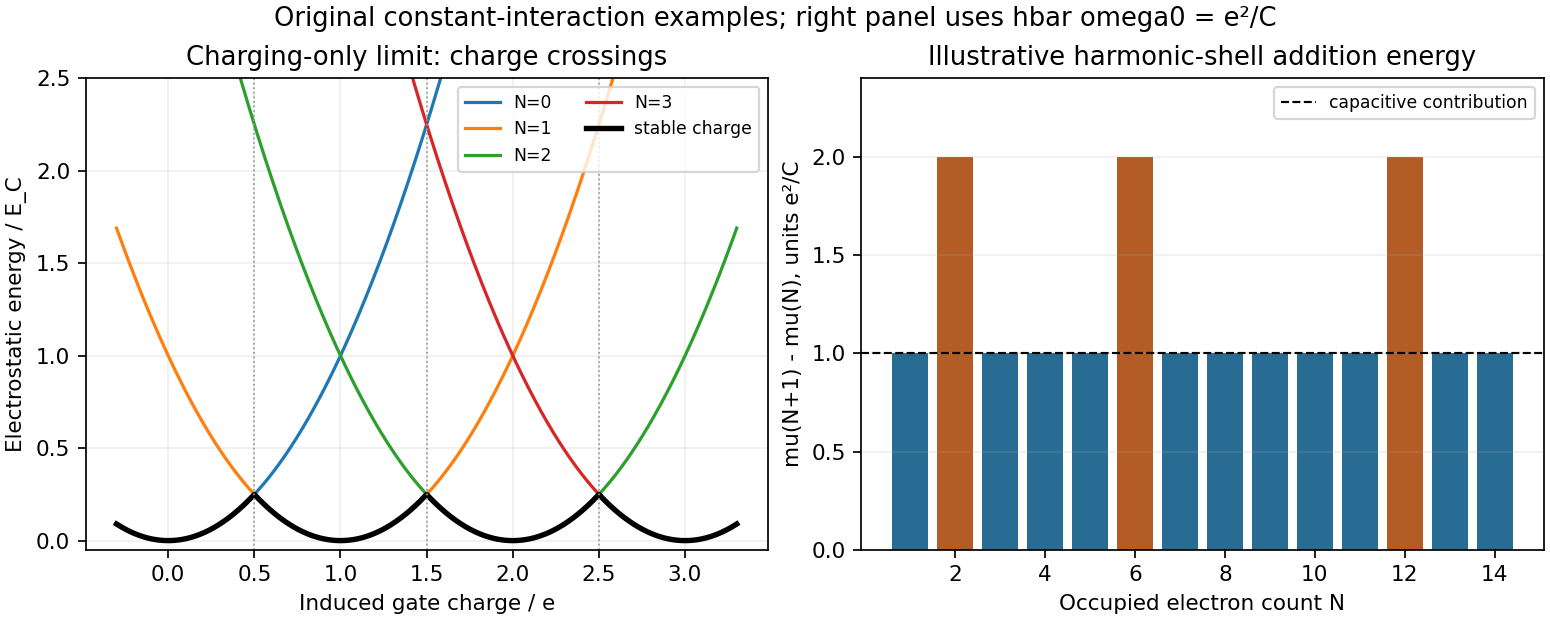
Original constant-interaction charge parabolas and addition-energy example showing charging, spin pairing and shell closure
. Details. Use a three-dimensional electron gas with a uniform positive background, the jellium model. The Hartree-Fock method minimizes the expectation of the interacting Hamiltonian over normalized Slater determinants. Antisymmetry is exact within that trial class, but correlations requiring a superposition of determinants are omitted. For orthonormal occupied spin orbitals , the energy iswhere is the direct Coulomb integral and the exchange integral; the spin overlap makes exchange vanish between opposite-spin orbitals. The self-interaction terms and cancel. Variation gives a self-consistent Fock operator ; exchange is nonlocal. Its eigenfunctions define occupied orbitals of a stationary determinant, and the determinant must be compared with competing self-consistent solutions to select a variational ground state.
The eigenvalues are orbital Lagrange multipliers. Their sum counts each interaction twice:Frozen-orbital removal energies may be estimated using Koopmans' theorem, but measured quasiparticle energies can contain relaxation and correlations absent from this approximation. Unoccupied orbital energies are not automatically an exact excitation spectrum. In particular, unscreened exchange in a uniform three-dimensional gas produces an unphysical logarithmic slope singularity at its Fermi surface; a one-determinant mean field does not reproduce the interacting Fermi liquid's screened response.
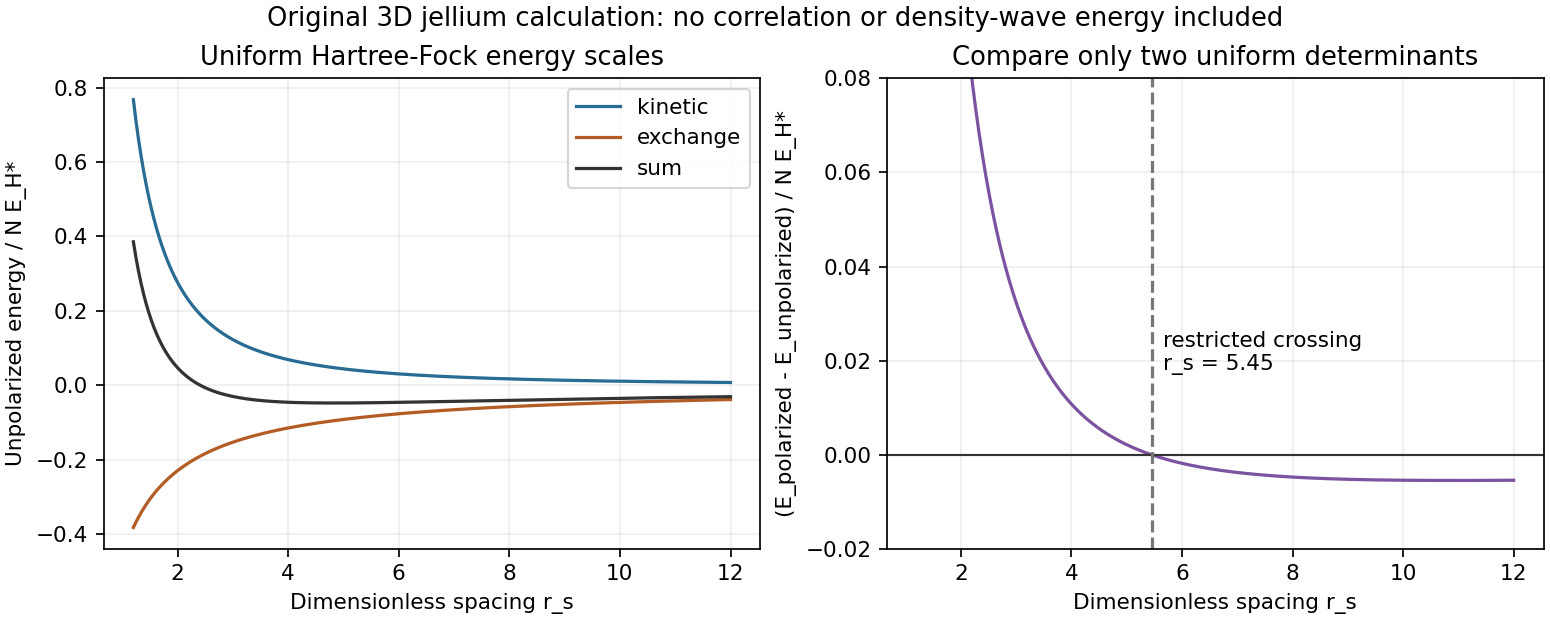
For a spatially uniform plane-wave determinant, electron-background and background-background terms cancel the uniform direct Coulomb contribution. Retain the background when making this cancellation: an isolated infinite electron charge distribution would have a divergent direct energy. The surviving contributions per particle are kinetic energy and negative same-spin exchange energy. Let define the Dimensionless Wigner-Seitz radius, with , and . ThenFor the unpolarized state this is approximately . The kinetic contribution penalizes spin polarization because it enlarges an occupied Fermi sphere; exchange favors polarization because equal-spin occupation gains more exchange energy. As density falls, the exchange scale overtakes the kinetic scale. The uniform fully polarized and unpolarized energies cross atThis is a variational comparison within the homogeneous Hartree-Fock electron gas, not an exact physical ferromagnetic phase boundary. It demonstrates how Pauli kinetic energy and exchange compete and why the allowed trial states matter.
Allowing spatial symmetry breaking changes the result: the Overhauser instability lowers the paramagnetic determinant's Hartree-Fock energy through a spin density wave, even in the high-density limit. A calculation restricted to uniform Fermi spheres therefore does not give the unrestricted Hartree-Fock ground state.[ref]
Spin Density Waves in an Electron Gas by A. W. Overhauser. abstract and p. 1437, instability of the uniform paramagnetic state to spin-density waves
At still lower density, localization and a Wigner crystal compete with fluid states. electron-gas correlation energy beyond a single determinant is important in assessing their competition. Quantum Monte Carlo provides a concrete route to comparing correlated fluid and crystal energies; the original stochastic calculation demonstrates why exchange-only energy differences are insufficient.[ref]Ground State of the Electron Gas by a Stochastic Method by D. M. Ceperley and B. J. Alder. abstract and pp. 566–569, correlation energies and competing fluid/crystal states
Hartree-Fock is a useful variational baseline with exact exchange, not a controlled complete low-density phase diagram. At high density the kinetic scale dominates, but even a small symmetry-breaking energy gain can invalidate a restricted determinant as the exact Hartree-Fock minimizer. At low density neglected correlations, screening and localization can change both transition locations and the ordering of candidate phases. A numerical phase boundary should therefore state dimension, spin constraints, background model and whether correlation and spatially modulated states were included.


Articles by others on the same topic
There are currently no matching articles.