Choose the covariant derivative , so the interaction term is . The gauge transformation is and . The derivative of this local phase cancels the added vector-potential term in , making gauge-invariant.
For renormalized fields and parameters, a complete local QED counterterm parametrization isWith , , the definitions are , , and . In particular is the coefficient in the Lagrangian density, not just .
The Ward identity requires in a gauge-preserving renormalization scheme. The kinetic and vertex counterterms then combine into , so gauge invariance is explicit and . A photon mass term is not an allowed counterterm in unbroken QED. For perturbative inversion one separately adds gauge fixing, , taking in Feynman gauge. That quantization term is not itself part of the gauge-invariant density. The Abelian Faddeev-Popov determinant is field independent for this linear gauge and introduces no interacting ghost contribution.
At second order in the interaction term, attach the two external fermion fields to different vertices and contract the remaining two fermion fields with each other and the two vector fields with each other. The factor in the expansion is cancelled by the two ways to assign the external ends. There is no closed fermion loop, and hence no extra closed-loop fermionic sign.
After removing the two external Dirac propagators, the internal momentum assignment for the photon and for the fermion gives the one-loop insertionThus the insertion is proportional to exactly the propagator product specified in the source. Define . With Fourier convention , the reduced free inverse kernel is , since the printed Dirac propagator equals . Repeated insertions giveThe factors of and the sign of the named self-energy are convention dependent; the cancelling counterterm is fixed once this insertion convention is specified. The internal photon joins two vertices on one directed fermion line, as in the first panel of the figure in 1b.
Multiply the supplied Feynman gauge propagators before reducing the numerator. Their two factors and the source's Clifford algebra implyFor example, contracting the numerator before the propagator factors gives ; the extra minus from reverses both signs.
Use a Feynman parameter on the massive denominator and shift . The combined denominator isThe term odd in integrates to zero in dimensional regularization. The pole can be evaluated away from on-shell infrared singularities; its local ultraviolet coefficient is independent of . With the source's master integral,Terms proportional to multiply the pole into a finite term, so they do not change this result. The counterterm kernel from 1ai is . Cancelling therefore givesThe distinction between mass definitions matters. Since ,Equivalently the mass-dependent part of the counterterm density is , because its definition includes the explicit minus sign in . In the alternative convention , replace every here by . These are ultraviolet minimal-subtraction poles, not the finite on-shell mass correction. The Ward identity also fixes ; the photon coefficient requires its own two-point function and is not obtained from this graph.
In pure QCD, different incoming and outgoing quark flavours allow only the tree-level -channel gluon graph. A quark-gluon vertex preserves flavour, so no flavour-changing -channel exchange is available. Label the incoming momenta and outgoing momenta . For transparent spin traces, use the auxiliary metric and its usual gamma matrices; the positive-energy Mandelstam variables areThis is a consistent change of metric notation, not a change of the physical invariants. Define the fixed-index colour tensor . Up to an irrelevant common phase,The indices label incoming colours and outgoing colours. Averaging over the two spins of each incoming particle and summing the outgoing spins givesThe gamma-matrix trace identity makes the contractionFor instance and the crossed products are . Therefore, before the remaining colour sum and average,Here the bar averages spins only; it does not silently include the colour average requested next.
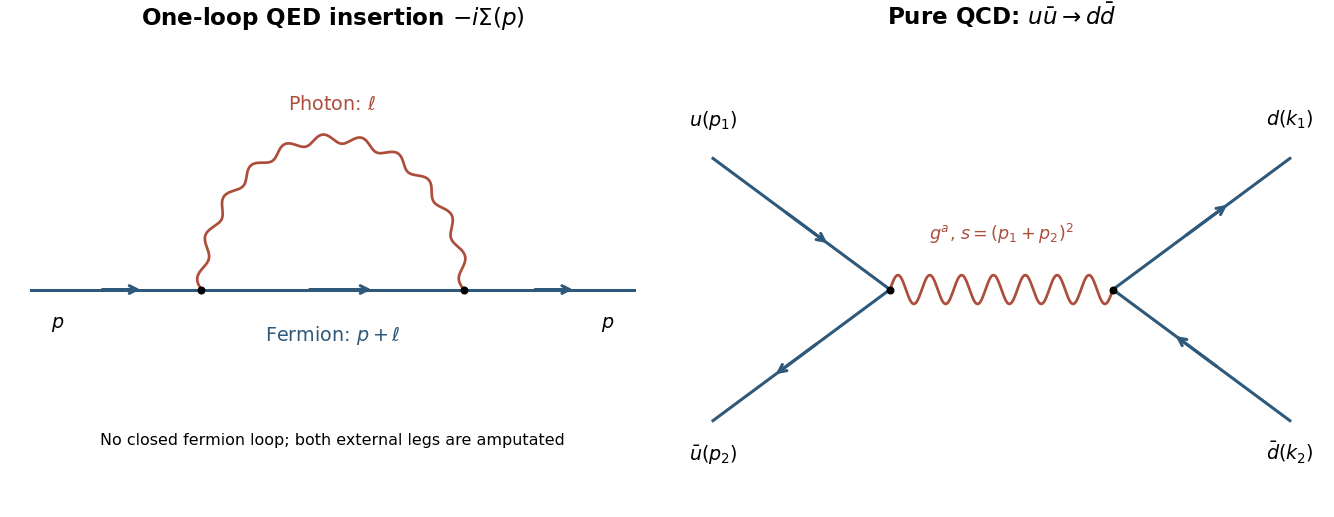

Use the fundamental SU(3) normalization , with Hermitian generators. The average over the incoming colours and sum over the outgoing colours givesThe complete spin and colour averaged result is consequentlyFor massless two-body centre-of-momentum kinematics, and , so the same answer is . This checks positivity, the symmetry under exchanging the outgoing directions, and the absence of a forward -channel singularity in this particular process.
Articles by others on the same topic
There are currently no matching articles.