Source paper: www.whatdotheyknow.com/request/oxford_physics_past_papers_2/response/2340696/attach/4/Physics%20Papers%202015.pdf?cookie_passthrough=1. The held cover dates this sitting to 19 April 2016; the annual bundle's filename does not determine the year. We use for the ultraviolet regulator, reserving for the causal prescription. The supplied propagators correspond to and . Q1 and Q3 are readable. A duplicate cover obscures Q2 on printed page 3; its known a–c scopes retain explicit source-gap TODOs.
Choose the covariant derivative , so the interaction term is . The gauge transformation is and . The derivative of this local phase cancels the added vector-potential term in , making gauge-invariant.
For renormalized fields and parameters, a complete local QED counterterm parametrization isWith , , the definitions are , , and . In particular is the coefficient in the Lagrangian density, not just .
The Ward identity requires in a gauge-preserving renormalization scheme. The kinetic and vertex counterterms then combine into , so gauge invariance is explicit and . A photon mass term is not an allowed counterterm in unbroken QED. For perturbative inversion one separately adds gauge fixing, , taking in Feynman gauge. That quantization term is not itself part of the gauge-invariant density. The Abelian Faddeev-Popov determinant is field independent for this linear gauge and introduces no interacting ghost contribution.
At second order in the interaction term, attach the two external fermion fields to different vertices and contract the remaining two fermion fields with each other and the two vector fields with each other. The factor in the expansion is cancelled by the two ways to assign the external ends. There is no closed fermion loop, and hence no extra closed-loop fermionic sign.
After removing the two external Dirac propagators, the internal momentum assignment for the photon and for the fermion gives the one-loop insertionThus the insertion is proportional to exactly the propagator product specified in the source. Define . With Fourier convention , the reduced free inverse kernel is , since the printed Dirac propagator equals . Repeated insertions giveThe factors of and the sign of the named self-energy are convention dependent; the cancelling counterterm is fixed once this insertion convention is specified. The internal photon joins two vertices on one directed fermion line, as in the first panel of the figure in 1b.
Multiply the supplied Feynman gauge propagators before reducing the numerator. Their two factors and the source's Clifford algebra implyFor example, contracting the numerator before the propagator factors gives ; the extra minus from reverses both signs.
Use a Feynman parameter on the massive denominator and shift . The combined denominator isThe term odd in integrates to zero in dimensional regularization. The pole can be evaluated away from on-shell infrared singularities; its local ultraviolet coefficient is independent of . With the source's master integral,Terms proportional to multiply the pole into a finite term, so they do not change this result. The counterterm kernel from 1ai is . Cancelling therefore givesThe distinction between mass definitions matters. Since ,Equivalently the mass-dependent part of the counterterm density is , because its definition includes the explicit minus sign in . In the alternative convention , replace every here by . These are ultraviolet minimal-subtraction poles, not the finite on-shell mass correction. The Ward identity also fixes ; the photon coefficient requires its own two-point function and is not obtained from this graph.
In pure QCD, different incoming and outgoing quark flavours allow only the tree-level -channel gluon graph. A quark-gluon vertex preserves flavour, so no flavour-changing -channel exchange is available. Label the incoming momenta and outgoing momenta . For transparent spin traces, use the auxiliary metric and its usual gamma matrices; the positive-energy Mandelstam variables areThis is a consistent change of metric notation, not a change of the physical invariants. Define the fixed-index colour tensor . Up to an irrelevant common phase,The indices label incoming colours and outgoing colours. Averaging over the two spins of each incoming particle and summing the outgoing spins givesThe gamma-matrix trace identity makes the contractionFor instance and the crossed products are . Therefore, before the remaining colour sum and average,Here the bar averages spins only; it does not silently include the colour average requested next.
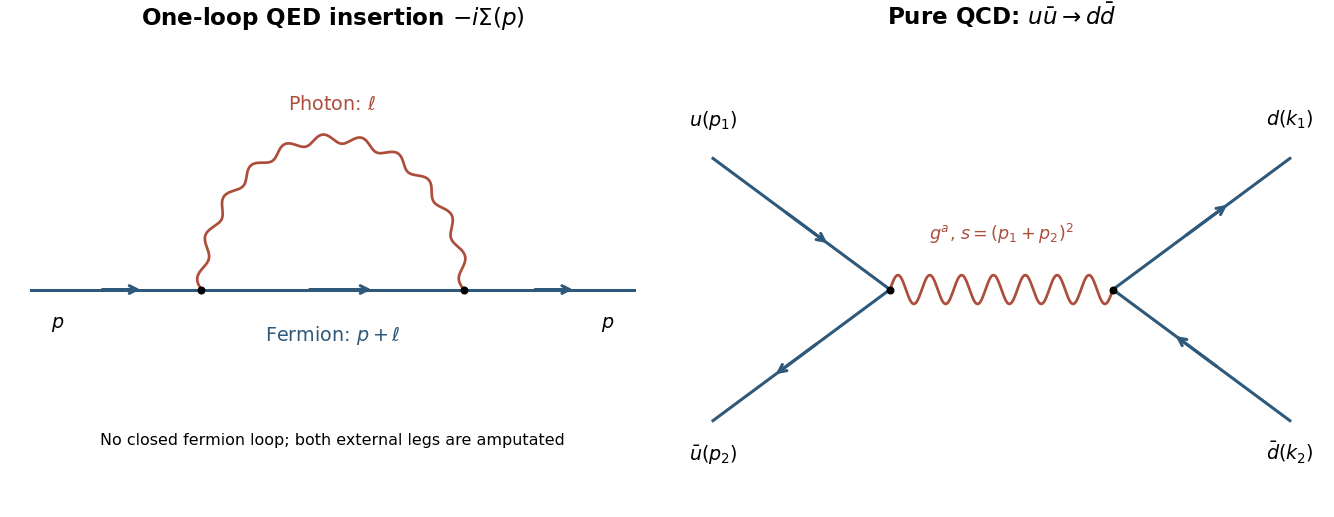

Use the fundamental SU(3) normalization , with Hermitian generators. The average over the incoming colours and sum over the outgoing colours givesThe complete spin and colour averaged result is consequentlyFor massless two-body centre-of-momentum kinematics, and , so the same answer is . This checks positivity, the symmetry under exchanging the outgoing directions, and the absence of a forward -channel singularity in this particular process.
TODO (source data): the original held printed page 3 has an opaque duplicate cover over the action, equations and most of this request. The reviewed transcription confirms the obstruction. The visible label identifies part a, but the surviving fragments do not specify a mathematical problem well enough to solve it. A readable copy of this same A15272W1 sitting is required; no hidden interaction, source functional or normalization is inferred from another year.
TODO (source data): part b is obscured by the same duplicate-cover overlay. Its required equations, hypotheses and marks cannot be recovered from the held page. Without those data, assigning a particular field-theory derivation to this scope would invent the request. This scope remains incomplete pending a readable matching original.
TODO (source data): the label c survives but the mathematical content beneath the duplicate cover does not. In particular the held source cannot establish any further inline subparts inside this block. Those must be checked if a readable same-sitting source is obtained. No solution or extra subpart labels are fabricated.
Work entirely with left-handed Weyl fermions; a right-handed field is counted through its left-handed charge conjugate. For a simple non-Abelian group , defineThe two orientations of a chiral triangle supply the symmetrized trace. Spectator representation dimensions multiply each trace. The perturbative gauge anomaly conditions for are thereforeThe first concerns , the second , and the third . A triangle has group factor , because non-Abelian generators of a semisimple group are traceless. If coupling to gravity is required, also impose the mixed gauge-gravitational condition . Cancellation of these local triangles is not a universal substitute for checking global anomalies; the Witten SU(2) anomaly is the relevant additional test here.[ref]
Gauge Theory by David Tong. §§3.4.1–3.4.4: local gauge anomalies, mixed gravitational condition, SU(2) global anomaly and Standard Model
For the Standard Model, one generation consists of , , , and . These are precisely the all-left-handed representations; conjugating the singlets reverses their hypercharges relative to right-handed particles. Check the requested triangles separately:
For ––, normalize the cubic coefficient of a fundamental to . Its conjugate has , so the weak-doublet multiplicity givesFor ––, the doublet generators obey , so . Thus every doublet separately has zero local cubic weak anomaly. For the global Witten SU(2) anomaly, each generation has three coloured quark doublets and one lepton doublet, an even total of four. All three generations give twelve, so the global obstruction also cancels.
For ––, use . The two conjugate triplets have the same quadratic index, not its negative:For ––, the three quark colours and one lepton doublet giveFor ––, count every coloured and weak component:The mixed gauge-gravitational coefficient also vanishes:Unlisted gauge combinations contain a single generator of at least one simple factor. For example, –– has , and –– has ; both vanish. The same reasoning covers ––, –– and ––, including permutations of the legs. Scalars contribute no chiral triangle anomaly. Therefore
For , the scalar potential is minimized at . With the specified upper-component vacuum expectation value and hypercharge , the unbroken generator isThe other three independent generator directions act nontrivially on . Thus the connected unbroken gauge subgroup is , while three gauge directions are broken. The normalization here is , not the alternative convention in which hypercharge is doubled.
Apply the covariant derivative directly to the vacuum:In the mostly-plus convention the canonical scalar kinetic term is . Its quadratic vector terms areDefine and . Diagonalization givesThe neutral combination lies along the nonzero eigenvector ; the orthogonal combination is the massless photon. Comparing the mass terms with yieldsFinally insert the inverse neutral rotation into the coupling:Both coefficients in the photon term agree, givingThe upper vacuum component is electrically neutral and the lower scalar component has charge , consistently with the source's negative hypercharge. This doublet is the conjugate convention to the commonly displayed positive-hypercharge doublet; it does not change the vector masses or the electromagnetic coupling. The four real scalar components supply three would-be Goldstone modes and one physical radial Higgs mode, preserving the total physical degrees of freedom.
For , integrate the vector action by parts, dropping the boundary term, and write it as a quadratic functional:The explicit mass makes this Proca kernel invertible: the displayed action alone has no gauge redundancy left to fix. It is interpreted as unitary gauge when obtained from a Higgs or Stückelberg completion with its would-be Goldstone field removed.
Introduce a source and complete the square, . The normalized Gaussian path integral isThe source-independent functional determinant cancels in . For Fourier momentum , the mixed-index kernel is . For , use the projectorsTheir orthogonality givesCombining the projectors removes their apparent massless denominator. Adding the Feynman prescription gives the unitary-gauge propagatorMultiplication by verifies that it inverts the quadratic operator. On the physical pole , the numerator is transverse to , as required for the three physical massive-vector polarizations.
The drawback is its off-shell ultraviolet behaviour: at large spacelike momentum the transverse term falls as , but the longitudinal tensor term remains of order . Naive loop power counting therefore looks worse and renormalizability is not manifest. In a finite gauge the corresponding expression iswhich falls as at fixed finite . Its limit gives the unitary-gauge longitudinal term, so taking that limit before the ultraviolet limit changes power counting.
This is not a claim that a renormalizable Higgs theory ceases to be physically renormalizable in this gauge. Nor does it mean that the free Proca Gaussian integral is inconsistent. For conserved external sources , the longitudinal numerator drops out of and the tree exchange again falls as . The difficulty concerns off-shell Green functions and manifest control of loop divergences, not the number of physical polarizations.
Articles by others on the same topic
There are currently no matching articles.