The postulates of quantum mechanics assign a pure state to a normalized ray in a complex Hilbert space, and an observable to a self-adjoint operator. A spectral outcome projector has Born rule probability . An ideal projective measurement updates the state to when ; degeneracy requires the full outcome projector.
Between measurements, an isolated system obeys , giving unitary evolution. Composite systems use tensor products; identical particles additionally obey the appropriate exchange symmetry. Mixed preparations use a density matrix, with . These postulates require a specified Hamiltonian and measurement model; they do not assign those automatically.[ref]
The central field approximation replaces the anisotropic many-electron environment by an average spherical potential, giving one-electron orbitals labelled by . Screening changes the effective radial attraction and removes the pure Coulomb degeneracy between different .
The Hartree method improves the potential self-consistently. For normalized occupied orbitals,Guess orbitals, construct their mean fields, solve the Hartree equations, and iterate to convergence. The sum excludes self-interaction in this product-state model. A spherical average can enforce the central-field specialization. A Hartree product state omits fermionic exchange and dynamical correlation; Hartree-Fock method adds antisymmetry and exchange through a Slater determinant. Converged orbital eigenvalues must not simply be added as the total energy, because that double counts pair interactions.[ref]
Topics in Quantum Mechanics by David Tong. Authored Atoms chapter,§7.3.1: Hartree self-consistency and product-state limitations
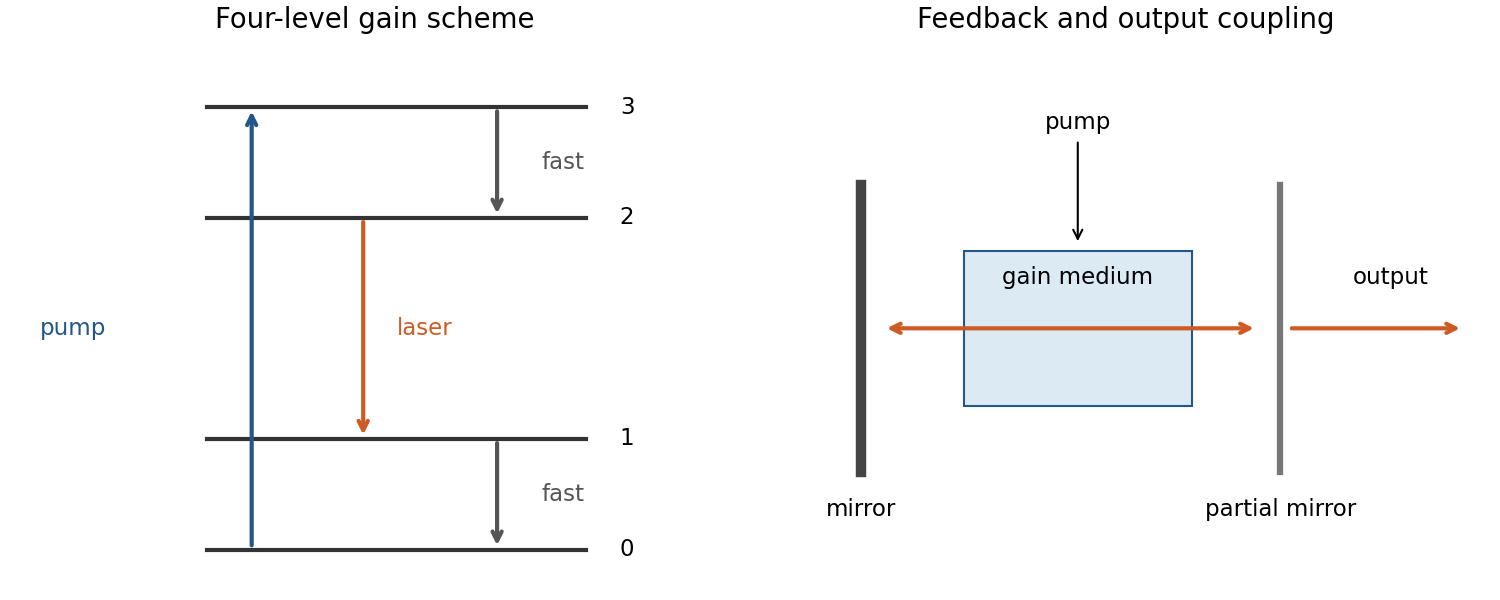
A laser combines pumping, an amplifying medium and optical feedback. Stimulated emission adds photons to an occupied optical mode; net amplification requires population inversion between the relevant levels after accounting for their degeneracies. Pumping through additional levels and rapid lower-level relaxation can sustain inversion; a closed two-level system under steady incoherent resonant pumping cannot sustain it.
An optical resonator selects modes and feeds light back through the gain medium. For intensity gain coefficient , internal intensity loss , length and mirror intensity reflectivities , the round-trip laser threshold condition isAbove threshold, saturation limits gain and a partially transmitting mirror provides output. Typical properties are strong directionality, substantial coherence and narrow bandwidth; multiple modes and pulsed operation are possible, so perfect monochromaticity is not universal.[ref]
Fundamentals of Photonics and Quantum Electronics lecture notes by Franz X. Kärtner. Chapter7,§§7.1–7.2 and laser threshold: feedback, gain and level schemes

Articles by others on the same topic
There are currently no matching articles.