For a self-adjoint Hamiltonian operator bounded below with ground-state energy , every admissible nonzero trial wavefunction has a Rayleigh quotient at least . To see this explicitly in a complete orthonormal eigenbasis, write with . ThensoFor continuous spectral components, the spectral theorem replaces the sum by an integral with the same nonnegative integrand. Equality requires the trial quantum state to lie entirely in the ground-state subspace. The variational method chooses a tractable family, evaluates the quotient and minimizes over its parameters. This gives an upper bound; enlarging the family can only improve that bound. The trial must belong to the operator domain for the operator expression above, or have finite energy in the corresponding quadratic-form version of the quantum variational principle.
For the oscillator, use the standard kinetic operator : the original PDF omits the superscript on the derivative in its numerator. Take , and normalize the scaled exact ground state asThe factor is optional in a quotient but makes the calculation transparent. Changing variable to and differentiating the scaled wavefunction givesAt this trial is the exact minimizing state, so its energy has zero derivative there. Hence . Since ,This is the quantum virial identity from scaling for a quadratic potential, and hence the oscillator form of the virial theorem.
For the inverse-power attraction, take and suppose, for contradiction, that an exact ground state exists with separately finite kinetic energy and potential mean , admitting the same dilation variations. Homogeneity now givesStationarity at would require . Its second derivative would then beFor this is negative, contradicting a ground-state minimum. More strongly, one does not need a presumed exact state: choose any normalized smooth test function supported away from the singular origin. Its and are finite, and its scaled quotient satisfiesThe unregularized attraction therefore exhibits fall to the centre for a supercritical inverse-power potential and has no stable ground state.
There is a necessary qualification to the PDF's broader wording about “no bound state”. Under the usual finite-energy virial theorem assumptions, a putative negative-energy bound state would satisfywhich contradicts being below the continuum threshold at zero. Thus no negative-energy bound state satisfying those regularity assumptions is possible. But this singular differential expression needs a specified domain at ; separately divergent kinetic and potential means or boundary conditions not preserved by dilation invalidate that ordinary calculation. The domain assumptions in singular-potential virial arguments must therefore be stated: the scaling proof establishes absence of a semibounded ground-state problem, rather than a domain-independent theorem about every formal square-integrable solution. A short-distance regularization would be a different potential.
The single-electron isotropic quantum harmonic oscillator has energiesIts lowest spatial orbital, denoted , is unique, with energy . Including spin one-half gives two spin orbitals. Two identical Electrons can occupy both only with opposite spin in the unique singlet state. Thus the two-electron ground state has energy and multiplicity one.
The first excited spatial shell consists of , each of energy , giving six spin orbitals. A first-excited two-electron Slater determinant occupies one of the two ground-shell spin orbitals and one of these six excited-shell spin orbitals. HenceNo further factor of two is inserted for interchanging the electrons, since the fermionic exchange symmetry is already built into a Slater determinant.
The spatial Hamiltonian operator is invariant under simultaneous rotations of both positions, so for each component of the total orbital angular momentum. It is also spin independent, so for each total spin component. Thereforeexpressing conservation of angular momentum and conservation of the total spin magnitude for this model. The Pauli exclusion principle restricts which states occur but does not break either symmetry.
To change the first-shell basis, take normalized real Cartesian orbitals . Using spherical coordinates, and . Comparison with the spherical harmonics gives the Cartesian and spherical bases of the first oscillator shell:Each is a common radial factor times , so and . Their normalizations and mutual orthogonality follow because this is a unitary change of basis. The ground spatial orbital has .
For two ground-shell electrons, addition of angular momentum gives , and their symmetric spatial state requires . For one electron in each shell, gives only . For each , form the normalized spatial combinationsThe exchange symmetry of two identical spin-one-half fermions permits with the singlet state and with each triplet state . In term symbol notation the manifolds are thereforeThe count reproduces and , as required. Both exchange symmetries are possible for the distinct occupied orbitals; dropping either spin sector would undercount the two-electron states in the first two shells of an isotropic oscillator.
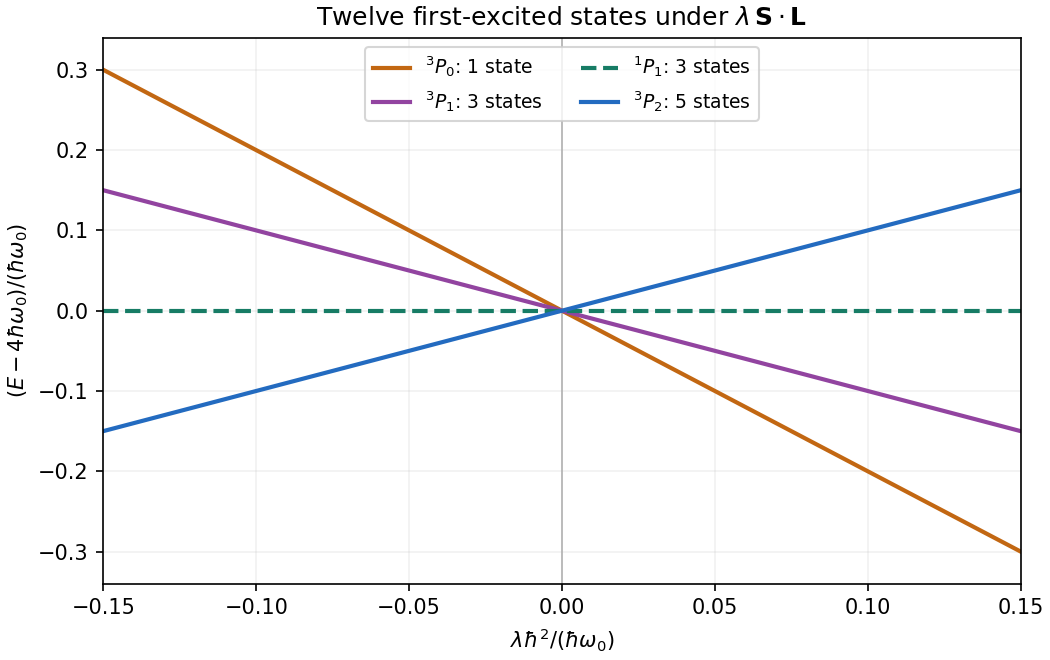
For the specified spin-orbit interaction, and are the total two-electron operators. Set . The spin-dot-product eigenvalue identity givesFor the singlet, and the shift is zero. For the triplet, . The spin-orbit splitting of the first excited two-electron oscillator level is consequentlyAdd each shift to . The multiplicities sum to twelve and their weighted shift sums to zero. For positive the table is ordered in energy; for negative the ordering reverses. Weak coupling means . Since this total-spin interaction commutes with , and , the shifts within this invariant manifold are in fact exact for the specified model, although only first order was requested.

Expand the time-dependent quantum state in unperturbed energy eigenstates, factoring out free dynamical phases:The Schrödinger equation gives the exact interaction picture coefficient equationsInitially . To first order in time-dependent perturbation theory, replace the coefficients on the right by these zeroth-order values and integrate. ThusFor a transition , this is the desired leading probability amplitude, and to leading order. The formula is understood with free asymptotic phases removed. For , the full survival amplitude also contains the zeroth-order ; the displayed integral alone is its first-order correction, not the whole amplitude. This specifies the usual scattering operator meaning of the paper's notation at infinite times.
For the ion pulse, write and . ThenConsider an excitation with and put , . The first real pulse is even in time and the second is odd. Their respective surviving Fourier components are therefore cosine and imaginary sine:Since , the longitudinal term is smaller for comparable position matrix elements. Hence the electric-dipole excitation by a passing ion hasThis leading limit extends to either sign of using . If by a selection rule, the retained leading term vanishes and the smaller longitudinal term may give the first nonzero probability. The conditions also include a small total transition probability, approximately straight constant-velocity motion, and large compared with atomic size for the electric-dipole approximation. The paper uses a Coulomb-coupling convention in which the factor is written ; in SI units replace throughout by .
The collision duration is of order . Excitations with angular frequency receive an unsuppressed impulse when this is short relative to . In contrast, for , cancellations in the Fourier transform suppress the transition: a slowly varying distant field approximately preserves the atomic energy eigenstate. The exact dipole-pulse transforms make this explicit:where is a Modified Bessel function of the second kind. Their large-argument exponential decrease explains the slow-passage cutoff. These transforms are optional refinements of the small- derivation above, not a separate assumption about the target.
To connect the microscopic transition probability to energy loss, suppose the atom begins in a low-energy state. Exciting bound electronic states and causing ionization transfer positive energies from the ion to the material. For target atomic number density and path length , a schematic independent-encounter sum iswith a continuum integral as well as a sum for ionized final states. The short-collision formula gives , so the impact-parameter integral has logarithmic dependence on its cutoffs. Its upper effective cutoff is of order , where the transition ceases to be sudden; the lower cutoff must exclude regions where the dipole or weak-collision approximation fails. Thus the leading high-speed charge and isotope scaling of electronic stopping isAlthough a faster ion can access more energetic transitions and a wider range of distant encounters, its shorter interaction time reduces each ordinary excitation probability. In the fast-ion regime shown, the decrease dominates the slower variation of the excitation factor. The energy loss consequently falls with increasing incident kinetic energy. The original figure has increasing downward, so the curves' rise toward the top of the page means decreasing loss, not increasing loss. A low-speed extrapolation of the inverse-square law is invalid because excitation thresholds, slow-passage suppression, changing ion charge and nuclear recoil can then matter.
For nonrelativistic ion mass , . At fixed incident energy the leading prediction becomesThe greater atomic number of nitrogen than carbon than boron therefore gives larger loss; at the same velocity the leading species factor is . Within an isotopic family, the heavier ion moves more slowly at the same and loses more energy. Equivalently, a heavier isotope needs proportionally greater kinetic energy to achieve the same velocity and approximately the same electronic loss. Comparing at fixed energy per nucleon, rather than fixed total , approximately removes this leading isotope mass dependence. This accounts for the separate isotope bands in the original graph without assigning different electronic excitation spectra to isotopes of the same projectile element.
The charge in this scaling is the effective ion charge if screening by bound projectile electrons is important. The interpretation assumes the same traversed material and thickness and uses the paper's small-fractional-loss regime, ; points with loss comparable to incident energy cannot be described quantitatively by treating as constant. The plotted curves support the qualitative ordering and high-energy decrease, rather than determining a universal normalization from the supplied single-atom model.
Articles by others on the same topic
There are currently no matching articles.