A uniform conducting fluid supports three propagating magnetohydrodynamic wave branches. Ideal magnetohydrodynamics couples fluid velocity to the magnetic field through the induction equation; the Lorentz force then supplies magnetic tension and magnetic pressure restoring forces. Let be the angle between wave vector and background field , and define Alfvén speed and adiabatic sound speed .
The shear Alfvén wave hasIts velocity perturbation is perpendicular to both and . It bends field lines without first-order compression, so magnetic tension is the restoring force. Its group velocity follows the background field; the displayed phase speed along is not the full group speed.
The fast magnetosonic wave and slow magnetosonic wave involve coupled compression and magnetic perturbations, with displacement in the plane of :The plus sign is the fast branch. Parallel propagation gives characteristic speeds ; perpendicular propagation gives fast speed while the other two phase frequencies vanish. Degenerate directions require care in assigning polarizations, rather than claiming three distinct nonzero frequencies everywhere.
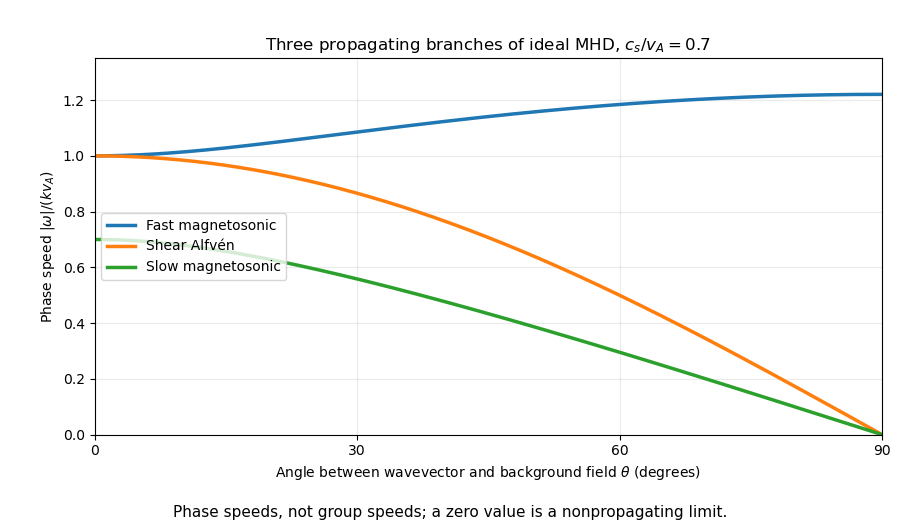
Angular dependence of the three ideal magnetohydrodynamic phase speeds
. Original homogeneous ideal-fluid calculation for sound speed 0.7 times the Alfvén speed. The curves are phase speeds and do not depict group-velocity rays. Details.
These waves transport energy and momentum through magnetized stellar atmospheres and astrophysical plasmas. Their restoring mechanisms distinguish them from ordinary acoustic waves. Resistivity, viscosity, ion-neutral friction and kinetic effects introduce damping or change the model; an ideal undamped dispersion relation alone does not calculate coronal heating.
Articles by others on the same topic
There are currently no matching articles.