A uniform conducting fluid supports three propagating magnetohydrodynamic wave branches. Ideal magnetohydrodynamics couples fluid velocity to the magnetic field through the induction equation; the Lorentz force then supplies magnetic tension and magnetic pressure restoring forces. Let be the angle between wave vector and background field , and define Alfvén speed and adiabatic sound speed .
The shear Alfvén wave hasIts velocity perturbation is perpendicular to both and . It bends field lines without first-order compression, so magnetic tension is the restoring force. Its group velocity follows the background field; the displayed phase speed along is not the full group speed.
The fast magnetosonic wave and slow magnetosonic wave involve coupled compression and magnetic perturbations, with displacement in the plane of :The plus sign is the fast branch. Parallel propagation gives characteristic speeds ; perpendicular propagation gives fast speed while the other two phase frequencies vanish. Degenerate directions require care in assigning polarizations, rather than claiming three distinct nonzero frequencies everywhere.
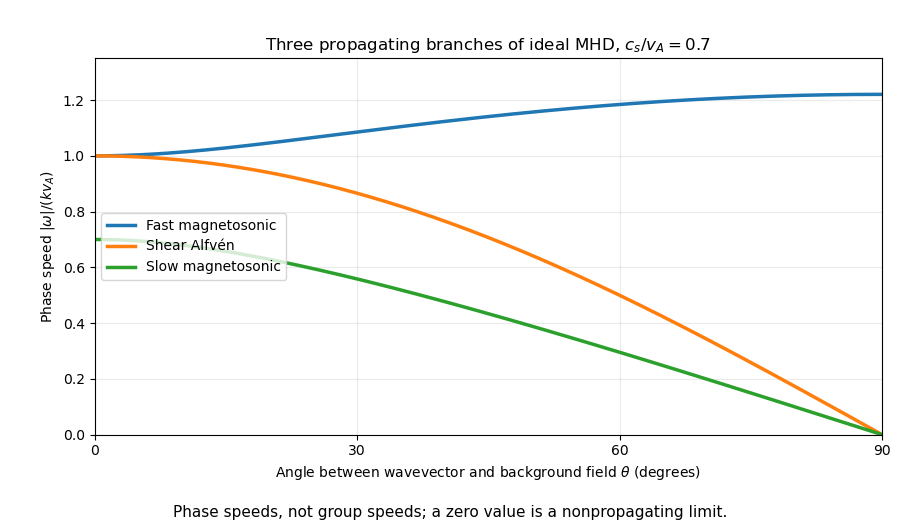
Angular dependence of the three ideal magnetohydrodynamic phase speeds
. Original homogeneous ideal-fluid calculation for sound speed 0.7 times the Alfvén speed. The curves are phase speeds and do not depict group-velocity rays. Details.
These waves transport energy and momentum through magnetized stellar atmospheres and astrophysical plasmas. Their restoring mechanisms distinguish them from ordinary acoustic waves. Resistivity, viscosity, ion-neutral friction and kinetic effects introduce damping or change the model; an ideal undamped dispersion relation alone does not calculate coronal heating.
For steady inviscid motion of a barotropic fluid in a conservative gravitational potential , the Euler equations for an inviscid fluid imply the Bernoulli equationalong each streamline. The barotropic enthalpy function has units of energy per unit mass. For an isentropic ideal gas, gives up to an additive constant. For constant density, the corresponding term is . Pressure work converts between kinetic, enthalpy and gravitational energy.
A converging subsonic nozzle can accelerate a fluid at the expense of its enthalpy; in the incompressible horizontal approximation, higher speed accompanies lower static pressure. Together with conservation of mass, this explains a Venturi effect measurement. Compressible nozzle flow additionally needs its equation of state and sonic conditions. In a stellar wind, the potential term is , so enthalpy or mechanical energy can be spent escaping gravity. A pressure-negligible marginal-escape wind has .
The constant need not be the same on different streamlines. Irrotational barotropic flow in a connected region gives a common value; a general rotational flow does not. A pump, viscosity, a radiating shock, or heat addition changes the relevant energy balance. In particular, adiabaticity alone does not allow one to drop the enthalpy term.
Hydrostatic equilibrium and dimensional scaling give characteristic stellar pressure and mass density . For a fixed-index stellar polytrope with , eliminating density gives the polytropic mass-radius relationThe dimensionless coefficient is determined by the corresponding Lane-Emden equation and boundary conditions. Both the index and must be held fixed to infer this mass dependence.
Nonrelativistic electron degeneracy has , hence for cold fixed-composition white dwarfs: adding mass makes the object smaller. Relativistic electron degeneracy approaches ; the mass scale becomes proportional to independently of the radius, giving the ideal Chandrasekhar limit. The limiting model signals loss of the ordinary stable cold sequence; it does not determine a unique radius at that mass.
For a gas-pressure-supported star, the virial theorem instead gives characteristic temperature . Specifying a common characteristic temperature gives , but stellar temperatures are not generally identical. A main-sequence star also requires nuclear energy generation and radiative or convective transport. Consequently there is no universal mass-radius exponent applicable to every main-sequence mass and composition. An isentropic convective model and a cold degeneracy-supported model can share index while having quite different physical meanings and values of .
Articles by others on the same topic
There are currently no matching articles.