Alan Hodgkin and Andrew Huxley recorded the membrane potential directly between the inside of a squid axon and the external solution. The crucial result was an action potential that passed through zero: the interior became positive, rather than merely losing its negative resting membrane potential. A theory in which excitation simply abolishes membrane selectivity and shorts out the resting membrane potential cannot account for that reversal. Their original report establishes the historical interpretation independently of the unavailable examination picture.[ref]
Action Potentials Recorded from Inside a Nerve Fibre by Alan Hodgkin and Andrew Huxley. Nature 144 (1939), pp. 710–711: intracellular recording and reversal of the potential difference
The later Hodgkin-Huxley model explains the rising phase through increased sodium permeability and the falling phase through sodium ion-channel inactivation and increased potassium permeability. Distinct Nernst equilibrium potentials make a selective conductance change capable of reversing the membrane potential. The recording established the phenomenon; it did not by itself reveal individual ion channel structures or all their gating kinetics.
Source illustration TODO: the source page's recording is missing in both the held PDF and its archive parent. No amplitudes, time intervals, or trace layout are reconstructed here; the surviving historical request is answered above.
Here is the inside-minus-outside membrane potential, is the potassium Nernst equilibrium potential, and is the maximum potassium conductance, or conductance per area if is a current density. The factor is the permissive-state probability of an activation gate. Four independent permissive gates in an ion channel give the open fraction , henceThe model assumes identical independent gating units, additive currents from many ion channels, an approximately ohmic open-pore current, and fixed ionic activities setting . Outward positive electric current is obtained for . The original delayed-rectifier term omits rapid ion-channel inactivation. The fourth power is a successful phenomenological gating description, rather than a deduction of the molecular structure from this equation alone.
For two-state ion-channel gating, let and be the rates of entering and leaving the permissive state. Gain minus loss givesAt fixed membrane potential, these coefficients are constant. The deviation obeys , so the initial condition yieldsThis approaches the fixed-voltage limit monotonically and stays between and , as a valid probability must.
Convention qualification: the displayed single exponential function describes a voltage-clamp step, not an arbitrary time-dependent action potential. For example, a second imposed voltage step changes both coefficients and requires a new exponential segment. For general the integrating-factor solution is , with .
Fast ion-channel inactivation would reduce the outward potassium electric current just when it normally repolarizes the axon. Since , a reduction of positive makes the falling slope less negative. With other mechanisms unchanged, the action potential is generally broader and its after-hyperpolarization is weaker. A plateau or slow return is possible until sodium ion-channel inactivation, leakage, or another outward conductance restores the resting membrane potential. The precise trace depends on those remaining currents; rapid potassium inactivation alone does not determine a unique waveform.
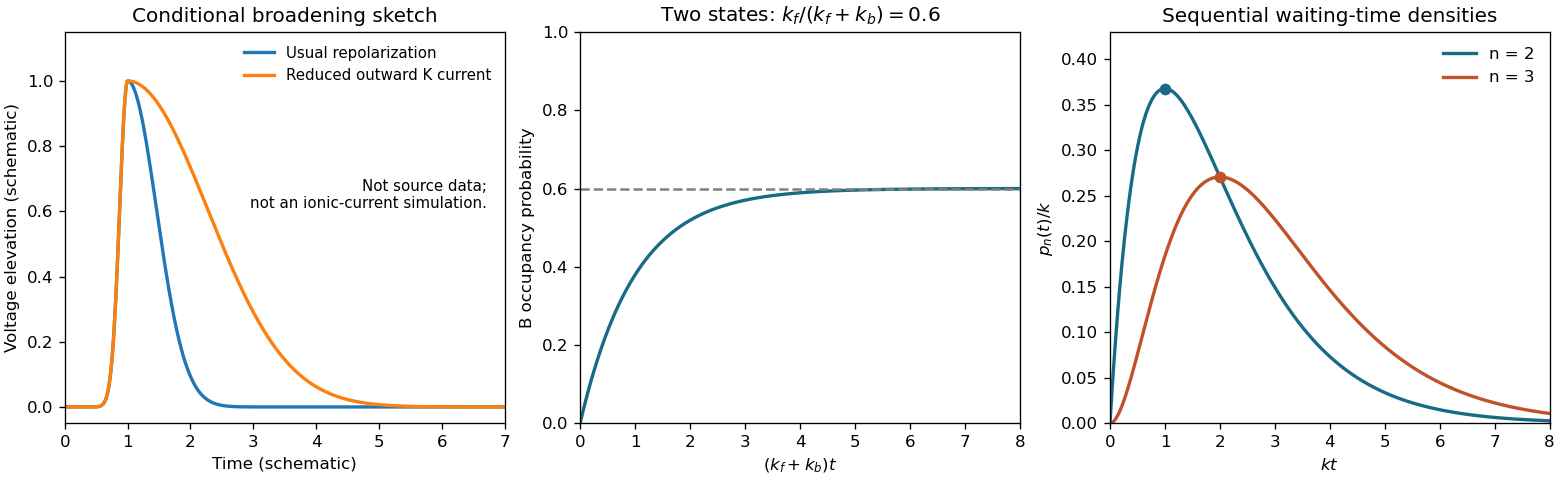
Original schematic action potential broadening and two-state relaxation and sequential-transition probability densities
. Details. 
The left panel is a qualitative sketch of this comparison, not a fit or a reconstruction of the missing historical recording.
In classical ball-and-chain inactivation, a cytoplasmic N-terminal part of the voltage-gated potassium channel acts as a tethered blocking particle. Once the pore opens, this particle reaches and occludes its intracellular entrance. The flexible connecting segment allows access; removal of the block permits recovery. Thus opening and subsequent loss of conduction can occur even while the activating voltage remains applied.
Several independent observations support this mechanism. Removing or disrupting the N-terminal inactivation segment suppresses fast ion-channel inactivation while leaving activation possible. An appropriate soluble peptide applied from the cytoplasmic side restores an open-channel block in otherwise noninactivating channels. Changes in the blocking segment alter block kinetics, while changing its access or tether can alter how rapidly it finds the pore. Rescue in trans is particularly informative: the blocking particle need not remain covalently attached to produce the effect.[ref]
Restoration of inactivation in mutants of Shaker potassium channels by a peptide derived from ShB by William N. Zagotta and others. Science 250 (1990), pp. 568–571: restoration of inactivation by the cytoplasmic peptide
[ref]Biophysical and molecular mechanisms of Shaker potassium channel inactivation by Toshinori Hoshi and others. Science 250 (1990), pp. 533–538: molecular perturbations of rapid inactivation
This mechanism is N-type inactivation. It should not be generalized to every potassium ion channel: C-type inactivation instead involves changes associated with the outer pore and selectivity filter.
Articles by others on the same topic
There are currently no matching articles.