The main generic costs of strongly confining a charged semiflexible polymer are bending it away from its preferred straight shape, crowding neighboring segments, and reducing its available configurations. Closely approaching charged strands also repel through electrostatic and hydration interactions; mobile ions screen or modify these interactions, while counterion organization contributes to the free-energy balance. The bending cost is especially large in regions of high curvature. A pressure on the confining wall and a force resisting further insertion are related thermodynamic responses, but are not identical quantities with the same units.
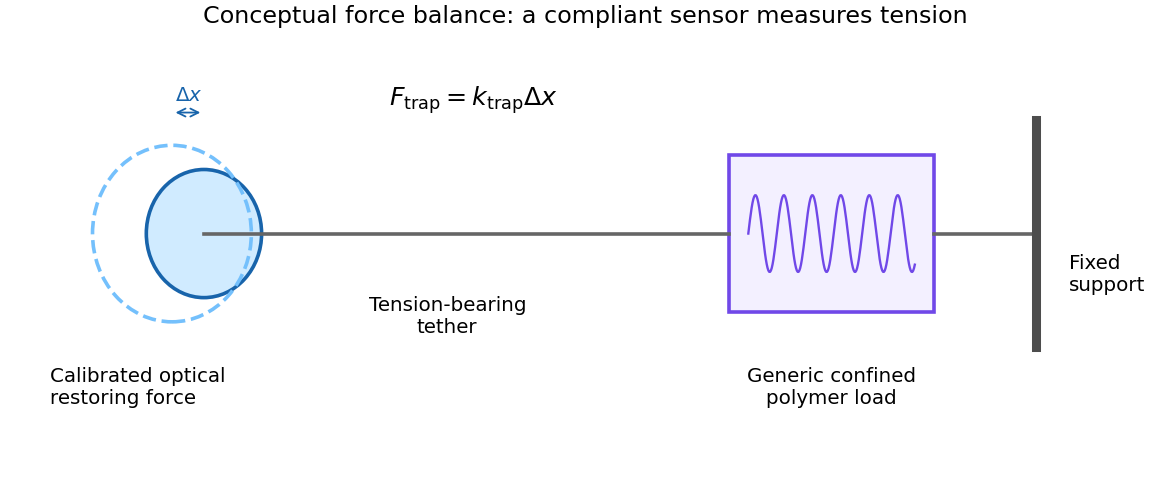
At the level of measurement principles, an optical tweezers apparatus acts as a calibrated compliant force sensor. A displaced trapped bead experiences approximately . A tether transmits tension between that sensor and the material under load; the opposing support fixes the other end. The conceptual force balance isThe extension and restoring force supply a mechanical record of the load. This is a force-sensing schematic, not a biological preparation or packaging protocol. The measured tension can include bending, interstrand interactions, dissipation and any other mechanically coupled contribution; it cannot be identified with only the bending term without additional assumptions. In a reversible generic model at specified geometry, while an internal pressure is at specified polymer content. These derivatives clarify what a force measurement can and cannot determine.

Articles by others on the same topic
There are currently no matching articles.