The main generic costs of strongly confining a charged semiflexible polymer are bending it away from its preferred straight shape, crowding neighboring segments, and reducing its available configurations. Closely approaching charged strands also repel through electrostatic and hydration interactions; mobile ions screen or modify these interactions, while counterion organization contributes to the free-energy balance. The bending cost is especially large in regions of high curvature. A pressure on the confining wall and a force resisting further insertion are related thermodynamic responses, but are not identical quantities with the same units.
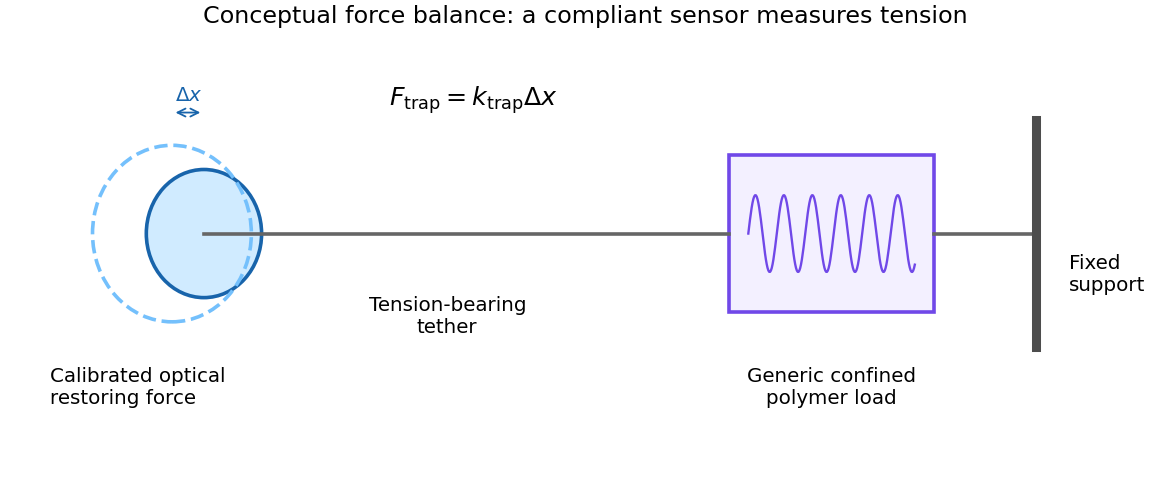
At the level of measurement principles, an optical tweezers apparatus acts as a calibrated compliant force sensor. A displaced trapped bead experiences approximately . A tether transmits tension between that sensor and the material under load; the opposing support fixes the other end. The conceptual force balance isThe extension and restoring force supply a mechanical record of the load. This is a force-sensing schematic, not a biological preparation or packaging protocol. The measured tension can include bending, interstrand interactions, dissipation and any other mechanically coupled contribution; it cannot be identified with only the bending term without additional assumptions. In a reversible generic model at specified geometry, while an internal pressure is at specified polymer content. These derivatives clarify what a force measurement can and cannot determine.

Use the elastic-rod bending functional for an abstract inextensible worm-like chain,A circular ring of radius has curvature and length , hence energy . With rings of each radius, add their energies:For a cylindrical annulus of height , choose neighboring rings separated vertically by . Then , while adjacent radial layers are separated by . Replacing the radial sum by its continuum integral givesandEliminate the inner radius to obtainThe dimensions are energy, and the expression is positive for . It tends to zero with and diverges as the inner hole closes in this continuum model. The divergence signals the growing cost of forcing an inextensible chain to zero radius; it is not a physical prediction at arbitrarily small molecular scales. Interstrand, hydration and configurational contributions have been excluded, and disconnected ideal rings represent local curvature without modeling the connections between them.
Use the given spherical-shell force balance directly; nm is the loaded radius. The radial enlargement isSince Pa, the pressure is . ThereforeThe diameter increases by nm, and nm. The relative radial or diametral enlargement is about , only . Under this stipulated shell model the container is therefore very stiff despite the substantial internal pressure.
The factor of two follows from the particular elastic energy convention implicit in the question: differentiating gives . Replacing it by the derivative of would change the answer incorrectly. The calculation treats the wall by an effective spherical radius; local deformation or discrete facets of an icosahedral shell are not resolved by this one-coordinate model.
Articles by others on the same topic
There are currently no matching articles.