Dense DNA packaging opposes three main physical effects. The negatively charged DNA backbones repel through electrostatic interactions, moderated by electrostatic screening and counterion condensation. At close approach, hydration forces and excluded volume become important. Bending a semiflexible DNA polymer on a radius comparable with its persistence length stores elastic energy. Confinement also removes configurational entropy, and concentrating mobile counterions can impose an additional osmotic pressure and free energy cost. Their relative importance depends on geometry and ionic conditions.
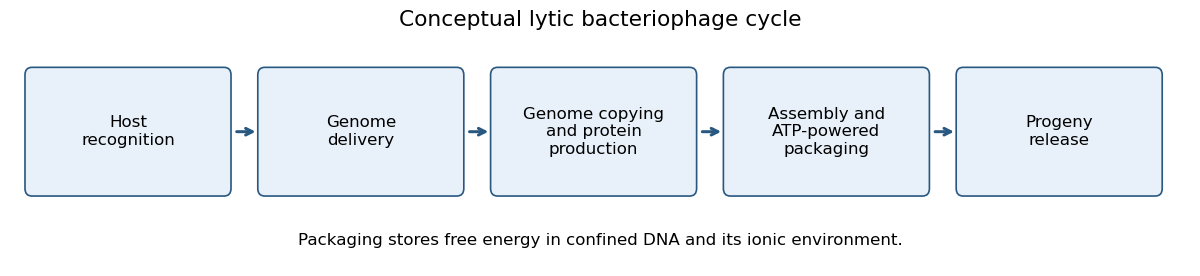
Conceptual lytic bacteriophage cycle and active DNA packaging
. Details. 
In many double-stranded DNA bacteriophages, a portal-associated molecular motor uses ATP hydrolysis to move DNA into a preformed capsid. Chemical free energy pays for bending, repulsion and confinement, so the opposing force rises as filling proceeds. This is active packaging rather than spontaneous equilibrium compaction. Optical tweezers can infer that opposing force from displacement of a trapped bead and monitor packaging through the changing external DNA extension. Such measurements establish the mechanical principle without requiring any virus-handling procedure. The inverse spool model used below is an idealized packing geometry, not an exact structural claim for every bacteriophage.
Articles by others on the same topic
There are currently no matching articles.