Dense DNA packaging opposes three main physical effects. The negatively charged DNA backbones repel through electrostatic interactions, moderated by electrostatic screening and counterion condensation. At close approach, hydration forces and excluded volume become important. Bending a semiflexible DNA polymer on a radius comparable with its persistence length stores elastic energy. Confinement also removes configurational entropy, and concentrating mobile counterions can impose an additional osmotic pressure and free energy cost. Their relative importance depends on geometry and ionic conditions.
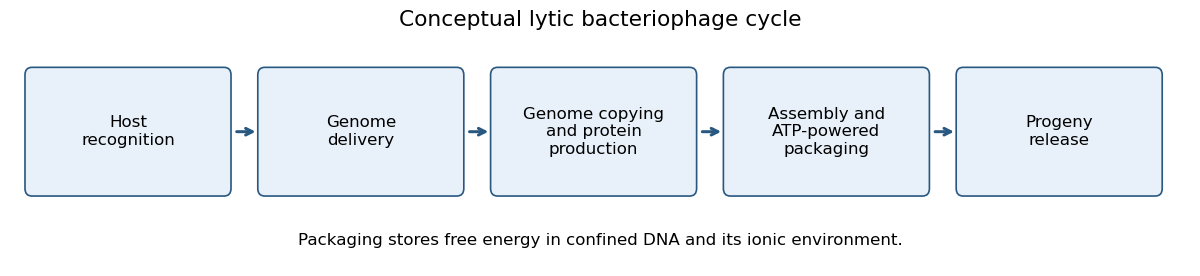
Conceptual lytic bacteriophage cycle and active DNA packaging
. Details. 
In many double-stranded DNA bacteriophages, a portal-associated molecular motor uses ATP hydrolysis to move DNA into a preformed capsid. Chemical free energy pays for bending, repulsion and confinement, so the opposing force rises as filling proceeds. This is active packaging rather than spontaneous equilibrium compaction. Optical tweezers can infer that opposing force from displacement of a trapped bead and monitor packaging through the changing external DNA extension. Such measurements establish the mechanical principle without requiring any virus-handling procedure. The inverse spool model used below is an idealized packing geometry, not an exact structural claim for every bacteriophage.
For an inextensible worm-like chain, the DNA bending energy iswhere is curvature and is polymer contour length. A circle of radius has and length . Its elastic energy is therefore . Adding the contributions of rings at each radius givesThis ignores short connecting segments, twist, interactions between neighboring DNA segments and end effects. In a cylindrical stack with axial spacing , away from the ends.
Correction of the printed limits: ordinary positive polymer contour length requires integration from to , because and the ring count is positive. For example, taking , and makes the printed outward-to-inward integral negative. Thus its sign cannot be retained as a physical length.
For hexagonally packed strands choose axial ring spacing and radial layer spacing . With and radial layer density ,The same continuum replacement in b givesEliminating the inner radius yieldsThe resisting packaging force is the marginal free energy per added polymer contour length, at fixed , and :The force opposing insertion is positive; its contribution to outward ejection has the same magnitude. The domain is . The divergence as the inner hole closes reflects the singular curvature of ideal rings and marks breakdown of the continuum model. If spacing also relaxes, the full free energy must include interstrand interactions before optimization; simply varying in this bending-only formula is insufficient.
The small binding RNA can serve conceptually as an RNA aptamer recognition probe. Coupling recognition to an optical label would make a specifically bound virus appear as a moving fluorescent spot. Single-particle tracking estimates successive spot positions and fits their displacement statistics. Specificity is assessed by comparison with a nonbinding recognition probe or a sample without the target, while the much faster diffusion of unbound probes distinguishes freely moving label from target-associated signal. Subnanomolar dissociation constant supports appreciable occupancy at low probe abundance, but affinity alone does not determine the dissociation lifetime because . This describes detection principles, not an operational virus preparation or labelling protocol.
For a dilute spherical particle of radius in bulk water, the Stokes–Einstein relation gives, at an explicitly assumed ,A free probe would have , roughly thirty times larger. The recognition probe changes the target's hydrodynamic size only modestly in this estimate.
For isotropic Brownian motion, the mean vector displacement is zero. In , distinct measures of how far it moves areA two-dimensional image instead gives projected root-mean-square displacement and mean projected distance . The projected mean squared displacement is ; independent localization errors of variance in each coordinate add . Finite exposure blurs motion, and nearby walls reduce diffusion; those effects must be separated from particle size when interpreting a trajectory.
Articles by others on the same topic
There are currently no matching articles.