The bacterial RNA polymerase core associates with a sigma factor to form a holoenzyme. The sigma factor recognizes promoter features and helps position the DNA and stabilize its opening. Initial binding gives a closed promoter complex; local DNA unwinding creates an open promoter complex with the template accessible. Initial RNA synthesis can produce short abortive products while the RNA polymerase remains attached to the promoter, taking in downstream DNA by scrunching. Growth of the RNA eventually permits promoter escape and productive elongation. The sigma factor changes its interactions during this transition; immediate complete dissociation is not obligatory.
In magnetic tweezers, torsionally constrained DNA joins a surface to a magnetic bead. A field gradient applies upward force, rotation of the magnets controls the imposed DNA supercoiling, and optical tracking measures bead height. At suitable modest force, DNA supercoiling forms writhed loops, shortening the tether. Opening roughly one helical turn at fixed linking number makes the remaining DNA more positively twisted: . Thus opening lengthens a negatively supercoiled tether by removing some negative writhe, but shortens a positively supercoiled tether by adding positive writhe. This opposite sign distinguishes unwinding from ordinary compaction, which shortens both tethers. Height-versus-turn calibration converts the two extension changes into an unwinding angle and a compaction contribution. Repeated height transitions give opening and closing dwell times.[ref]
Promoter unwinding and promoter clearance by RNA polymerase: Detection by single-molecule DNA nanomanipulation by Andrey Revyakin and others. Figures 1–3: torsionally constrained tether, opposite-sign extension responses, and approximately one-turn unwinding
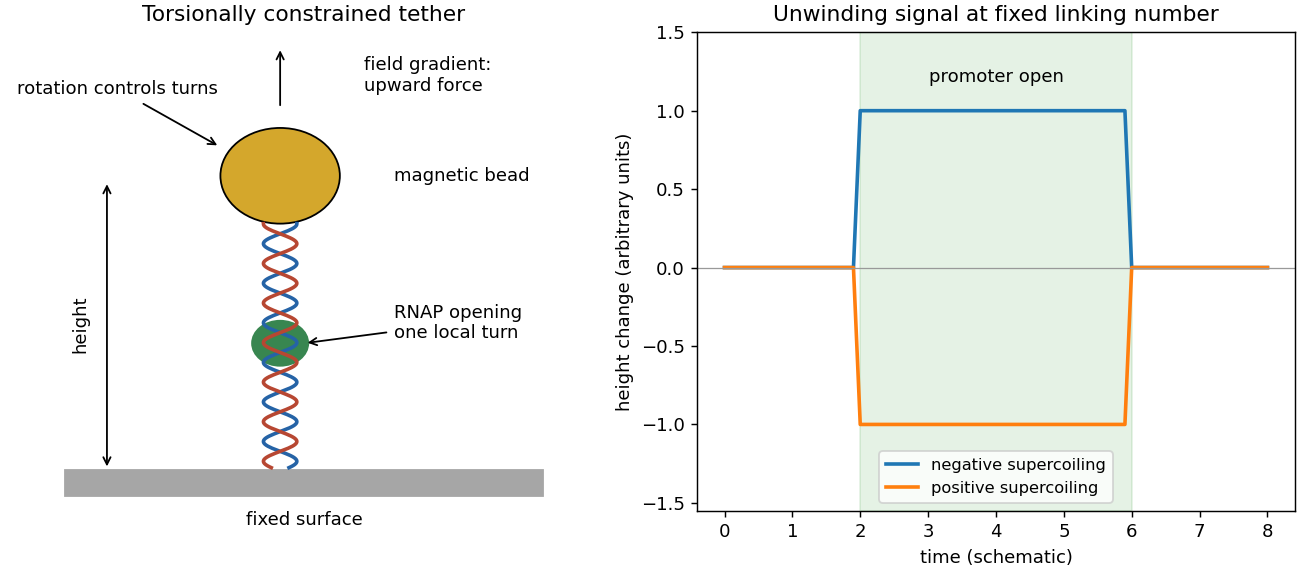
The sketch is a schematic prediction, not a copy of an experimental trace. Opening must be distinguished from promoter escape: an unwound DNA region can remain associated with an elongating RNA polymerase.
Treat the target as an absorbing sphere of effective capture radius , surrounded by a uniform dilute reservoir of RNA polymerase with number density . The steady diffusion equation, spherical symmetry, and boundary conditions giveBy Fick's laws, the inward capture rate per target is . Multiplying by the target number density and comparing with the bimolecular rate law therefore yields the Smoluchowski association rateIts units here are , since the concentrations count particles rather than moles. The absorbing boundary assumes every encounter is productive; orientation constraints would reduce the effective association rate constant.
The Stokes–Einstein relation, for RNA polymerase radius at an illustrative temperature , givesNeither cell volume nor the effective is specified, so a unique numerical time is unavailable. A representative Escherichia coli volume is . The -base pair target has a DNA contour extent of about ; using this as an order-of-magnitude capture radius gives . For independent searchers, the target's approximately constant encounter hazard is , henceUsing half the target's contour extent for instead gives about ; the spherical capture model is not exact target geometry. One searcher's mean would be about under the first convention, whereas the first arrival among is much faster.
If only a fraction of each searcher's time is available for three-dimensional diffusion, and nonspecific DNA binding neither scans nor delivers the target, the effective searching population is . Thus , about under the stated estimate. This assumes stationarity, well-mixed searchers and no additional target-access route; nonspecific binding alone is sequestration, not facilitated diffusion.
Write and . The search time is : it decreases from infinity at small positive , reaches one minimum, and increases without bound at large within this idealized model.
During a facilitated diffusion search, roughly separate DNA landing-and-sliding episodes sample a chromosome. A three-dimensional encounter with any chromosomal landing region has characteristic time , so the total bulk-search contribution is . Each one-dimensional diffusion excursion lasts order ; multiplying by gives . Longer sliding therefore reduces the number of bulk relocations but increases time spent repeatedly exploring local DNA. Numerical constants and overlap corrections are already omitted in the given model.
Differentiating and using the positive second derivative givesAt the two time contributions are equal. The optimum is meaningful only if lies between the microscopic capture scale and the available chromosomal contour length.
A decrease in DNA concentration means a decrease in , but its effect on the time is not determined by that ratio alone. At fixed chromosome length , dilution by increasing increases at fixed and increases as ; bulk relocation becomes slower. If instead decreases at fixed , while the target is retained, the stated model predicts a smaller sliding contribution and a smaller optimized time, proportional to . In both cases . This distinction prevents attributing a unique time trend to concentration without specifying how it changes.


Let be the donor's total decay rate without acceptors, including radiative and nonradiative decay, and let be its transfer rate to one acceptor. In weak excitation, independent equivalent acceptors supply additive transfer rates, so FRET efficiency isEliminating givesThis assumes the same Förster distance, equivalent donor–acceptor distances and unchanged donor decay, with no acceptor saturation or other transfer pathways affecting donor de-excitation.
For Förster resonance energy transfer, , henceHere the single-pair FRET efficiency would be , which indeed produces .
Articles by others on the same topic
There are currently no matching articles.