The gross requirement is an anisotropic polarizability tensor, so that changing molecular orientation changes the induced response. A permanent electric dipole moment is not required; a homonuclear diatomic can therefore have a rotational Raman scattering spectrum.
For the inelastic lines of a linear rigid rotor, the detailed rule is , with . The contribution is unshifted Rayleigh scattering, not a rotational Stokes Raman scattering line. Stokes Raman scattering has because the molecule gains rotational energy.
For a transition starting at and ending at , the molecule gainsEnergy conservation therefore gives the scattered-light wavenumbersThe first shifts below the laser are . Adjacent Stokes lines are separated by , while the first line is from the Rayleigh line. The figure uses positive Raman shift ; increasing shift means decreasing scattered-light wavenumber.
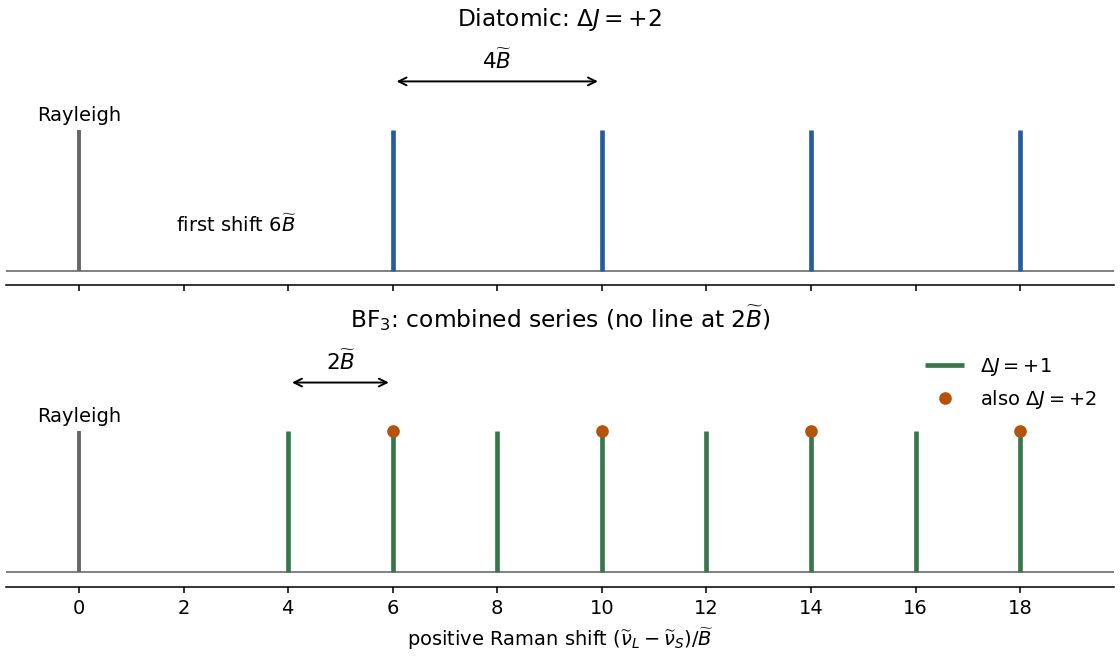
Original line-position sketches for the diatomic and BF3 rotational Raman series; stick heights carry no intensity information
. Details. 
All three fluorine atoms are at perpendicular distance from the axis normal to the molecular plane. Boron lies on the axis, so it contributes zero. ThusThe boron mass does not enter this moment, rather than needing to be approximated or neglected.
In the printed geometry, one B–F bond lies along the in-plane axis and contributes zero. The other two fluorines have perpendicular distance ; boron is again on the axis. ThereforeThe other in-plane principal moment is the same by threefold symmetry. Hence Boron trifluoride is an oblate symmetric top with and .
Because , the terms cancel between the initial and final states. The two positive-shift branches are consequentlyThe branch gives shifts , as for the diatomic. The branch fills in a series spaced by , so the combined nonzero series is .
There is a boundary qualification to the abbreviated rules printed in the question: for an ordinary symmetric polarizability tensor, has zero strength when . Thus does not produce a line; the first transition can start at and has shift . This follows from the rank-two angular-momentum coupling: the all-zero-projection coupling for and vanishes because is odd. If one applies only the printed inequalities without this matrix-element restriction, is a formal position, but its intensity is zero.
The lower panel of the figure in part (a)(ii) marks the two branches and their overlaps. The useful spacing is , not the diatomic value .
The combined boron trifluoride series givesUsing with the wavenumber in inverse metres,With integer fluorine mass and ,Using for the observed spacing would incorrectly treat BF as a linear diatomic rotor and overestimate the bond length by .
Articles by others on the same topic
There are currently no matching articles.